
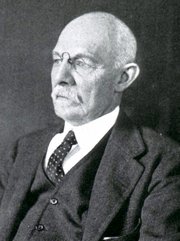



By Maurits Biesbrouck, MD. Continued from "Andreas Vesalius’ fatal voyage to Jerusalem (1)".
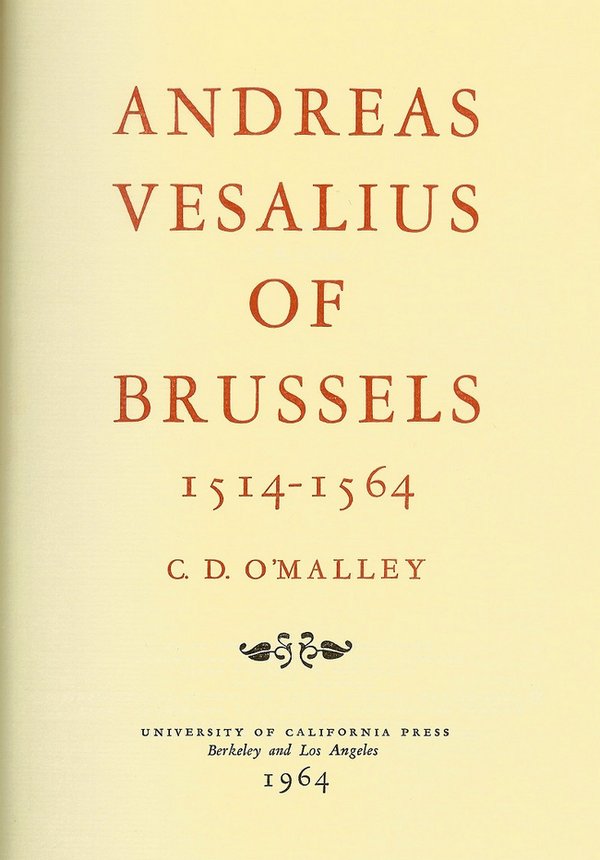
Front cover of C. D.O'MALLEY,
Andreas Vesalius of Brussels 1514 1564,
Many other letters of Languet, in that period, to his friends and acquaintances were published but surprisingly in none of them he repeated the story, just as if it was of no importance (or even wrong) (4). We found it not even in his Historica descriptio susceptae a caesarea maiestate executionis... (Aug. 1567), in a copy of which North found his manuscript on the first flyleaf. In his biography of Hubert Languet the French biographer Henri Chevreuil found no mention of it either (5). The overall impression is that this short message is not more than a gossip written by Languet as a fait divers, perhaps who knows somewhat light-hearted after a couple of glasses on that first day of the new year. Apparently Languet didn’t believe in the story himself as he begins with the words ‘Fama est…’ (Rumour has it…) and he continues with the remark that the story with the direct motive for his Jerusalem travel is a remarkable (mirabilis) one. His letter concerns only that motive, thus things that happened some twelve months before, and were not at all very recent. He gives no details on Vesalius’s death itself. Languet and Peucer knew each other well. That same year 1565 Languet returned to Germany after a mediation of Peucer, but later on he returned to France (6). In any case it can not be regarded as a genuine letter, as such writings, for obvious reasons, normally treat on different subjects and are considerably longer. C.D. O'Malley, who gives an English translation too, calls this story "wholly unacceptable" (7).
The best and most detailed account of Vesalius’s last months is indeed to be found in O’Malley’s biography, but he was apparently not yet aware of the letters found by Barón Fernández. Yet it represents the first proper attempt to distinguish truth from fabrication. O’Malley was convinced that the ulterior motive behind Vesalius’ journey to Jerusalem was to escape the Spanish court and take up for a second time the chair in anatomy in Padua, which had fallen vacant, as a result of the death of Gabriele Falloppio, well before Vesalius’s departure.
The letters found by José Barón Fernández
After the congress of 1962 José Barón Fernández, a Spanish pediatrician, published his discovery of the four relevant letters, that he came across in the archives of Simancas (Spain), also in his Vesalius biography of 1970 (8). They were:
• a letter from the king of Spain to Garcihernandez, at his embassy in Venice;
• an answer from his ambassador ad interim;
• followed by an additional letter; and
• a letter from Bonifacio de Ragusa, custodian in Jerusalem, also addressed to the king (9).
Each of them concerns Vesalius’s trip to the Holy Land, a journey or pilgrimage, which was the subject of so much speculation.
Letter 1: from Philip II to Garcihernandez
This first letter is thus from Philip II, son of Emperor Charles V, and king of Spain, and is addressed to Garcihernandez, secretary to his ambassador, who was temporarily in charge of the Spanish embassy in the then powerful and wealthy Republic of Venice. The letter was written in Monzon, in Aragon, and dated January 1564. It reads in translation:
“ … Doctor Vesalius, who gives you this [letter], was the physician of the Emperor, my late father, and is now the same for me. He served his Majesty and likewise serves me, so that I have now very willingly allowed him and granted him permission, to travel to Jerusalem and visit the Holy Sepulchre of our Redeemer, in which he is motivated by piety. With my grateful consent, I expressly urge you, to help him on his way, so that he has a good passage, and to give him every help and assistance, …, so that he may swiftly travel there in safety, and remain there for as short a time as possible, in order that he may return with the same speed, so as to resume his service to me. Kindly encourage him to do this on my behalf. Monzon, January 1564.”
So, the king stresses that he gave Vesalius the permission to travel, and that the motive was his pious desire to visit the holy places. The Spanish ruler asks his ambassador to provide Vesalius with the necessary facilities for his journey, and to guarantee his safety, and also to ensure that he returns as soon as possible, in order to resume his service at the royal court.
Article continued here: Andreas Vesalius’ fatal voyage to Jerusalem (3).
Sources and author's comments:
4. Huberti Langueti Epistolae ad Joachimum Camerarium Patrem et Filium, Lipsiae et Francofurti, Mauritius Georgius Weidmannus, 1685. Also The Correspondence of Sir Philip Sidney and Hubert Languet, London: William Pichering, 1845. And Hubert Langueti ... Epistolae secretae ad principem ... Augustum Sax. Ducem ..., Halae Hermunduror., J. F. Zetler en H. G. Mussellus, 1699
5.Henri CHEVREUIL, Hubert Languet, Paris: L. Potier, 1856.
6. Oscar SCHOLTZ, Hubert Languet als kursächsischer Berichterstatter und Gesandter in Frankreich wärend der Jahre 1560-1572, Halle: Hermann Gesenius, 1875, 62 pp.
7. Charles Donald O'MALLEY, Andreas Vesalius of Brussels 1514 1564, Berkeley and Los Angeles: University of California Press, 1964, 8°, XV-480 pp.; see p. 304.
8. BARON FERNANDEZ, José. Andrés Vesalio: su vida y su obra, Madrid, Consejo Superior de Investigaciones Cientificas, Instituto “Arnaldo de Villanova”, 1970, 8°, XIX-312 pp., ill.; see pp. 234-248.
9. Ragusa is Italian for Dubrovnik in Croatia.