
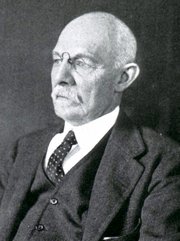



This article was written by Maurits Biesbrouck, MD. It is an expanded version of Dr. Biesbrouck’s communication on the International Conference Vesalius Continuum on the Ionian island of Zakynthos (Greece) on September 5th, 2014. This study is the result of a close collaboration with Dr. Biesbrouck’s colleagues and friends Prof. Omer Steeno and Dr. Theodoor Goddeeris, as a trio nicknamed ‘Cerberus’ by Theo Dirix, then the Consul of Belgium in Athens, and co-organizer of the conference with Pascale Pollier, Mark Gardiner and Ann Van de Velde.
In this overview I will try to tell something about the reasons for Andreas Vesalius’ travel, his stay in the Holy Land, his return voyage, the cause of his death, his burial place, and his epitaph. This text contains some new details and insights since our previous publications (1).
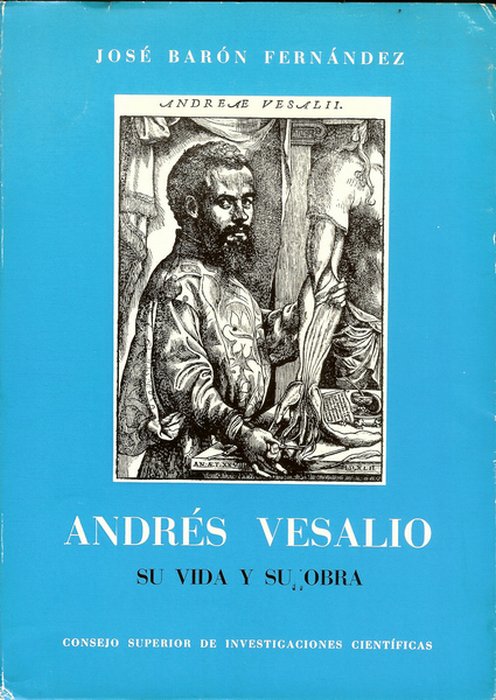
Title page of Barón Fernández’s
Vesalius biography (1970)
The legends
Many biographers wrote about the last months of Andreas Vesalius’ life. But because the necessary primary sources have been lacking, most of their stories should be regarded now as speculative. Thanks to the discovery of several letters in the archives of Simancas by José Barón Fernández in 1962 various points became clearer. As he presented the letters at the 19th International Congress on the History of Medicine in Basel in September of that year, it remains very strange that his important contributions remained unnoticed. Yet they were published at several instances in Spanish, a world language (2).
But first, something about the legends. The most persistent story, has it that Vesalius performed a dissection in Spain, on a nobleman whose heart was still beating when he exposed it, causing a great outcry. As a result Vesalius was condemned to death by the Inquisition, a sentence being commuted to perform a pilgrimage to Jerusalem, thanks to the intervention of Philip II, king of Spain.
There are numerous variants of this story, and anyone looking through the literature, invariably comes across one of these. Apart from this story - a legend as we must assume - here is a summary of the other so-called reasons that led Vesalius to travel to Jerusalem, according to different writers: for killing a woman; for dissecting a cleric’s mistress; because of an insatiable lust for wealth; to be away from his (quarrelsome) wife; troubles with the Galenist Spanish physicians; to escape from the tiresome Spanish Court; a promise after recovering from an illness; etc.
What is remarkable is that all these stories, without exception, only started to circulate after Vesalius’ death. It may be interesting however to look at the origin of the Inquisition story, the most tenacious one. This was caused by a short letter (merely twenty-four short rules) from Hubertus Languetus (1518-1581), a French diplomate, written in Paris on January 1st, 1565 to Caspar Peucer (1525-1602), physician and son-in-law of Philipp Melanchthon (1497-1560). That was ten weeks after Vesalius’s death. Michael J. North (Head of Rare Books and Early Manuscripts in the History of Medicine Division at the National Library of Medicine) had the lucky idea to reproduce a manuscript of it (3).
[Note: The manuscript is two pages and can be seen here: [Page 1]; [Page 2].
Here is a transcription:
De morte Vesalii ex literis Huberti Langueti, scriptis ad D. D. Casparum Peucerum anno Theos krononias 1565 Mense janu.
Fama est Vesalium esse mortuum audivisti proculdubio eum Hierosolymam esse profe ctum. Causa istius profectionis est mirabilis ut ad nos perscriptum est. Commissus erat eius curae viri nobilis in hispania, quem cum obiisse existimaret, nec satis causam mortis sibi percepisse videretur, petebat ab amicis uti sibi liceret corpus dissecare. Cumque pectus apperuisset, reperit cor palpitans. Cognati illius mortui non contenti erant illum accusare factae caedis accusarent impietatis apud inquisitionem existimantur se ibi vindictam vehementiorem assecuturos. Cum iam constaret de caede, nec tam facile excusaretur error medici tam periti, voluit omnino inquisitio de eo sumere supplicium. Vixque potuit autoritate sua vel potius precibus eum a tanto periculo eripere Rex ipse. Tandem concessum est Rei, et toti aulae pro eo deprecanti, ea conditione, ut ad expiandum illud scelus proficisceretur Jerosolymam ad montem Sinai. Vale. Datur Lutetiae calend Janu. anno a nato Christo 1565.
Translation
On the death of Vesalius, from a letter by Hubert Languet, written to doctor Caspar Peucer in January 1565 pcn.
Rumor has it that Vesalius is dead. You undoubtedly heard of his travel to Jerusalem. The reason for his departure, as it was written to us, is remarkable. In Spain the cure of a nobleman was trust to him. Thinking he was deceased, but not convinced about the cause of his death, he asked his friends to dissect the body. But on opening the chest he found the heart beating. The relatives of the deceased, not satisfied with an accusation for the committed murder, found it necessary to accuse him of godlessness before the Inquisition to obtain a more severe punishment. Once things became clear it was not so easy to excuse that error in a man of such an experience.
In short, the Inquisition intended to execute him. The King himself hardly succeeded to withdraw him from that great danger, relying on his authority or rather on his appealing. Eventually the King, and the entire Court that was pleading for him, were given in, on the condition that he should make a travel to the Mount Sion near Jerusalem, as a penalty for that crime. All the best, Paris, January 1st, 1565.
Article continued here: Andreas Vesalius’s fatal voyage to Jerusalem (2).
Sources and author's comments:
1. Maurits BIESBROUCK, Omer STEENO. ‘The last months of Andreas Vesalius. Part I - From Monzon (Aragon) to Jerusalem’ in Vesalius - Acta Internationalia Historiae Medicinae, 2010, 16 (no. 2): 100-106, ill.; IDEM, ‘The last months of Andreas Vesalius. Part II - From Jerusalem to Zakynthos (Zante)’ in Vesalius - Acta Internationalia Historiae Medicinae, 2011, 17 (no. 1): 30-34, ill. Also Maurits BIESBROUCK, Theodoor GODDEERIS, Omer STEENO. ‘The Last Months of Andreas Vesalius: a Coda’ in Vesalius - Acta Internationalia Historiae Medicinae, 2012, 18 (no. 2): 70-75, ill..
2.For the various publications on this subject by José Barón Fernández (and by others as well) see section ‘bibliography’ in www.andreasvesalius.be
3. Michael J. NORTH, ‘The Death of Andreas Vesalius’ in Circulating Now, U.S. National Library of Medicine, 15.10.2014, 2 pp., ill.; see http://circulatingnow.nlm.nih.gov/2014/10/15/ the-death-of-andreas-vesalius/. > Also https://www.facebook.com/nationallibraryofmedicine/ posts/10152749352150491.