
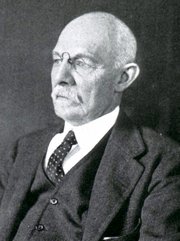



This article is part of the series "A Moment in History" where we honor those who have contributed to the growth of medical knowledge in the areas of anatomy, medicine, surgery, and medical research.
This article continues the musings of "Interesting discoveries in a medical book". In this book I found a copy of a letter written by Ephraim McDowell, MD; who on December 25, 1809 performed the first recorded ovariotomy in the world. The patient was Mrs. Jane Todd Crawford, who has also been the subject of several articles in this website, including a homage to the "unknown patient/donor".
The book belonged to Cecil Striker, MD, who practiced in Cincinnati. Dr. Striker was a faculty at the University of Cincinnati and one of the founders of the American Diabetes Association (ADA). He also was one of the first physicians to work in 1923 with a "newly discovered" drug by the Eli Lilly Company (Indianapolis) this drug was named Insulin. The medical application of Insulin had only just been discovered about a year earlier.
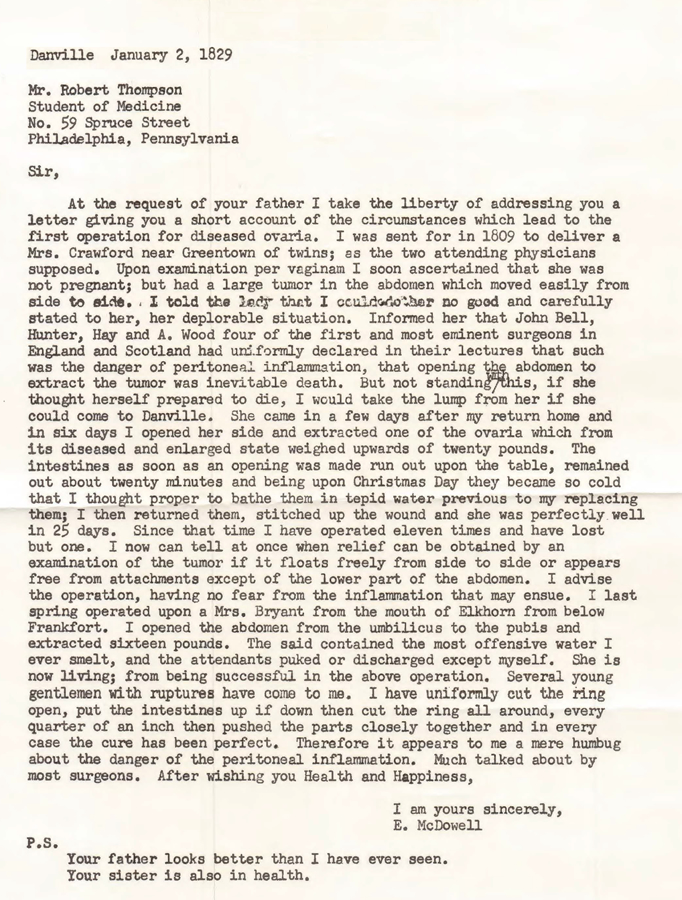 Inside the book there is a copy of a letter by Dr. Ephraim McDowell to Dr. Robert Thompson dated January 2nd, 1829, a year before Dr. McDowell's death. At the time (1829) Dr. Thompson (Sr.) was a medical student in Philadelphia. According to the note Dr. Thompson lived in Woodford County, KY, had three children and died in 1887. One of his children was also a doctor, but I have not been able to ascertain if this book was given to him by Dr. Striker.
The letter is shown in the image attached. In this letter Dr. McDowell describes in his own words the ovariotomy he performed on Jane Todd. He also describes other ovariotomies he performed and his opinion on "peritoneal inflammation".
Note how the letter has no paragraph separation. Apparently, at the time writing paper was expensive and the less pages used, the better! The text of the letter is as follows:
Danville, January 2, 1829
Mr. Robert Thompson
Student of Medicine
No. 59 Spruce Street
Philadelphia, Pennsylvania
Sir,
At the request of your father I take the liberty of addressing you a letter giving you a short account of the circumstances which lead to the first operation for diseased ovaria. I was sent in 1809 to deliver a Mrs. Crawford near Greentown of twins; as the two attending physicians supposed. Upon examination per vaginam I soon ascertained that she was not pregnant; but had a large tumor in the abdomen which moved easily from side to side. I told the lady that I could do her no good and carefully stated to her, her deplorable situation. Informed her that John Bell, Hunter, Hay, and A. Wood four of the first and most eminent surgeons in England and Scotland had uniformly declared in their lectures that such was the danger of peritoneal inflammation, that opening the abdomen to extract the tumor was inevitable death. But not standing with this, if she thought herself prepared to die, I would take the lump from her if she would come to Danville. She came in a few days after my return home and in six days I opened her side and extracted one of the ovaria which from its diseased and enlarged state weighed upwards of twenty pounds. The intestines as soon as an opening was made run out upon the table, remained out about twenty minutes and being upon Christmas Day they became so cold that I thought proper to bathe them in tepid water previous to my replacing them; I then returned them, stitched up the wound and she was perfectly well in 25 days. Since that time I have operated eleven times and have lost but one. I now can tell at once when relief can be obtained by an examination of the tumor if it floats freely from side to side or appears free from attachments except of the lower part of the abdomen. I advise the operation, having no fear from the inflammation that may ensue. I last spring operated upon a Mrs. Bryant from the mouth of the Elkhorn from below Frankfort. I opened the abdomen from the umbilicus to the pubis and extracted sixteen pounds. The said contained the most offensive water I ever smelt, and the attendants puked or discharged except myself. She is now living; from being successful in the above operation. Several young gentlemen with ruptures have come to me. I have uniformly cut the ring open, put the intestines up if down the cut the ring all around, every quarter of an inch then pushed the parts closely together and in every case the cure has been perfect. Therefore it appears to me a mere humbug about the danger of the peritoneal inflammation. Much talked about by most surgeons. After wishing you Health and Happiness,
I am yours sincerely
E. McDowell
P.S. Your father looks better than I have ever seen. Your sister is also in health
The most important point of this letter is how easily and publicly they name patients and their home addresses. Today this would be a violation of the Health Insurance Portability and Accountability Act of 1996, commonly known as HIPPA, a legislation that provides data privacy and security provisions to safeguard patient medical information.
It is also interesting to see how Dr. McDowell explained to Mrs. Crawford how difficult and dangerous the procedure would be. He stated how four renown surgeons in England and Scotland said that opening the abdomen was "inevitable death". Another point was how long the intestines were outside the body ... twenty minutes, and the maneuver Dr. McDowell used to bring them back to normal temperature. Late December in Kentucky is quite cold, even with wooden stoves and such. I wonder how much the lower temperature helped the patient.
The last point refers to his success in hernia procedures in young males. In the 1800's the word "rupture" was the standard to name abdominal hernias. Without explaining the procedure in detail, Dr. McDowell says that "every cure has been perfect". At the time, this was unprecedented, as the recurrence of inguinal hernia procedures, when attempted, was close to 25%.
The house where Dr. McDowell lived and practiced is today a museum in Danville, KY. In February, 2017 I visited this museum and wrote an extensive article on it. I encourage those interested in the History of Medicine to visit the place.