

Medical Terminology Daily - Est. 2012

Medical Terminology Daily (MTD) is a blog sponsored by Clinical Anatomy Associates, Inc. as a service to the medical community. We post anatomical, medical or surgical terms, their meaning and usage, as well as biographical notes on anatomists, surgeons, and researchers through the ages. Be warned that some of the images used depict human anatomical specimens.

You are welcome to submit questions and suggestions using our "Contact Us" form. The information on this blog follows the terms on our "Privacy and Security Statement" and cannot be construed as medical guidance or instructions for treatment.


We have 522 guests online


A Moment in History

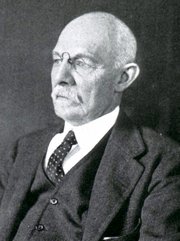
Jean George Bachman

Jean George Bachmann
(1877 – 1959)

French physician–physiologist whose experimental work in the early twentieth century provided the first clear functional description of a preferential interatrial conduction pathway. This structure, eponymically named “Bachmann’s bundle”, plays a central role in normal atrial activation and in the pathophysiology of interatrial block and atrial arrhythmias.

As a young man, Bachmann served as a merchant sailor, crossing the Atlantic multiple times. He emigrated to the United States in 1902 and earned his medical degree at the top of his class from Jefferson Medical College in Philadelphia in 1907. He stayed at this Medical College as a demonstrator and physiologist. In 1910, he joined Emory University in Atlanta. Between 1917 -1918 he served as a medical officer in the US Army. He retired from Emory in 1947 and continued his private medical practice until his death in 1959.

On the personal side, Bachmann was a man of many talents: a polyglot, he was fluent in German, French, Spanish and English. He was a chef in his own right and occasionally worked as a chef in international hotels. In fact, he paid his tuition at Jefferson Medical College, working both as a chef and as a language tutor.

The intrinsic cardiac conduction system was a major focus of cardiovascular research in the late nineteenth and early twentieth centuries. The atrioventricular (AV) node was discovered and described by Sunao Tawara and Karl Albert Aschoff in 1906, and the sinoatrial node by Arthur Keith and Martin Flack in 1907.

While the connections that distribute the electrical impulse from the AV node to the ventricles were known through the works of Wilhelm His Jr, in 1893 and Jan Evangelista Purkinje in 1839, the mechanism by which electrical impulses spread between the atria remained uncertain.

In 1916 Bachmann published a paper titled “The Inter-Auricular Time Interval” in the American Journal of Physiology. Bachmann measured activation times between the right and left atria and demonstrated that interruption of a distinct anterior interatrial muscular band resulted in delayed left atrial activation. He concluded that this band constituted the principal route for rapid interatrial conduction.

Subsequent anatomical and electrophysiological studies confirmed the importance of the structure described by Bachmann, which came to bear his name. Bachmann’s bundle is now recognized as a key determinant of atrial activation patterns, and its dysfunction is associated with interatrial block, atrial fibrillation, and abnormal P-wave morphology. His work remains foundational in both basic cardiac anatomy and clinical electrophysiology.

Sources and references
1. Bachmann G. “The inter-auricular time interval”. Am J Physiol. 1916;41:309–320.
2. Hurst JW. “Profiles in Cardiology: Jean George Bachmann (1877–1959)”. Clin Cardiol. 1987;10:185–187.
3. Lemery R, Guiraudon G, Veinot JP. “Anatomic description of Bachmann’s bundle and its relation to the atrial septum”. Am J Cardiol. 2003;91:148–152.
4. "Remembering the canonical discoverers of the core components of the mammalian cardiac conduction system: Keith and Flack, Aschoff and Tawara, His, and Purkinje" Icilio Cavero and Henry Holzgrefe Advances in Physiology Education 2022 46:4, 549-579.
5. Knol WG, de Vos CB, Crijns HJGM, et al. “The Bachmann bundle and interatrial conduction” Heart Rhythm. 2019;16:127–133.
6. “Iatrogenic biatrial flutter. The role of the Bachmann’s bundle” Constán E.; García F., Linde, A.. Complejo Hospitalario de Jaén, Jaén. Spain
7. Keith A, Flack M. The form and nature of the muscular connections between the primary divisions of the vertebrate heart. J Anat Physiol 41: 172–189, 1907.


 "Clinical Anatomy Associates, Inc., and the contributors of "Medical Terminology Daily" wish to thank all individuals who donate their bodies and tissues for the advancement of education and research”.

Click here for more information


abebooks banner

bookplateink.com


Pectoralis major muscle
Click for a larger image

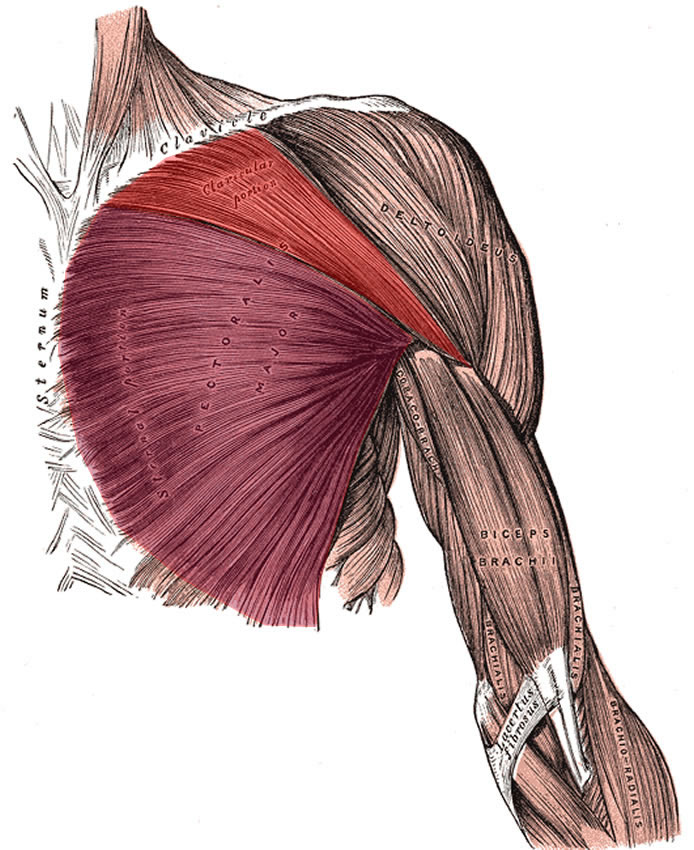
UPDATED: The pectoralis major muscle is the largest muscle in the anterior aspect of the thorax. It is thick and fan-shaped.  It attaches superiorly to the medial 2/3rds of the clavicle, and medially to the anterior aspect of the sternum and cartilages of the first to sixth or seventh ribs, extending inferiorly to attach to the aponeurosis of the external oblique muscle. Laterally, this muscle attaches to the lateral lip of the intertubercular groove (bicipital groove) of the humerus by a two-layered quadrilateral tendon which inserts each of the two heads of the muscle.

The superficial tendon attaches the clavicular head (red in the accompanying image), which extends between the intertubercular groove of the humerus and the clavicle. The deep tendon attaches the sternocostal head (purple in the accompanying image), which extends between the humeral intertubercular groove and the attachments in the sternum, costal cartilages, and the aponeurosis of the external oblique muscle. There is usually a well-defined interval between the two heads of the pectoralis major.

The pectoralis major is innervated by the medial pectoral nerve (C8-T1) and lateral pectoral nerve (C5-C7).

This muscle is covered by the pectoral fascia. An extension of this fascia is the clavipectoral fascia. In both male and female, the mammary gland is situated anterior to and anchors to the pectoral fascia by a number of fascial ligaments known as "Cooper's ligaments"
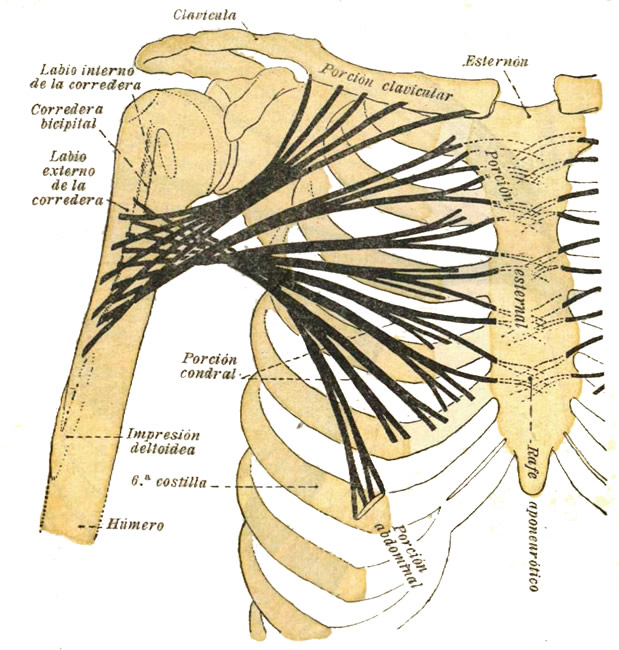
Pectoralis major muscle - Direction of the muscular fibers. Public domain
Click for a larger image

When both pectoral heads contract as a unit, the muscle adducts. flexes, and medially rotates the shoulder joint and humerus, such as when swimming doing and Australian crawl. Testut & Latarjet (1931) describe three separate muscular segments to this muscle, a clavicular component, a superior sternocostal component, and an inferior sternocostal component. They state that the clavicular components is quite evident, but the other two, although difficult to see, are separate. The clavicular head draws the humerus forward, upward, and medially, such as when you reach for something in front and above you. The sternocostal head draws the humerus down, forward, and medially.

The second image in this article is from Testut & Latarjet (1931) and shows the direction of muscular fibers of the three segments of the pectoralis major.

The word pectoral arises from the Latin term "pectum" meaning "chest, breast". In its true meaning, pectoral or pectoralis refers to a "chest plate" or an "adornment of the chest".

Sources:
1. “Gray’s Anatomy” Henry Gray, 1918
2. "Tratado de Anatomia Humana" Testut et Latarjet 8th Ed. 1931 Salvat Editores, Spain
3. "Gray's Anatomy" 38th British Ed. Churchill Livingstone 1995
4. “An Illustrated Atlas of the Skeletal Muscles” Bowden, B. 4th Ed. Morton Publishing. 2015
First image modified from the original by Henry VanDyke Carter, MD. Public domain. Second image from Testut & Latarjet. Public domain