
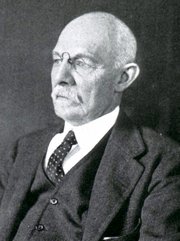



This article is part of the series "A Moment in History" where we honor those who have contributed to the growth of medical knowledge in the areas of anatomy, medicine, surgery, and medical research.
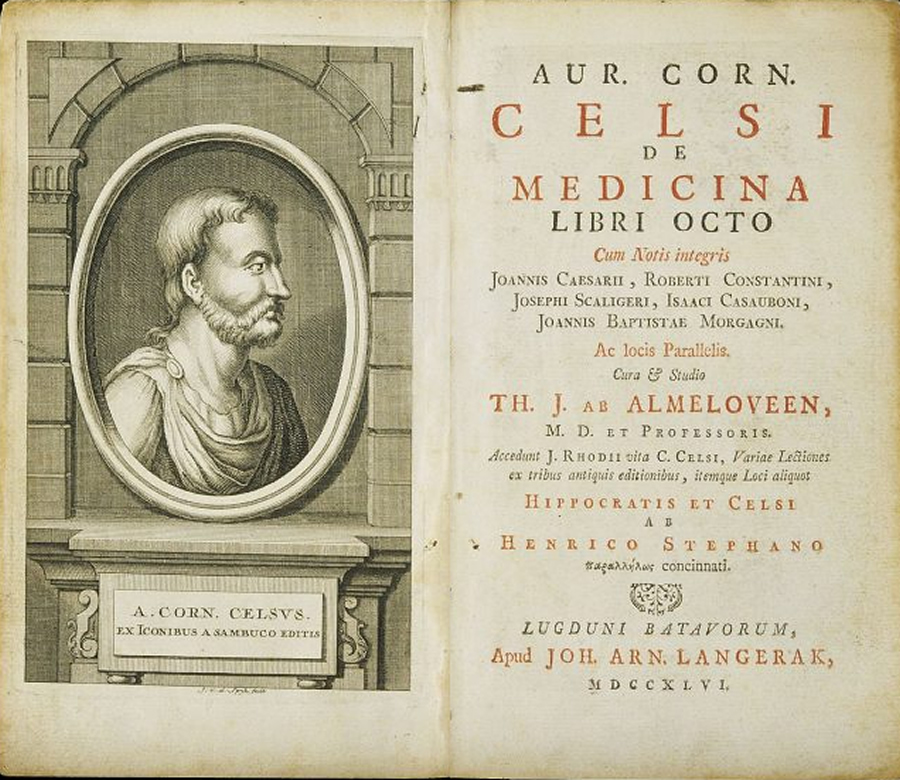
Celsus and Title Page De Medicina Libri Octo”
Click on the image for a larger version
Aulus Cornelius Celsus (25 BC - 45 AD) was Roman, probably born in the south of France. A controversial character, many dispute that he was even a physician or that he actually did what is mentioned in his opus magnum “De Medicina Libri Octo.” According to some, he was what today would be considered a compiler and editor of larger books where each chapter is written by a different author. Others present Celsus as a learned scholar of noble origin, a famous physician, either way, he influenced Medicine and Surgery for centuries. Some of his canons and medical terms he coined are in use today. such as omentum, cancer, vertebra, scalpel, etc.
He is the first to describe the four pillars of inflammation: dolor (pain), rubor (redness), calor (fever), and tumor (swelling) , and in passing criticizes Erasistratus on being wrong about inflammation. In his book he states “Notæ vero inflammationis sunt quatuor, rubor, et tumor, cum calore et dolore. Quo magis erravit Erasistratus, qui febre nullam sine hac esse dixir.” Translates as: “Note that there are four signs of inflammation: redness and swelling, with heat and pain. So much was Erasistratus mistaken, when he declared there was no fever without it.” Celsus popularized the use of the term “cancer”. although it was first used by Galen of Pergamon.
Not much is known about his life or work. Quintilian mentions a work of Celsus on rhetoric, but that work is lost. Quintilian, who apparently was not a fan of Celsus, writes: “…when even Cornelius Celsus, a man of a moderate share of genius, has not only composed treatises on all these arts, but has also left precepts of the military art, agriculture, and medicine.” His quote is what leads Alexander of Padua to state that his book “De Medicina, Libri Octo” is but a small part of a larger treatise that was called “The Arts.” Celsus is known by his book “De Medicina, Libri Octo,” (On Medicine, eight books). This book is sometimes presented as “De Re Medicina, Libri Octo.” Apparently, this book was part of a larger work by Celsus that has disappeared from History. This medical book was handwritten and was lost to history until one copy was discovered in the Vatican Library and released for copying as manuscripts. Of interest is the fact that the book found was titled "Aulii Cornelii Celsi liber sextus. idemque medicinæ primus," making it understood that these were six books, not eight! This was one of the first medical books to be printed upon the invention of the printing press by Gutenberg.
The first book begins with the principles for the preservation of health; the second is dedicated to the symptoms of diseases; the third is describes treatment of diseases which affect the whole organism and the fourth is focused on the diseases where the cause is found only in certain parts of the body, such as in head, lungs etc. The fifth book is dedicated to pharmacology. The sixth, seventh, and the eighth book deal with surgery, wounds, and fractures.
His book describes the importance of cleanliness of a wound and the use of topical treatment that today would be considered antiseptics. His contributions to surgery are many including anatomy of the eye, the description of ophthalmic diseases, methods of preventive treatment and surgery including eyelid surgery. He is probably the first to describe cataract surgery.
The eighth book, almost entirely dedicated to dislocations and fractures, provides an extensive description of head injuries such as extradural hematomas, lesions distant from the impact point, and intracranial damage in cases with no overlying fractures. He also provided the first description of brain swelling exceeding the level of the skull, described several surgical indications and craniotomy techniques, recommended treatment for depressed fractures (which had been previously considered untreatable), and detailed the surgical instruments employed.
De Medicina was among the first medical books to be printed (Florence, 1478), and more than 50 editions have appeared; it was required reading in most medical schools to the present century. It is the principal historical authority for the doctrinal medical teachings of Roman antiquity. The surgical section, which even Joseph Lister studied in the 19th century, is perhaps the best part of the treatise.
W. G. Spencer, the most recent translator of his works, supports an older, minority view that the details of medical procedure, the experienced judgment shown in the selection of treatment, and the frequent use of the first person reveal an author with an intimate acquaintance of clinical medicine who must have been himself a practitioner of the medical arts.
Because of this book and the clarity of the disease descriptions and treatments both pharmacological and surgical. Celsus has been lauded as one of the Fathers of Medicine and Surgery. His influence has stood the test of time and was read well into the 1800’s.
Personal note: This article was motivated by the recent acquisition of a 1713 copy of De Medicina, that is now part of my library. The book belonged to Dr. Harry Kaufmann Hines, a renown radiologist who lived and worked in Cincinnati, OH. The book was a gift to him from his sister-in-law Erma Wright Tateman neé Sharkey in August 1961. Dr. Miranda
Sources:
1. “The Contribution of Aulus Cornelius Celsus (25 B.C.–50 A.D.) to Eyelid Surgery” Davide Lazzeri, Tommaso Agostini, Michele Figus, Marco Nardi, Giuseppe Spinelli, Marcello Pantaloni & Stefano Lazzeri (2012), Orbit, 31:3, 162-167
2. “Aulus Cornelius Celsus and the Head Injuries” GiuseppeTalamonti Giuseppe D'Aliberti, MarcoCenzato World Neurosurgery Volume 133, January 2020, Pages 127-134
3. “A. Cornelius Celsus of medicine. In eight books.” Translated, with notes critical and explanatory, by James Greive, M.D. 1756
For anyone interested in reading an online copy of this book, you can find it here. For the translation by Greive click here.