

Medical Terminology Daily - Est. 2012

Medical Terminology Daily (MTD) is a blog sponsored by Clinical Anatomy Associates, Inc. as a service to the medical community. We post anatomical, medical or surgical terms, their meaning and usage, as well as biographical notes on anatomists, surgeons, and researchers through the ages. Be warned that some of the images used depict human anatomical specimens.

You are welcome to submit questions and suggestions using our "Contact Us" form. The information on this blog follows the terms on our "Privacy and Security Statement" and cannot be construed as medical guidance or instructions for treatment.


We have 902 guests online


A Moment in History

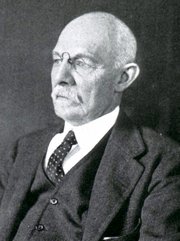
William S. Halsted, MD

William S. Halsted, MD
(1852 – 1922)

American anatomist, teacher, and surgeon, William Stewart Halsted was born in New York City, USA to a wealthy family of English origin. His father was involved in charitable work and Governor and trustee to a city hospital. Not a brilliant student initially, Halsted took an undergraduate in Liberal Arts in Yale, CT., after which he entered the Medical College of Physicians at the Columbia College, where he excelled.

As a second-year medical student Halsted applied and obtained a position in surgery at a local hospital. In here he learned about Lister’s antiseptic technique and became an adamant proponent of it to reduce infection. In 1877 Halsted obtained his MD. After a short time as House Physician at the New York Hospital, Halsted traveled to Europe to further his education studying for two years at the Universities of Vienna, Leipzig, and W?rzburg.

Besides being at the forefront of surgical and antiseptic techniques (introducing the use of rubber gloves in surgery), Halsted was extremely concerned with the way medical students were taught in the US. He pioneered bedside clinical round discussions with the medical students after two years of basic sciences studies. Halsted developed the idea of a patient chart; he also developed the residency program for medical students in use today.

Halsted is probably the most influential researcher and surgeon at the turn of the century. He dedicated time to the study of intestinal anastomoses and the use of silk as a suture material. His experimental work in 1887 proved that the inclusion of the submucosa layer in an anastomosis was mandatory, as well that a single layered anastomosis was enough to attain closure. Perhaps Halsted’s most important contribution was the application and use of the scientific method to surgical questions. Halsted’s principles, also known as  "Halsted's Rules of Surgery", set the standards used today in surgical suturing and surgical stapling.

He also pioneered the development and surgical techniques for radical mastectomy as a treatment for breast cancer.

As a side effect of this studied in anesthesia and the use of cocaine for anesthesia, Halsted became addicted to this substance, a problem that followed him through the years. Without impairing his capacity as a researcher and a surgeon, Halsted eventually recovered. He died in Baltimore in 1922 as a complication to surgery.

Sources:
1. Dubay, A. D., & Franz, G. M. (2003). Acute Wound Healing: The Biology of Acute Wound Failure. Surg Clin NA, 83, 463-481.
2. Halsted, W. S. (1887). Circular Suture of the Intestine - An Experimental Study. Am J Med Sci, 436-461.
3. “William Stewart Halsted: his life and contributions to surgery” Osborne, P. Lancet Oncol 2007; 8: 256–65
4. “William Stewart Halsted: Surgical pioneer” Burress, P Endoc Today (2010), 8: (2) 22
5. “William Stewart Halsted (1852–1922) Neurological stamp” Haas, LF J Neurol Neurosurg Psych 2000;69:641
Original image courtesy of "Images from the History of Medicine" at  www.nih.gov


 "Clinical Anatomy Associates, Inc., and the contributors of "Medical Terminology Daily" wish to thank all individuals who donate their bodies and tissues for the advancement of education and research”.

Click here for more information


bookplateink.com


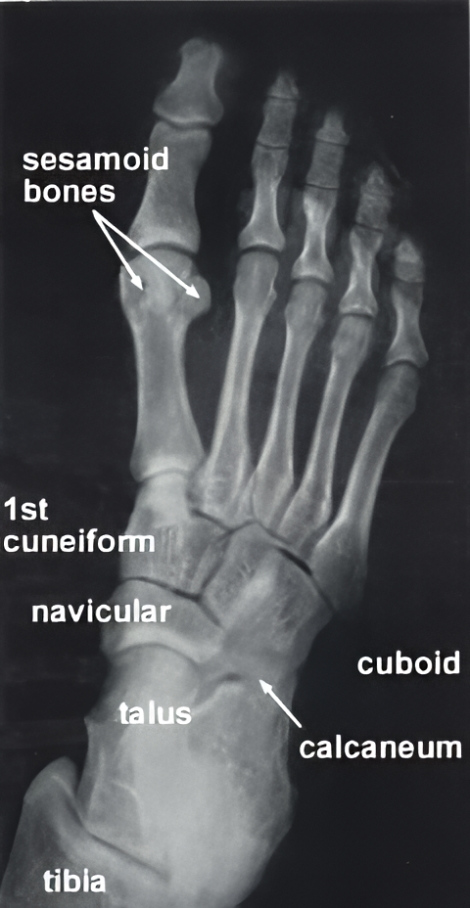
Foot X-ray. Sesamoid bones
Click for a larger image

The word [sesamoid] means "similar to a sesame". First used by Galen c.180AD, he describes small ovoid bones that are "similar to a sesame seed", referencing the seed of the plant sesamum indicum, the oil of which was used as a laxative at that time. 

Sesamoid bones are found in the tendons of some muscles and are mostly inconstant. Largey and Bonnet proposed a classification for these bones as: accessory, capsuloligamentous, intratendineous, and mixed.

Of special interest to this article are the sesamoid bones found within the two tendons of the flexor hallucis brevis muscle in the base of the foot (see accompanying X-ray image). These bones, especially the medial sesamoid bone, was attributed religious, mystical, and magical powers since ancient times. This is due to the fact that this small bone is highly resistant to natural decomposition. A Hebrew medical text dated 210 BC, attributed to Ushaia presented a small bone he called "luz" as the "depository of the soul". Many other authors, including Vesalius (who called it Albadaran), believed that upon resurrection, the whole body could reform from this "seed" bone.

This belief was later reinforced by religious texts into the early Renaissance which stated that this bone was indestructible and its presence was enough to guarantee resurrection for believers. 

Note: The original X-ray was published here courtesy of Wesley Norman, PhD in his website. The website is no longer available, so the image is now in the public domain via www.archive.org.

Sources:
1. "Les os sesamoides de l’hallux : du mythe a`la fonction" Largely,A; Bonnel, BE Med Chir Pied 2008 24: 28–38
2. "Tratado de Anatomia Humana" Testut et Latarjet 8 Ed. 1931 Salvat Editores, Spain
3. "De Humani Corporis Fabrica" Vesalius, Andrea. 1543 Oporinus
Thanks to the first year medical students at the University of Cincinnati who inspired this article. Dr. Miranda