
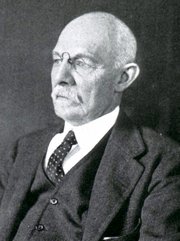



This article is part of the series "A Moment in History" where we honor those who have contributed to the growth of medical knowledge in the areas of anatomy, medicine, surgery, and medical research.
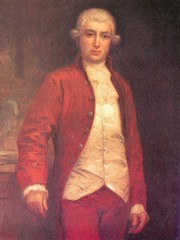
Don Antonio de Gimbernat i Arbos
UPDATED: Don Antonio de Gimbernat y Arbós (1734-1816). Spanish anatomist and surgeon. His complete name was Don Manuel Luis Antonio de Gimbernat y Arbós. He was born to a farmer’s family in 1734 in Cambrils (Tarragona), in what today is Cataluña. Gimbernat studied Latin and Philosophy at the University of Cervera, continuing his studies at the School of Surgery in Cádiz, where he graduated in 1762.
Gimbernat joined the Spanish Navy, but because of this capabilities, in 1765 he was offered the position of Anatomy Professor at the Royal School of Surgery in Barcelona. In 1768 he made an anatomical discovery that would render him immortal: he demonstrated the presence of the lacunar ligament. Furthermore he applied his knowledge of this ligament to improve on the surgical technique to reduce a strangulated femoral hernia. Gimbernat also discovered the lymph node found deep in the femoral ring (later to be known as Cloquet’s or Rosenmueller’s node)
In 1774 Gimbernat traveled through Europe to learn the latest surgical techniques. This trip was sponsored by King Carlos III. During his stay in London Gimbernat studied with John Hunter (1728 – 1793). In an attitude not common for a student at the time, at the end of one of Hunter's anatomical lectures on hernia, Gimbernat asked to go to the cadaver and demonstrate his findings. With approval of the teacher, he demonstrated for Hunter the lacunar ligament as well as his strangulated femoral hernia technique. Hunter watched the demonstration and at the end of it he just said "You are correct, sir".
Hunter was so impressed that from that day on he referred to the lacunar ligament as “Gimbernat’s ligament" and adopted his surgical technique. Gimbernat also showed Hunter his studies and technique to repair diaphragmatic hernias.
Manuel Gimbernat participated in the creation of the Spanish Royal School of Surgery, became a professor of surgery and orthopedics, and in 1789 he was named First Royal Surgeon and president of all the surgical schools in Spain.
In 1793, Gimbernat published his “ Nuevo Método de Operar en la Hernia Crural” dedicated to King Charles IV, which was translated as “A New Method of Operating for the Femoral Hernia”, into English in 1795.
In 1803 the Spanish king Carlos IV commissioned Don Francisco Javier de Balmis i Berenguer (1753 – 1819), a Spanish physician, to find a solution to the smallpox problem in the Spanish colonies in South America. While planning what was later to be known as the “Royal Philanthropic Vaccine Expedition” Balmis received critical contributions from Don Manuel Gimbernat.
All of his titles and positions were removed by King Fernando VII because Gimbernat was a supporter of Napoleon during his invasion of Spain in 1808. Sick, poor, blind, and with ailing mental faculties, Don Manuel Gimbernat died in Madrid on November 17, 1816.
Gimbernat was also a pioneer in ophthalmology, vascular surgery and urology. As for his incredible anatomical dissection capabilities, Gimbernat often said “mi autor más favorito es el cadaver humano" (my favorite author is the human body”
Personal note: My thanks to Dr. José Luis Bueno-López for his correction of the name of Gimbernat: "Although don Antonio de Gimbernat y Arbós was born in a town in Catalonia, Spain, he never wrote his name nor his contemporaries did, with the particle 'i' between his two family names (in the manner of the Catalan language) but with particle 'y' in the way of the Spanish language". There are many articles where Gimbernat's last name is written "Gimbernat i Arbos" (see link #3 on the Source section) which according to Dr. Bueno-López is incorrect. To read the article co-authored by Dr. Bueno-López on Gimbernat (#6 in our Sources section) click here.
Sources:
1. “Manuel Antonio de Gimbernat y Arbós. 1734-1816” Trauma (2012) 23: (1)
2. ” Gimbernat y Arbós, Antonio de (1734-1816) Loukas M et al World J Surg 2007; 31: 855-7
3. “Epónimos médicos: Ligamento de Gimbernat” Febrer JLF 1999 (Link)
4. “Antonio de Gimbernat (1734- 1816). Anatomist and surgeon” Puig-LaCalle J, Mart?-Pujol R. Arch Surg 1995; 130: 1017- 20
5. “Antonio de Gimbernat, 1734-1816” Matheson NM. Proc R Soc Med 1949; 42: 407-10.
6. "Antonio Gimbernat y Arbós: An Anatomist-surgeon of the Enlightenment (In the 220th Anniversary of his ‘‘A New Method of Operating the Crural Hernia’" Arraez-Aybar LA, Bueno-Lopez JL. Clin Anat (2013) 26:800–809