



By Maurits Biesbrouck, MD. Continued from "Andreas Vesalius’s fatal voyage to Jerusalem (3)".
For the first page of this article, click here.
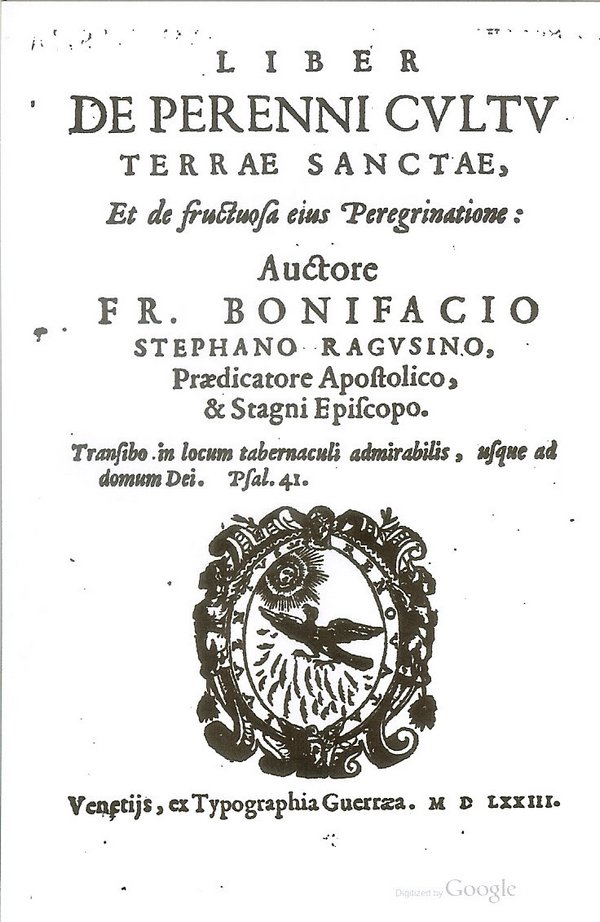
Stephanus BONIFACIUS, Liber
de Perenni Cultu Terrae Sanctae
et de Fructuosa eius Peregrinatione,
Venice: Guerra, 1573
Letter 4: from Brother Bonifacio to Philip II
The last letter is from Fra Bonifacio de Ragusa, guardian of the monastery of Mount Sion, and Custodian of the Holy Places, and is dated May 29th, 1564 in Jerusalem. That is two months later and it is likewise addressed to Philip II. As much in this letter is of a religious nature, I only translate what is important to our story: “Holy and Royal Majesty, … , Doctor Vesalius, a devout pilgrim in Jerusalem, and the bearer of this letter, has taken the risk of bringing to us, … , the royal gift of five hundred ducats, intended for the Catholic worshippers in the kingdom of Jerusalem, as a contribution for its shrines, … , etc.”
He ends with:
“… Here I conclude by kissing your royal hands. From … the Holy Mount Sion in Jerusalem, May the 29th, 1564. The pious chaplain, Brother Bonifacio, Guardian of the Holy Land and Apostolic Vicar.”
The letter is, on its address side, sealed with an oval seal, around which run the words (in Latin) “Seal of the guardian of the monastery of the holy Mount Sion”.
Thus, Bonifacio de Ragusa confirms that Vesalius was in Jerusalem on 29 May 1564, and mentions that Vesalius had brought five hundred ducats with him as a contribution for the holy places from the King. Next, Bonifacio states in this letter, that it (the letter) was given to Vesalius to deliver it personally to the King. This is very important! As we shall see, the letter reached its destination although Vesalius himself remained behind on Zakynthos, and died there shortly afterwards, as we all know. Most importantly that letter does not only still exist, but it is preserved in good shape, and there are no signs of damage by seawater (thus debunking the theory that Vesalius shipwrecked and fell into the sea).
As Bonifacio specifies that Vesalius will deliver the letter himself, this shows that Vesalius had not yet made it known on 29 May 1564 that he did not wish to return to Madrid. It may only have been afterwards, that he received the invitation, from the Venetian Senate, to return to Padua, to which various sources refer. Then he might have changed his mind, but we found no authentic documents to support this. At the time Bonifacio de Ragusa wrote this letter, Vesalius clearly was in the favor of the King and intended to return to Spain.
Vesalius’ stay in the Holy Land
Vesalius was in Palestine for at least five months: from the end of March to the end of August 1564. So we must ask what he did there during this months. Well, we don’t know very much about that. The only thing is that Bonifacio writes elsewhere, that he visited the planes in Jericho, together with Vesalius, and that they were interested in the medical virtues of the various herbs and fruits of that region. This point is confirmed by a passage in Bonifacio’s book Liber de Perenni Cultu Terrae Sanctae (11).
Thanks to the four letters, found by José Barón Fernández, the purpose of the journey is now clear: a pilgrimage by Vesalius to the Holy Land with a monetary contribution for the holy places, from the king of Spain. The letters do not give the impression that the primary purpose of the journey was to send Vesalius on ‘a diplomatic mission’. Rather, it seems that the king simply took the opportunity provided by this pilgrimage to send the sum of money with his physician. Such a gift, was not an extraordinary one, as the catholic king used to do this each year.
His return voyage
Now, let us look at his return voyage. The voyage to Jerusalem was usually made, according to Jean Zuallart, in April, May or June, and was accompanied by fine, warm weather, whereas the return trip was made in the autumn, when the weather was usually not so fine and could be windy or even stormy. During the return trip, the traditional stops after Jerusalem were Tripoli, Cyprus, Candia in Crete, Zakynthos and then to Corfu and finally Venice. This represented a route without too many detours. Zuallart also refers to Jaffa and Ramma as stops. According to him, the route took anything from between ten and thirty days, depending on the wind. Interesting perhaps, to illustrate how adventurous and uncertain the trip was, is that Zuallart himself did not reach Zakynthos while returning, and sailed past the island, because of adverse winds.
The causes of Vesalius’s death
We all know that Vesalius died in Zakynthos. The reasons and circumstances of his death remain mysterious however. Most authors refer to a shipwreck due to a storm. Also, the literature consistently refers to Vesalius as the only victim when arriving at Zakynthos. When there is a shipwreck, there are multiple victims. But – as already told - the fact that Vesalius had the letter with him, from Bonifacio for the King, and that this letter still exists, rules out definitely the possibility of a shipwreck. Exhaustion from lack of food or drinking water and from drifting aimlessly over a long period due to adverse winds, as some have suggested, is certainly possible. But Vesalius was a man of means, and if there was a general shortage on board, he would certainly not have been the only one with problems. The most plausible explanation does indeed seem to be illness, possibly exacerbated by general weakness, from whatever cause.
Article continued here: Andreas Vesalius’s fatal voyage to Jerusalem (5).
Sources and author's comments:
11. Stephanus BONIFACIUS, Liber de Perenni Cultu Terrae Sanctae et de Fructuosa eius Peregrinatione, Venetië: Guerra, 1573; see p. 235.