
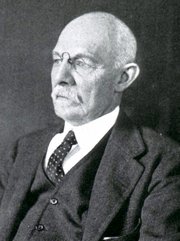



By Maurits Biesbrouck, MD. Continued from "Andreas Vesalius’s fatal voyage to Jerusalem (5)".
For the first page of this article, click here.

Passage in Abraham Ortelius’s Teatro del Mondo with Pigafetta’s report on Vesalius’s burial place. In Italian
“Leaving aside the discussion on the epitaph of Cicero, who did not die on this island [Zakynthos], I, Filippo Pigafetta, add having seen the grave of Andreas Vesalius from Brussels, famous anatomist and the first one to render in appropriate Latin wordings and accompanied with modern illustrations the fabric of the human body, as can be seen in his marvelous books. While returning from a pilgrimage to the Holy Land he ended his life here after glorious years. An inscription to his memory was placed above the door to the church of Saint Franciscus, in golden letters on black velvet, that was taken away by the Turcs in 1571. Thus this island was ennobled likewise by the bones of such famous persons” (16).
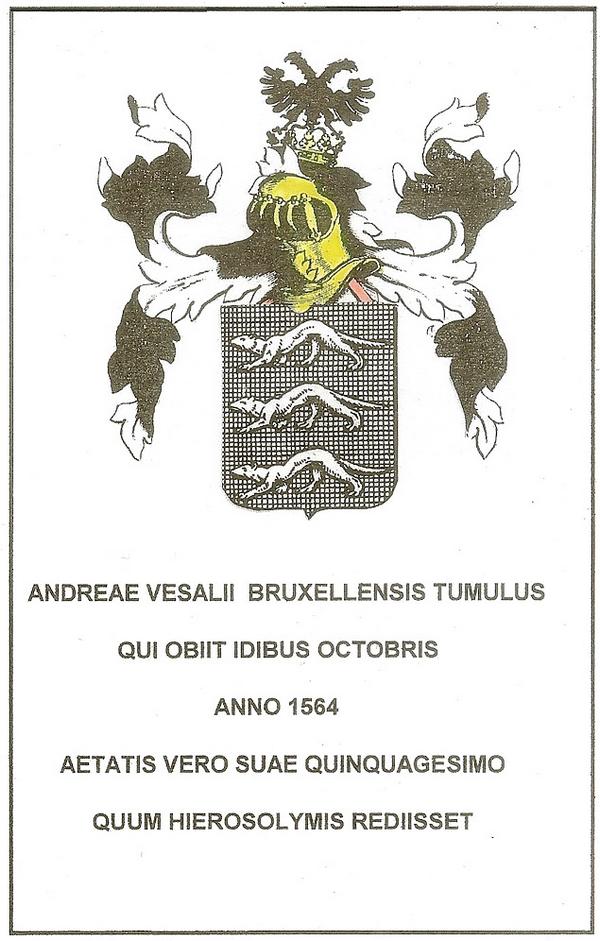
Reconstruction of Vesalius’ epitaph
by Theodoor Goddeeris (2012)
Pigafetta saw the grave in July 1586, almost at the same time as Jean Zuallart, but he may have seen it yet in 1568, on his way to Cyprus, or during his travelling to Egypt and Mount Sion in 1576-1577. When his information dates from 1568, or was based on reliable sources later on, then the Turcs could have taken two inscriptions: his epitaph and a plaque at the entrance of the church (17).
The church S. Maria delle Grazie
As far as is known, Fürer, Zuallart, and Pigafetta were the only three travellers to Jerusalem, to have seen Vesalius’s grave in the S. Maria delle Grazie with their own eyes. Thanks to them we are sure that Vesalius was buried in that church, built in 1488. Regrettably, it was destroyed on October 18th 1840 by a severe earthquake. It was then rebuilt, but moved a few meters inland. In 1893 the church was again destroyed by an earthquake. This time it was not restored, and the rubble was used by the fishermen along the coast to rebuild their houses, as told by Barbiani (18).
Vesalius’s epitaph
So Fürer saw Vesalius’s epitaph before it was stolen, but he gave an incorrect description of Vesalius’ coat of arms on it. Anyway, it follows that Vesalius’ grave was indeed at this church, and that he must have been buried there and not by the side of a road somewhere. An effort was immediately made to give him a worthy burial place. The epitaph with the coat of arms, which was already present so soon after his death, is proof of this. The people of Zakynthos were well aware of who this person was. To correct the errors in the epitaph and in the coat of arms as well, some years ago, Dr. Theodoor Goddeeris, made a graphic reconstruction of both.
Conclusions
I can summarize with four conclusions (19):
1° Andreas Vesalius' trip to Jerusalem had nothing to do with the Inquisition: he went to Jerusalem for religious reasons, and the King took the opportunity to send with him his financial support for the Holy Places, as he used to do.
2° Vesalius did not die in a shipwreck. He died most probably of a combination of exhaustion and illness.
3° He was not buried on some desolate spot, but in the church Santa Maria delle Grazie. His remains are not yet found, however. (see here for additional information on the search for Vesalius' grave).
4° His grave had an epitaph (and we know exactly what it said and looked like).
Personal note: My sincere thanks to Dr. Maurits Biesbrouck for contributing this article to "Medical Terminology Daily". His clear and factual analysis gives us an insight on the last months of Andreas Vesalius' life and the problems that eventually led to his death on Zakynthos, Greece. I am proud to have been one of the many international attendees to the 2014 meeting in the island of Zakynthos where I saw Dr. Biesbrouck deliver the presentation and research on which this article is based. Dr. Miranda.
Sources and author's comments:
16. Teatro del Mondo di Abrahamo Ortelio: da lui poco inanzi la sua morte riveduto, e di tavole nuove, et commenti adorno, e arricchito con la vita dell’Autore. Traslato in Lingua Toscana dal Sigr. Filippo Pigafetta, in Anversa, si vende nella Libraria Plantiniana, 1608 and 1612.
17. Maurits BIESBROUCK, Theodoor GODDEERIS, Omer STEENO. ‘Post Mortem Andreae Vesalii (1514-1564). Deel I: De laatste reis van Andreas Vesalius en de omstandigheden van zijn dood’ [After Vesalius’ Death: The Last Travel of Andreas Vesalius and the Circumstances of his Death] and ‘Deel II: Het graf van Andreas Vesalius op Zakynthos’ [Vesalius’ Grave in Zakynthos] in A. Vesalius, 2015, 27 (no. 3): 154-161 and (no. 4): 193-200, ill.
18. Nicolas Ant. BARBIANI, O André Vésale kai è proodos tès anatomias [Andreas Vesalius and the evolution of anatomy] – L’évolution de l’anatomie et André Vésale, Athens, 1953, 32 pp., ill.; in Greek with a French summary on pp. 7-8.
19. For more details see the papers mentioned in ref. 1.