
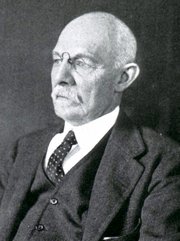



This article is part of the series "A Moment in History" where we honor those who have contributed to the growth of medical knowledge in the areas of anatomy, medicine, surgery, and medical research.
This is the continuation of the article “The Ephraim McDowell House and Museum (2)”. For the first article, click here.
The “Operating Room”
The so-called “operating room” is the place where everybody thinks a historical surgical event took place. The room is at a different level and communicates with the master bedroom. There is a plaque placed there byt Chapter XI of the Colonial Dames of America. In the room there is antique furniture and surgical instruments of the time.These are most probably not Dr. McDowell’s instruments, but I would like to believe so.
In the instrument kits you can clearly see different types of knives, lancets, needles, trephines, tourniquets, and amputation saws. What is interesting is that at the time (1809) there were no concepts of asepsia or anesthesia. So why did this historical operation did not get infected? Dr. McDowell’s habits and the location of the room may provide an answer. It is said that Dr. McDowell was very strict about bodily and environmental cleanliness (clothes and such). The location of the operating room is directly above the kitchen and has a separate set of stairs that leads directly to it. In the 1800's white linen was boiled.
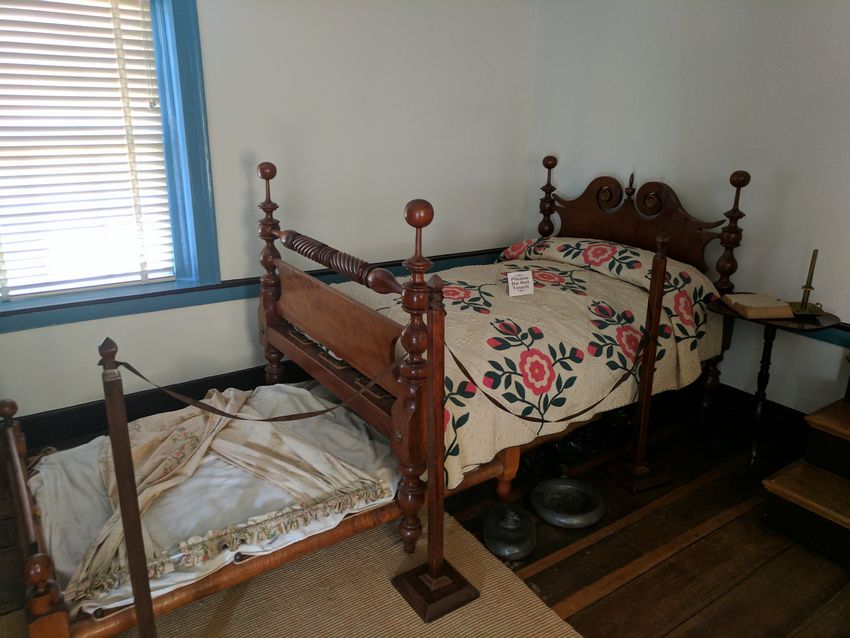
The operating room
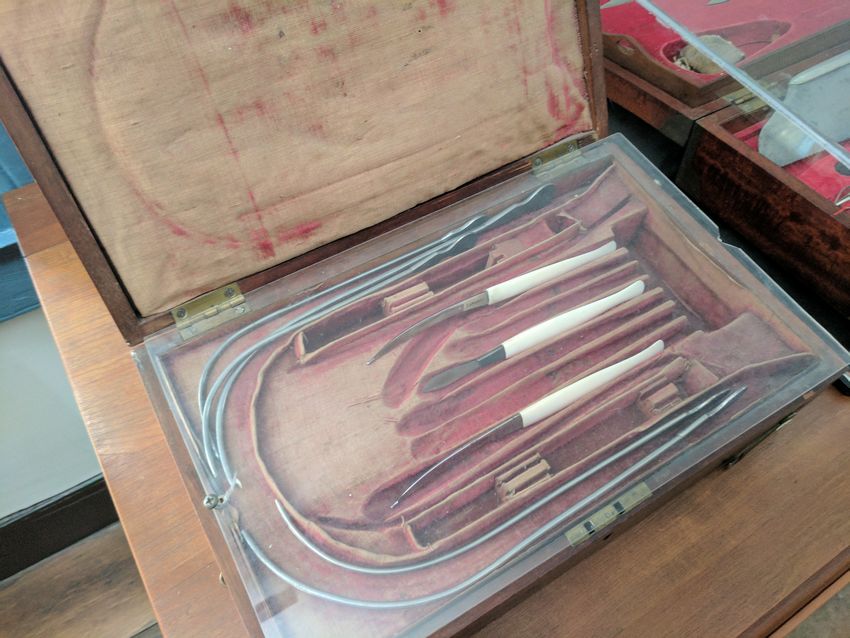
Surgical kit
In my opinion, this room was not only the “operating room” but also the “convalescent room” for people that were operated by Dr. McDowell. A room that served as pre and postoperatory, as well as an operating room.
In the room there are also additional artifacts, one of which definitely caught my attention: A doctor’s saddle bag. Since all transportation was by horse or buggy, a young doctor needed a special saddle bag that contained surgical instruments, medicine, and all that was needed for a home visit. This reminds me of a book I strongly recommend: “The horse and buggy doctor” by Arthur E. Hertzler, MD who was born almost 40 years after Dr. McDowell died.
The operation
Dr. McDowell visited Jane Todd Crawford in early December 1809 at her home 60 miles away. The reason was that two doctors wanted him to help in the birthing, as they thought the patient was pregnant and in pain. After examination Dr. McDowell explained to the patient that she had an (at the time) inoperable ovarian tumor and the she had a fatal prognosis. He also explained that he would be willing to try a risky and experimental surgery, but only at his home in Danville, KY. Mrs. Crawford agreed, as this was the only opportunity to save her life.
Mrs. Crawford, traveled very slowly for several days on horseback, crossing several rivers in the process. When she arrived she was tired and in a delicate condition, so she stayed several days before Dr. McDowell attempted the operation.
The operation itself has been described countless times. On Sunday December 25th, 1809 the patient was placed on a table in the “operating room”. Dr. James McDowell, a nephew assisted in the operation. He repeatedly asked his uncle to desist in the attempt that he was convinced was going to fail, the other physician attending was Dr. Alban Gilpin Goldsmith (1795 - 1876).
The patient was given some opioids (not anesthesia), her face was covered with a light piece of cloth and while she recited psalms and sang hymns Dr. Ephraim McDowell cut a 9-inch left paramedian incision opening her abdomen. The tumor was so big that it had to be cut open initially to partially drain a “dirty, mucous content”. After a single ligature through the broad ligament and infundibulopelvic ligament, the tumor was removed. It weighed 22 and a half pounds (10.2 kgs)! The incision was closed with an interrupted suture.
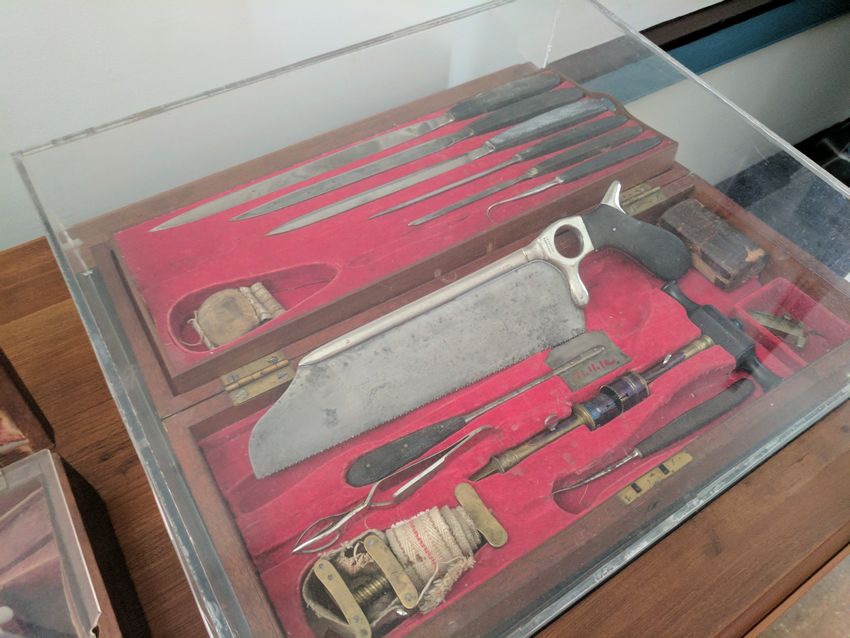
Surgical kit
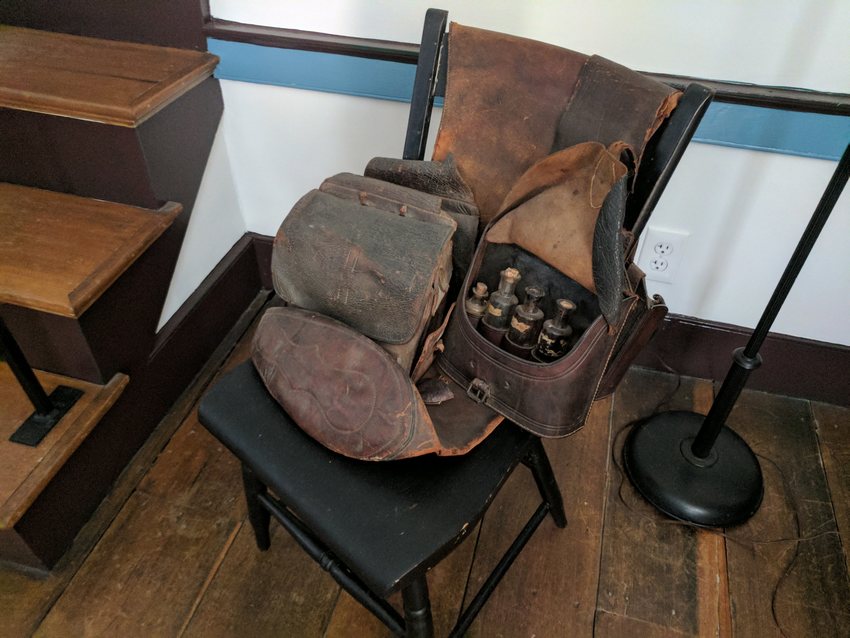
Doctor's saddlebag
Five days after the operation, when Dr, McDowell came from the master bedroom to the now “postoperative” guest room he was surprised to see Mrs. Crawford on her feet making her bed! In Dr. McDowell’s own recounting of the procedure, the patient stayed with the McDowell family for 25 days after which she then again horseback rode 60 miles back to her home, in the middle of winter. Apparently these two protagonists never met again and Mrs. Crawford survived Dr. McDowell for at least 13 years. More information on the patient can be found in this article.
Dr. McDowell was a very religious man and the night before the operation he wrote a prayer that he kept in his pocket during the operation. Following is the text of the prayer. If you visit a store across the street from the McDowell House and Museum you can buy a facsimile of the prayer.
The Prayer
"Almighty God be with me I humbly beseech Thee, in this attendance in Thy holy hour; give me becoming awe of Thy presence, grant me Thy direction and aid, I beseech Thee, that in confessing I may be humble and truly penitent in prayer, serious and devout in praises, grateful and sincere, and in hearing Thy word attentive, and willing and desirous to be instructed. Direct me, oh! God, in performing this operation, for I am but an instrument in Thy hands, and am but Thy servant, and if it is Thy will, oh! spare this poor afflicted woman. Oh! give me true faith in the atonement of Thy Son, Jesus Christ, or a love sufficient to procure Thy favor and blessing; that worshipping Thee in spirit and in truth my services may be accepted through his all-sufficient merit. Amen."
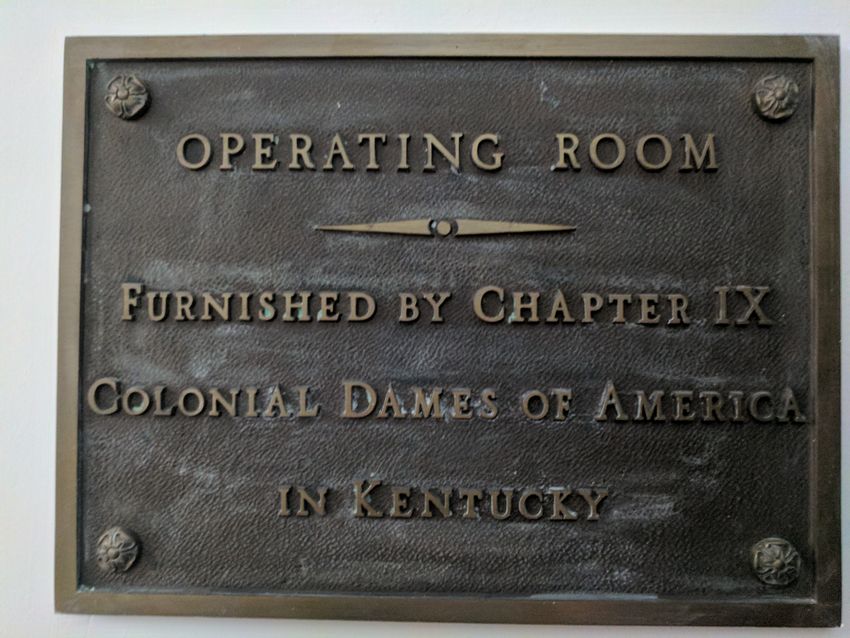
Plaque on the operating room
Dr. McDowell only published the operation and its results in 1817. In several biographies that I have read it is stated that many were envious and jealous of his accomplishments to the point of creating tales that he “cut women open to murder them”. In her granddaughter’s biography or her illustrious grandfather she writes: “McDowell was conscious at the time he was doing the operation, that an angry and excited crowd of men were collected in the street awaiting the result of his experiment of "butchering a woman," as they expressed it. Had she died under the operation, there was no law in those primitive days sufficiently strong to have protected him from the people who were clamoring for his life—determined men who would have shown no mercy, for they regarded it a duty to avenge the wrong inflicted on Mrs. Crawford. Indeed his life hung on the recovery of the heroic woman.”
NOTE: Not long after I wrote this article, I came across a biography book of Dr. McDowell; inside it I found a copy of this prayer owned by Dr. Robert Thompson, along with a copy of a letter From Dr. McDowell addressed to Dr. Thompson with a description of the procedure.
Sources:
1. “Ephraim McDowell and Jane Todd Crawford, the Bicentennial of a Surgical Masterpiece” Benigno, BB Obst & Gynecol (2009) 113. 5:1141-1144
2. “The Biography of Ephraim McDowell, M.D.; The Father of Ovariotomy” Ridenbaugh, MY, 1890 CL Webster & Co.
3. “Ephraim McDowell: "Father of ovariotomy" and founder of abdominal surgery, with an appendix on Jane Todd Crawford” Schachner, A 1921, J.B. Lippincott Co.