
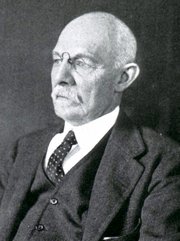



Did Andreas Vesalius really die from scurvy on the island of Zakynthos in 1564?
Evidence does not support this theory.
NOTE: The following article authored by Theo Dirix, and Dr. Rudi Coninx, is a rebuttal of Pavlos Plessas' theory that Andreas Vesalius indeed died from scurvy. The original article entitled "Powerful indications that Vesalius died from scurvy" by Pavlos Plessas was presented in a meeting at the island of Zakynthos in 2014.

Dr. Rudi Coninx, and Theo Dirix
For the first segment of this article, click here.
...continued...
4. The sudden death
Vesalius did indeed die upon arrival in Zakynthos. And sudden death is indeed associated with scurvy.
We know this from two accounts. Both are second hand accounts:
The Italian Pietro Bizzari based his account on what he had been told by an anonymous Venetian goldsmith. The goldsmith claimed that he had happened upon the sick Vesalius by chance on a deserted beach and, in spite of the opposition he had faced from the Zakynthians, had tried to assist him in his final hours and had buried him with his own hands in a plot he had purchased for that purpose. This account suggests the Vesalius’ death was not sudden, but was prolonged process, lasting at least hours, if not days. None of the typical scurvy signs like the bleeding and joint pain, the foul mouth, are mentioned in the account.
The second written account has come to us via Johannes Metellus, the Latinised name of a Frenchman named Jean Matal. Metellus claims to have received this information from a German traveler from Nuremberg named Georg Boucher. Boucher travelled on the same ship with Vesalius to Zakynthos.
Boucher tells us that Vesalius was poorly supplied with food, fell ill, initially with worry over the breakout of the disease and his own fate, and soon after disembarking dropped dead. Boucher arranged for a stone to be put on his grave. Boucher’s account is generally considered more reliable
Metellus describes the symptoms of Vesalius’ illness and they do not match the description of a scorbutic patient. The disease described by Metellus includes symptoms of extreme fear and irrational behaviour, immediately prior to his illness. These are not well known scurvy symptoms, as sometimes is claimed.
Metellus attributes the illness that broke out on Vesalius’ ship, at least partly, to food and water shortages. He is clear though in that the deaths were caused by illness and not directly by starvation or dehydration. Not everyone of the ship was affected. Boucher, for example, does not appear to have fallen ill at any point, despite having had to share the same food as other passengers. The possibility of rotten food as a cause of death on the ship is plausible.
The behaviour changes described by Metellus are sometimes given as proof of scurvy, and reference is made to a 1971 study by Kinsman and Hood [16] which allegedly claims that personality changes are amongst the first symptoms of scurvy.
However, this study was done on only five volunteer prisoners. Not a big sample and certainly not a sample representative of a general population, especially when making conclusions about personality disorders which, moreover are based on answering a questionnaire, not based on observation. In addition, the quoted personality changes appear related to the body pool of ascorbic acid, but the peak appears on day 107. Certainly not an early symptom. And finally, the authors admit that these signs are not specific for vitamin C deficiency: “elevation of this triad is also found in prolonged semi starvation, and deficiencies of B-complex vitamins. These changes are characteristic of individuals who are physically ill, as the subjects were”.
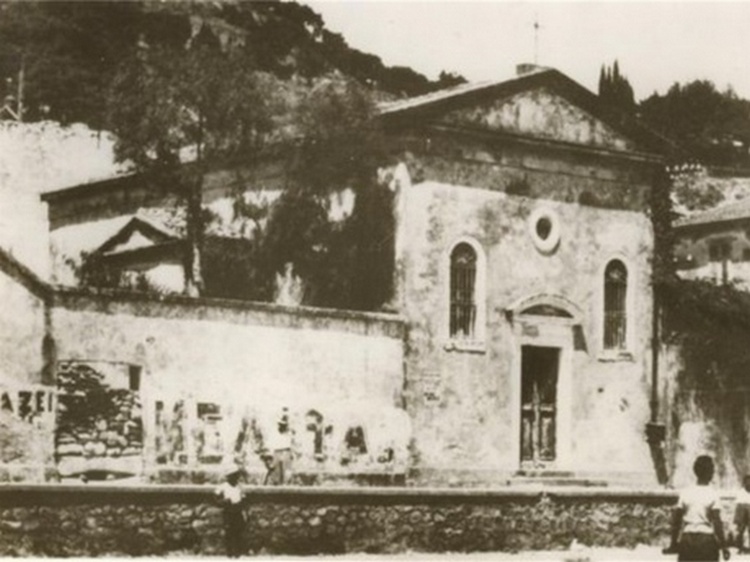
Church of Santa Maria delle Grazie
Click for a larger image
Vesalius’ immense worry and fear of falling ill, when he had not yet showed symptoms, would not point to an abnormal hypochondriac reaction, as alleged, but rather to a normal reaction. In the view of many passengers getting sick, die and being thrown overboard. Vesalius was known to be introvert. [quotation]
5. Burial on Zakynthos.
We know that Vesalius died in Zakynthos and was buried there as his tombstone has been described by several contemperous travellers. The German traveller Christoph Fürer Von Haimendorff visited the island in 1565, just a year after Vesalius’ death, and described Vesalius’ grave in the Franciscan monastery of Santa Maria delle Grazie. Von Haimendorff provided us with the details of the burial inscription. In 1586 the tombstone had disappeared, looted in the Turkish attack of 1571, according to Giovanni Zuallardo (Johannes Schwallart), a compatriot of Vesalius, who visited Zakynthos in 1586.
Conclusion
We conclude that the death from scurvy theory, while not entirely implausible, is not backed up by facts. The symptoms attributed to Andreas Vesalius prior to his death simply do not correspond to scurvy. While his altered mental state and his sudden death are compatible with scurvy, the absence of typical tell-tale signs of scurvy (gingival bleeding, joint pain, ecchymoses,) which were known at the time, would certainly have attracted the attention of Vesalius, one of the most prominent doctors of his era. The two remaining signs -altered mental state and his sudden death- are non-specific and are consistent with many other diseases. We therefore agree with the conclusion recently advanced by three eminent Vesalius experts (M. Biesbrouck, Th. Goddeeris and O. Steeno) that Vesalius died from exhaustion combined by illness [17].
In order to have a definite diagnosis, it will be important to locate the grave of Andreas Vesalius, find the remaining bones and test them for signs of scurvy. X-ray changes to the long bones are typical for scurvy [18] and even in adults one should be able to find signs of osteopenia, pathological fractures or others.
This would provide a definitive diagnosis of scurvy, even 500 years after the death of the great anatomist.
Note: My personal thanks to Theo Dirix and Dr. Rudi Coninx for contributing this article to this blog. The search for the grave of Andreas Vesalius continues on and you can find more information on "The Quest for the Lost Grave" GoFundMe page. Dr. Miranda
Note: Pavlos Plessas has published a counterargument to this article in a separate document entitled "An answer regarding the death of Andreas Vesalius", also found in this blog.
Sources:
1. https://circulatingnow.nlm.nih.gov/2014/10/15/the-death-of-andreas-vesalius/ accessed 27.12.2016
2. Matheson Cullen, G. Vesalius and the inquisition myth. Lancet, January 14, 1928, p 105-6.
3. Dirix Th. In search of Andreas Vesalius. The quest for the lost grave. Lannoo, 2014.
4. https://en.wikipedia.org/wiki/Andreas_Vesalius accessed on January 21, 2016
5. Biesbrouck M, Goddeeris Th, Steeno O. The last months of Andreas Vesalius. A coda. In Vesalius, Acta Internationalia Historiae Medicinae. 2012, 18 (No 2), 70-75.
6. Plessas P. http://www.parathemata.com/2014/09/pavlos-plessas-powerful-indications.html 2014. Accessed January 21, 2016.
7. https://www.clinicalanatomy.com/andreas-vesalius
Aa https://ods.od.nih.gov/factsheets/VitaminC-HealthProfessional/
8. Fain, O. La Revue de Médecine Interne, 2004; vol 25, Issue 12, 872-880.
9. Hodges RE, Hood J, Canham HE, Sauberlich HE, Baker EM. Clinical manifestations of ascorbic acid deficiency in man. Am J Clin Nutr 1971;24:432-43.
x. Hirschman JV, Raugi GJ. Adult scurvy. Journal of American Academy of Dermatology, 1999, 41; No 6, 895-909.
xx. Bartley W, Krebs HA, O’Brien JRP. Vitamin C requirement of human adults. Medical Research Council Special Report Series No 280. London: Her Majesty’s Stationary Office; 1953. P 1-179. Quoted in Hirschmann et al.
xxx Hodges RE, Baker EM, Hood J, Saueberlich HE, March SC. Experimental scurvy in man. American Journal of Clinical Nutrition. 1969;22:535-48.
10. Harrisons Principles of Internal Medicine, 1998; p 484-85
11. Leung FW, Guze PA: Adult scurvy. Annals of Emergency medicine; 1981; 10:652-655
12. Bennet M, Coninx R. The mystery of the wooden leg: vitamin C deficiency in East African prisons. Tropical Doctor, 2005; 35: 81-84.
13. Carpenter K. The history if scurvy and vitamin C.Cambridge University Press 1986, p29.
11. Bown S R. 4he Age of Scurvy. How a surgeon, a mariner and a gentleman helped Britain win the battle of Trafalgar. Summersdale, 2003, p 96-99.
15. Lind J. A treatise of the scurvy. Containing an inquiry into the nature, causes and cure of that disease. Together with a critical and chronological view of what has been published on the subject. Edinburgh: Sands, Murray and Cochran: 1753.
16. Kinsman RA, Hood J: Some behavioural effects of ascorbic acid deficiency. The American Journal of Clinical Nutrition, 1971, 455-464.
17. Biesbrouck M, Goddeeris Th, Steeno O: ‘Post Mortem’ Andreae Vesalii (1514 – 1564). Deel II. Het graf van Andreas Vesalius op Zakynthos. A. Vesalius, nr.4 December 2015. [in Dutch].
18. Bruce M Rothschild. Scurvy imaging. http://emedicine.medscape.com/article/413463-overview