
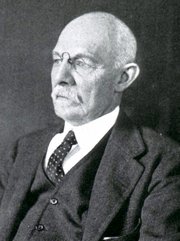



NOTE: In 2014 Pavlos Plessas presented the compelling theory that Andreas Vesalius died in 1564 from scurvy on the island of Zakynthos. With his permission his original article entitled "Powerful indications that Vesalius died from scurvy" was published in this blog in 2016.
His theory was later challenged by Theo Dirix and Dr. Rudi Coninx in this same blog with the article "Did Andreas Vesalius really died from scurvy?". Pavlos Plessas' rebuttal to the latter article is published here from a letter to Theo Dirix.
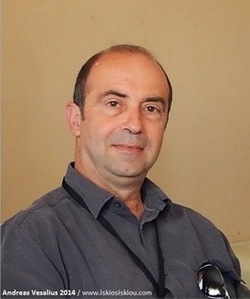
Pavlos Plessas
Click on the image for author information
An answer to Theo (and Rudi) regarding the death of Vesalius
Three years after my 2014 speech at the Vesalius Continuum meeting, where I suggested that scurvy appeared as the only possible explanation to Vesalius’ death, Dr. Rudi Coninx and Theo Dirix published a refutation. Theo is a dear friend and Dr. Coninx has dealt with scorbutic patients in Ethiopia. In addition, Theo is – along with another good friend, Pascale Pollier – the driving force behind the search for Vesalius’ remains. Arguments are always welcome, since they bring us closer to the truth, and are particularly important amongst people with common goals. Here is my reaction.
Quotes have been altered or truncated for brevity.
1. Vesalius must have eaten well in the Holy Land because he was a nobleman
The point I made was that at that time of year there was extreme scarcity of foods containing Vitamin C in that area, not that Vesalius was devoid of means or that he was not well looked after by the monks who hosted him.
2. Vesalius ate the food that protected monks from scurvy
It did not protect them. There is at least one recorded outbreak of scurvy in a Holy Land monastery (1). The circumstances were not unusual so scurvy in those monasteries was probably not uncommon.
3. Scurvy was not uncommon in the area but people were not dying in large numbers
If they had been suddenly forced to migrate en masse, through desert and sea for three months in Vesalius’ footsteps, there would have been a very large number of deaths.
4. Liver and kidneys are also sources of Vitamin C
True, but they are not prime cuts. How many times a month would a nobleman be offered offal? I would say probably none.
5. Forty days at sea is not long enough to develop scurvy. Symptoms appear after 3 months at least
This is true for a previously healthy-eating subject of a study. An 18th century British warship could easily have a dozen dead and another 50 sick in less than 2 months (2) . There are many factors such as activity, infections, temperature, stress, smoking and possibly others, like age, gender, weight and genetic make-up. The most important though is the amount of Vitamin C in the body when the period of deprivation starts. Some historians seem to believe that West European aristocrats would not have fared very well in this field because of their diet. There is an intriguing study by Susan Maclean Kybett that suggests Henry VIII of England, a contemporary of Vesalius, died from scurvy. And he was neither in the Middle East nor at sea. Vesalius had been travelling for seven months prior to his death. Of those, more than two he spent at sea and more than three in arid conditions during the summer. This is how and where he spent the last five months of his life. He could have been affected by scurvy and died even earlier than he did.
6. “Clinical description is typical for scurvy”. This is simply not true
What is not true is that I ever made the above statement. I am not a doctor and I did not make a diagnosis. I presented a theory based on historical research. What I said is that every single thing we know about this case, not only the few symptoms known to us, either points to scurvy or is compatible with scurvy. At the same time no other illness fits the picture. I also made two more observations. First that the sources, which do not name the disease – scurvy had no universally accepted name yet – and do not consciously describe its symptoms, do give a number of causes for it, all of which feature in a list of causes of scurvy in the treatise of Johannes Echtius. Second that the fact Echtius took the trouble to meet Georgius Boucherus – the man who travelled with Vesalius and paid for his burial – and hear for himself the details of what happened is probably not coincidental.
7. Vesalius would have recognized the symptoms of scurvy and described them
We have no description of the disease or its symptoms by Vesalius. There is no reason to believe that Vesalius would have described symptoms of scurvy but not of the plague or of cholera for example. All sources are unfortunately silent on the symptoms. His mental state and his sudden death were only mentioned because they were unusual and impressive events, and in the case of the former also as a factor that contributed to his illness. I am the one who considers them as symptoms of an illness.
Article continued here: An answer regarding the death of Andreas Vesalius (2)
Sources:
1. "Voyages and Travels in the Levant in the Years 1749, 50, 51, 52" London 1766, p. 147
2. "Medicina Nautica: an Essay on the Diseases of Seamen" Volume III, London 1803, p. 387
3. "De magnis Hippocratis" Lienibus Libellus, Antwerp 1564, pp. 26a – 31b
4. A voyage round the world in the years MDCCXL, I, II, III, IV, 5th edition, London 1749, p. 101.
5. Robert A. Kinsman and James Hood, Some behavioral effects of ascorbic acid deficiency, The American Journal of Clinical Nutrition, April 1971.
6. Fiona E. Harrison, Behavioural and neurochemical effects of scurvy in gulo knockout mice, Journal for Maritime Research, Volume 15, Issue 1, 2013.
7. Olivier Fain, Musculoskeletal manifestations of scurvy, Joint Bone Spine 72, 2005.
8. Wang et al, Effects of vitamin C and vitamin D administration on mood and distress in acutely hospitalized patients, the American Journal of Clinical Nutrition, 2013.