



NOTE: In 2014 Pavlos Plessas presented the compelling theory that Andreas Vesalius died in 1564 from scurvy on the island of Zakynthos. With his permission his original article entitled "Powerful indications that Vesalius died from scurvy" was published in this blog in 2016.
His theory was later challenged by Theo Dirix and Dr. Rudi Coninx in this same blog with the article "Did Andreas Vesalius really died from scurvy?". Pavlos Plessas' rebuttal to the latter article is published here from a letter to Theo Dirix.
...continued from: An answer regarding the death of Andreas Vesalius (2). For the initial article, click here.
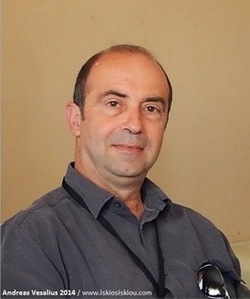
Pavlos Plessas
Click on the image for author information
16. The study’s sample is small, not representative of a general population, based on answering a questionnaire and not observation
Clinical studies of this nature face obvious limitations. If the authors are prepared to disbelieve the testimony of people who lived in a confined space with many victims of scurvy until the final fatal outcome, it is no wonder they complain about the study. Doubting is their prerogative, however, the way to discredit the study is to either find an error in the data or its interpretation, or conduct their own study and come up with different results.
17. The quoted personality changes peak on day 107. Certainly not an early symptom
Do the authors consider a symptom only when it peaks? Is pain not pain until it becomes unbearable?
18. Elevation of this triad is also found in prolonged semi starvation, and deficiencies of B-complex vitamins
The study at this point refers to Brozek and indirectly to the Minnesota Starvation Experiment of 1944-45, meaning semi-starvation over many months. It is clearly not relevant here as Vesalius did not face food shortages for more than a few weeks. As for vitamins of the B complex if the authors are ready to suggest that Vesalius may have died from beriberi or pellagra I am ready and happy to argue.
19. These changes are characteristic of individuals who are physically ill, as the subjects were
Yes, but in the beginning they did not know that they were ill (no clinical signs). Besides, there is another study which indicates that “behavioural change in human scurvy patients has a physiological rather than a solely psychological basis” (6). And there is a suggested biological explanation. “Vitamin C is a cofactor in the biosynthesis of catecholamines, most notably in the conversion of dopamine to norepinephrine, which may explain the behavior and mood disorders associated with vitamin C deficiency” (7). “Acutely hospitalized patients experience emotional distress for many reasons; therefore, it may seem unexpected that simple correction of their vitamin C deficiency could account for such rapid and dramatic improvements in psychological well-being. There are several reasons why this possibility merits serious consideration. First, the result is biologically plausible. Psychological dysfunction is known to occur in vitamin C deficiency, presumably because of the involvement of ascorbate in neuronal transmission and in brain neurotransmitter and fuel metabolism.” (8)
20. Vesalius’ reaction was normal in the view of many passengers getting sick, dying and being thrown overboard
Did all the passengers start begging the crew not to throw their dead bodies overboard? Did Boucherus do it? Why did he then only report Vesalius doing it? Was it normal behaviour for a distressed 16th century aristocrat to beg lowly-born sailors?
21. The only known symptoms of Vesalius are consistent with many other diseases
I think the best way for someone to debunk the scurvy theory is to make a list of diseases that could have killed Vesalius. It appears that the authors do not consider it too great a challenge. But these diseases have to be compatible with the circumstances and the authors will have to do considerably better than the suggestion of food poisoning.
22. Vesalius died from exhaustion combined by illness
All sources agree that Vesalius died from an illness. He had gone through an ordeal, he was probably malnourished and dehydrated to some extent but there is no evidence of exhaustion. He was sick, not tired. He was a passenger on a ship, not a galley slave. The crew, who worked around the clock, were fine. The only exhaustion was that of his reserves of Vitamin C.
23. In order to have a definite diagnosis, it will be important to locate the grave of Andreas Vesalius
Amen. I have one more reason to wish it than most of the many people who wish Theo and Pascale good luck in the search for the grave. I expect to be vindicated. And I hope that maybe my work will contribute in the beyond doubt identification of Vesalius’ remains..
Sources:
1. "Voyages and Travels in the Levant in the Years 1749, 50, 51, 52" London 1766, p. 147
2. "Medicina Nautica: an Essay on the Diseases of Seamen" Volume III, London 1803, p. 387
3. "De magnis Hippocratis" Lienibus Libellus, Antwerp 1564, pp. 26a – 31b
4. A voyage round the world in the years MDCCXL, I, II, III, IV, 5th edition, London 1749, p. 101.
5. Robert A. Kinsman and James Hood, Some behavioral effects of ascorbic acid deficiency, The American Journal of Clinical Nutrition, April 1971.
6. Fiona E. Harrison, Behavioural and neurochemical effects of scurvy in gulo knockout mice, Journal for Maritime Research, Volume 15, Issue 1, 2013.
7. Olivier Fain, Musculoskeletal manifestations of scurvy, Joint Bone Spine 72, 2005.
8. Wang et al, Effects of vitamin C and vitamin D administration on mood and distress in acutely hospitalized patients, the American Journal of Clinical Nutrition, 2013.
PERSONAL NOTE: My thanks to all the authors who are part of this ongoing discussion and who are also friends and contributors to this blog. Everybody is correct in the fact that the only way to find the truth of the cause of death of Andreas Vesalius is to find his grave. The quest is ongoing and hopefully we are closer every day to this objective. Dr. Miranda