
Medical Terminology Daily (MTD) is a blog sponsored by Clinical Anatomy Associates, Inc. as a service to the medical community. We post anatomical, medical or surgical terms, their meaning and usage, as well as biographical notes on anatomists, surgeons, and researchers through the ages. Be warned that some of the images used depict human anatomical specimens.
You are welcome to submit questions and suggestions using our "Contact Us" form. The information on this blog follows the terms on our "Privacy and Security Statement" and cannot be construed as medical guidance or instructions for treatment.
We have 910 guests online
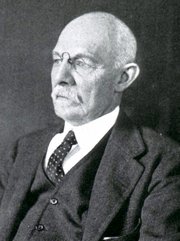
William S. Halsted, MD
(1852 – 1922)
American anatomist, teacher, and surgeon, William Stewart Halsted was born in New York City, USA to a wealthy family of English origin. His father was involved in charitable work and Governor and trustee to a city hospital. Not a brilliant student initially, Halsted took an undergraduate in Liberal Arts in Yale, CT., after which he entered the Medical College of Physicians at the Columbia College, where he excelled.
As a second-year medical student Halsted applied and obtained a position in surgery at a local hospital. In here he learned about Lister’s antiseptic technique and became an adamant proponent of it to reduce infection. In 1877 Halsted obtained his MD. After a short time as House Physician at the New York Hospital, Halsted traveled to Europe to further his education studying for two years at the Universities of Vienna, Leipzig, and W?rzburg.
Besides being at the forefront of surgical and antiseptic techniques (introducing the use of rubber gloves in surgery), Halsted was extremely concerned with the way medical students were taught in the US. He pioneered bedside clinical round discussions with the medical students after two years of basic sciences studies. Halsted developed the idea of a patient chart; he also developed the residency program for medical students in use today.
Halsted is probably the most influential researcher and surgeon at the turn of the century. He dedicated time to the study of intestinal anastomoses and the use of silk as a suture material. His experimental work in 1887 proved that the inclusion of the submucosa layer in an anastomosis was mandatory, as well that a single layered anastomosis was enough to attain closure. Perhaps Halsted’s most important contribution was the application and use of the scientific method to surgical questions. Halsted’s principles, also known as "Halsted's Rules of Surgery", set the standards used today in surgical suturing and surgical stapling.
He also pioneered the development and surgical techniques for radical mastectomy as a treatment for breast cancer.
As a side effect of this studied in anesthesia and the use of cocaine for anesthesia, Halsted became addicted to this substance, a problem that followed him through the years. Without impairing his capacity as a researcher and a surgeon, Halsted eventually recovered. He died in Baltimore in 1922 as a complication to surgery.
Sources:
1. Dubay, A. D., & Franz, G. M. (2003). Acute Wound Healing: The Biology of Acute Wound Failure. Surg Clin NA, 83, 463-481.
2. Halsted, W. S. (1887). Circular Suture of the Intestine - An Experimental Study. Am J Med Sci, 436-461.
3. “William Stewart Halsted: his life and contributions to surgery” Osborne, P. Lancet Oncol 2007; 8: 256–65
4. “William Stewart Halsted: Surgical pioneer” Burress, P Endoc Today (2010), 8: (2) 22
5. “William Stewart Halsted (1852–1922) Neurological stamp” Haas, LF J Neurol Neurosurg Psych 2000;69:641
Original image courtesy of "Images from the History of Medicine" at www.nih.gov

"Clinical Anatomy Associates, Inc., and the contributors of "Medical Terminology Daily" wish to thank all individuals who donate their bodies and tissues for the advancement of education and research”.
Click here for more information


- Details
Respiratory diaphragm
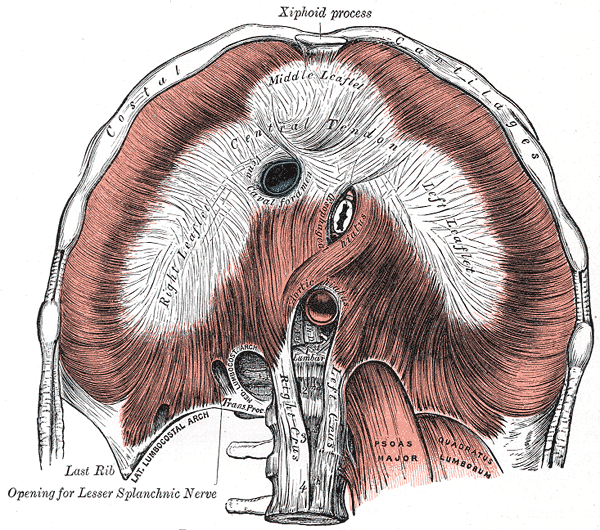
The respiratory diaphragm is a musculotendinous dome-shaped shelf that divides the thoracic cavity from the abdominal cavity. It is one of the four named diaphragms in human anatomy. This is why it is proper to call it the "respiratory diaphragm" instead of just "diaphragm".
The name comes from the Greek, where the prefix [dia-] means "complete" or "through" and [phragm] means "a partition". In Latin, Celsus called it the "septum transversum", meaning "the transverse partition". The root term for [diaphragm] is [-phren-], as in phrenic nerves and cardiacophrenic vessels.
The respiratory diaphragm has a club-shaped central tendon (as in a card suit) which has a large hiatus for the inferior vena cava. The muscular portion is formed by skeletal (voluntary) muscle and descends skirt-like to attach to the internal aspect of the sternum and ribs anterolaterally, and a complex system of lumbocostal tendinous arches posteriorly.
It receives its blood supply through branches of the intercostal arteries, the musculophrenic artery, and the pericardiacophrenic arteries. It is innervated by the phrenic nerves, which descend through the mediastinum in relation to the pericardium.
The respiratory diaphragm has not one, but seven openings (hiatuses) to allow for passageway of many structures:
- Esophageal hiatus
- Aortic hiatus
- Inferior vena cava hiatus
- Hiatuses (2) for the superior epigastric vessels, which are the inferior continuation of the internal thoracic (mammary) vessels. Also known as the hiatuses of Morgagni.
- Hiatuses (2) for the splanchnic nerves
The most common site for an internal abdominothoracic herniation is the esophageal hiatus, but there are other respiratory diaphragm hernias, including the retrosternal hernia of Morgagni (through the superior epigastric hiatus), and the hernia of Bochdalek (a congenital hernia through an incomplete central tendon of the respiratory diaphragm).
Sources:
1 "Tratado de Anatomia Humana" Testut et Latarjet 8 Ed. 1931 Salvat Editores, Spain
2. "Anatomy of the Human Body" Henry Gray 1918. Philadelphia: Lea & Febiger Image modified by CAA, Inc.
Original image by Henry Vandyke Carter, MD., courtesy of bartleby.com
- Details

Jejunoileal vascular supply
The jejunum is an intraperitoneal organ, it is the second portion of the small intestine and part of the digestive tract. It begins at the duodenojejunal junction where it is related to the ligament of Treitz, and extends 8 to 9 feet, continuing distally with the ileum.
Being intraperitoneal, it is anchored to the posterior abdominal wall by the double-layered mesentery through which the jejunum receives its blood and nerve supply. At the root (base) of the mesentery are the superior mesenteric vessels.
The Latin word [jejunis] means "empty" or "fasting". The Latin term [jejunum] was used by the Romans to denote the first meal of the day, breakfast, when you have an "empty" stomach. The term was associated with this segment of the small intestine, as it is most of the time found empty in cadavers being dissected.
There is no clear anatomical boundary between the jejunum and ileum, as they blend smoothly one into the other. There are several gross changes from jejunum to ileum, one of them being that the complexity of the mesenteric arterial arches increases from proximal to distal. See the accompanying image. Click on it for a larger depiction.
Two interesting side notes: In English, the term for the first meal of the day is self-explanatory: [break - fast], adding to the Roman concept of "fasting" or "jejunum". In Spanish, the term for breakfast is [desayuno], where the word [ayuno] means "fasting", therefore the word [des-ayuno] also means "the end of fasting". Look at the evolution (in Spanish) from [jejunum] to [yeyuno] (the Spanish term for the organ) to [ayuno], meaning "fasting" or "empty".
Sources:
1. "The Origin of Medical Terms" Skinner, HA 1970 Hafner Publishing Co.
2. "Clinically Oriented Anatomy" Moore, KL. 3r Ed. Williams & Wilkins 1992
3 "Tratado de Anatomia Humana" Testut et Latarjet 8 Ed. 1931 Salvat Editores, Spain
4. "Anatomy of the Human Body" Henry Gray 1918. Philadelphia: Lea & Febiger Image modified by CAA, Inc.
Original image by Henry Vandyke Carter, MD., courtesy of bartleby.com
- Details

Click for a larger image
The word [crus] is Latin (cruris) and refers to the leg, or region of the shin. It is commonly used to mean "leg" or "pillar". The plural form is [crura].
Several authors suggest a relation of [crus] with another Latin term [crux] meaning "cross" as if a cross is formed by two [crura] (legs).
The term crus is widely used in human anatomy:
- crus cerebri: there are two crus cerebri in the anterior aspect of the mesencephalon
- crura of the penis: the posterior aspect of the corpora cavernosa firmly attached to the ischiopubic rami
- crura of the clitoris: the posterior aspect of the corpora cavernosa firmly attached to the ischiopubic rami
- crura fornix cerebrii: the posterior converging bands that form the fornix of the cerebrum
Special mention is deserved by the crura of the diaphragm. There are two pairs of diaphragmatic crura. The esophageal crura (right and left) which bound the passageway of the esophagus from the thorax into the abdomen, the esophageal hiatus. The esophageal crura have a muscular structure. The aortic crura (righ and left) allow for passage of the aorta into the abdomen, and although muscular superiorly, they are mostly tendinous. The accompanying image shows an anteroinferior view of the respiratory diaphragm. Click on the image for a larger picture.
Sources:
1. "The Origin of Medical Terms" Skinner, HA 1970 Hafner Publishing Co.
2. "Medical Meanings - A Glossary of Word Origins" Haubrich, WD. ACP Philadelphia
3 "Tratado de Anatomia Humana" Testut et Latarjet 8 Ed. 1931 Salvat Editores, Spain
4. "Anatomy of the Human Body" Henry Gray 1918. Philadelphia: Lea & Febiger
Image modified by CAA, Inc. Original image by Henry Vandyke Carter, MD., courtesy of bartleby.com
- Details
This article is part of the series "A Moment in History" where we honor those who have contributed to the growth of medical knowledge in the areas of anatomy, medicine, surgery, and medical research.

Luigi Galvani
Luigi A. Galvani (1737-1798). Italian anatomist, surgeon, and physiologist, Luigi Aloisio Galvani was born in Bologna in 1737. Although he started his studies to join the church, Galvani followed with medical studies at the University of Bologna, where he became a skilled anatomist and surgeon. On July 15, 1759 Galvani obtained his degree in medicine and philosophy.
He was interested in the effects of electricity on tissues and through observation and experimentation he postulated the existence of "animal electricity", that is, electricity generated within the tissues. He postulated the possibility that nerves carried electricity. His theories led to a passionate controversy with Volta, who denied Galvani's postulates. Galvani's theories would only be confirmed after his death.
Galvani was deeply religious, and when forced by government officials to take an oath of atheism, he refused. He was stripped of his position and was lead to poverty. His position was restored close to his death. In his honor, Andre Ampere (1775-1836) named one of his inventions that measures electricity, the "galvanometer". His name is also present in vernacular English, when we say that a rock star or a movie "galvanizes" an audience, meaning it was "electrifying"!
Sources:
1. "Luigi Galvani" Haas LF J Neurol Neurosurg Psychiatry v.56(10); Oct 1993
2. "Luigi Galvani and the foundations of electrophysiology" Cajavilca C, Varonb,J,Sternbachc GL; Resuscitation 80 (2009) 159–162
- Details
Click for a larger image
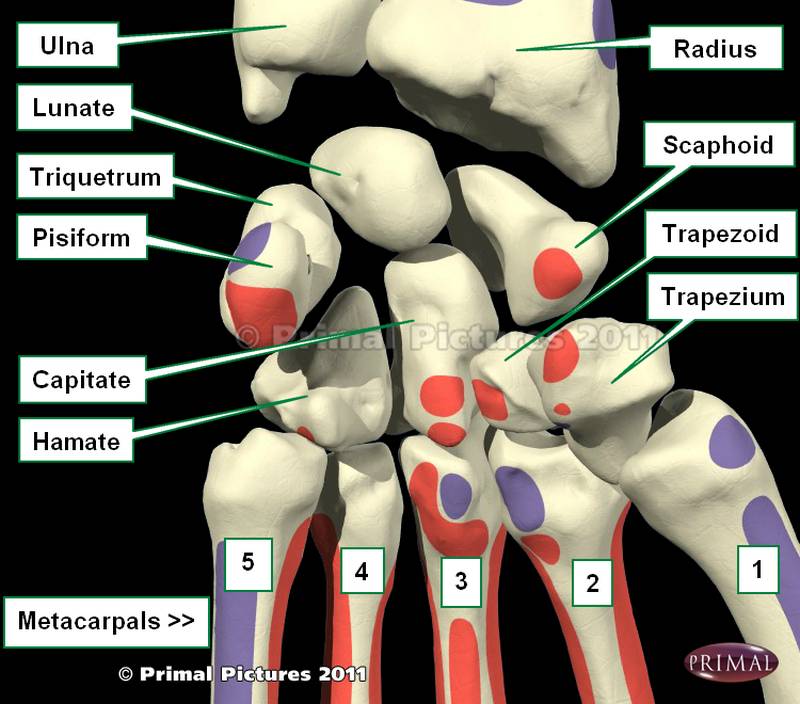
The capitate bone is one of the four bones that comprise the distal row of the carpus or carpal bones that form the wrist. It is the largest of the carpal bones and is placed in the center of the wrist (see image).
Its name originates from the Latin [caput], meaning "head". The capitate bone presents a large, rounded area, called the "head". To complete the homology, the capitate bone also has a narrow segment called the "neck", the rest of the bone called the "body". It is also known as "os capitatum" or "os magnum"
The capitate bone articulates with seven bones, including the scaphoid, lunate, trapezoid, hamate, and the three central metacarpals (2nd, 3rd, and 4th).
The accompanying image shows the anterior (volar) surface of the wrist.
Image modified from the original: 3D Human Anatomy: Regional Edition DVD-ROM" Courtesy of Primal Pictures
- Details
Click for a larger image
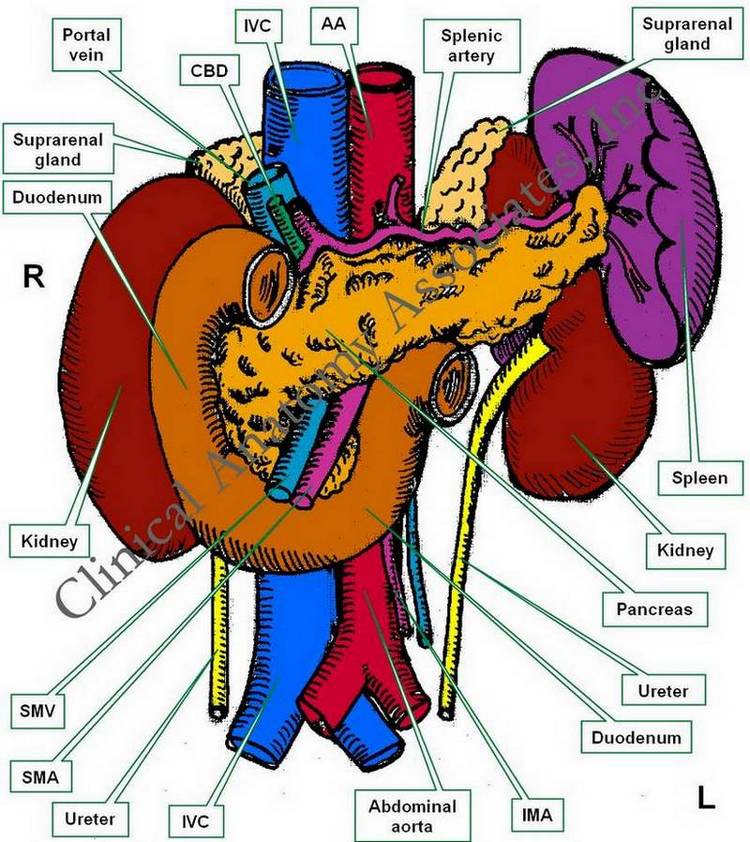
The duodenum is a mostly retroperitoneal organ, part of the digestive tract, and the most proximal portion of the small intestine. This organ is approximately 10 inches in length (24.5 cm). It starts at the pylorus of the stomach, has a "C" shape, curving around the head and the neck of the pancreas, to end at the duodenojejunal junction.
The duodenum is described as having four segments of differing length, usually named numerically:
- First segment: about two inches in length, it is dilated and called the "duodenal ampulla", or "superior duodenum"
- Second segment: about three inches in length, it receives bile and pancreatic juice through the hepatopancreatic ducts and ampullae. It is also called the "descending duodenum"
- Third segment: about four inches in length, it crosses the midline, and is also known as the "horizontal" or "transverse duodenum"
- Fourth segment: one inch in length, this is the shortest segment, it ascends towards the duodenojejunal junction, which is tethered to the diaphragm by a fold of peritoneum around a fibromuscular band called the "ligament of Treitz". At this point the retroperitoneal duodenum becomes the intraperitoneal jejunum. This fourth segment is also called the "ascending duodenum"
The name of the organ is interesting. Most textbooks claim that is originates from the Latin [duodeni], meaning "twelve". The fact is that the duodenum was originally named in Greek [δώδεκα δάχτυλαν] meaning "twelve fingers". If you place both your hands together and add 1/4 of an inch to each side (as if you had an extra finger on each hand) that measures approximately 10 inches. The term was shortened by an incorrect translation to "twelve" by Gerard of Cremona (1114 - 1187) who called it "duodenum", a bad translation, as twelve fingers in Latin is [duodecim digitorum].
While most of the duodenum is retroperitoneal, the first inch of the superior duodenum (first segment) is intraperitoneal as it shares a small portion of the lesser omentum with the stomach and liver.
Sources:
1. "Clinically Oriented Anatomy" Moore, KL. 3r Ed. Williams & Wilkins 1992
2. "The origin of Medical Terms" Skinner, AH, 1970
Image property of: CAA, Inc. Artist: Dr. E. Miranda