
Medical Terminology Daily (MTD) is a blog sponsored by Clinical Anatomy Associates, Inc. as a service to the medical community. We post anatomical, medical or surgical terms, their meaning and usage, as well as biographical notes on anatomists, surgeons, and researchers through the ages. Be warned that some of the images used depict human anatomical specimens.
You are welcome to submit questions and suggestions using our "Contact Us" form. The information on this blog follows the terms on our "Privacy and Security Statement" and cannot be construed as medical guidance or instructions for treatment.
We have 1269 guests online
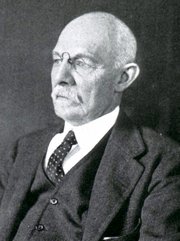
William S. Halsted, MD
(1852 – 1922)
American anatomist, teacher, and surgeon, William Stewart Halsted was born in New York City, USA to a wealthy family of English origin. His father was involved in charitable work and Governor and trustee to a city hospital. Not a brilliant student initially, Halsted took an undergraduate in Liberal Arts in Yale, CT., after which he entered the Medical College of Physicians at the Columbia College, where he excelled.
As a second-year medical student Halsted applied and obtained a position in surgery at a local hospital. In here he learned about Lister’s antiseptic technique and became an adamant proponent of it to reduce infection. In 1877 Halsted obtained his MD. After a short time as House Physician at the New York Hospital, Halsted traveled to Europe to further his education studying for two years at the Universities of Vienna, Leipzig, and W?rzburg.
Besides being at the forefront of surgical and antiseptic techniques (introducing the use of rubber gloves in surgery), Halsted was extremely concerned with the way medical students were taught in the US. He pioneered bedside clinical round discussions with the medical students after two years of basic sciences studies. Halsted developed the idea of a patient chart; he also developed the residency program for medical students in use today.
Halsted is probably the most influential researcher and surgeon at the turn of the century. He dedicated time to the study of intestinal anastomoses and the use of silk as a suture material. His experimental work in 1887 proved that the inclusion of the submucosa layer in an anastomosis was mandatory, as well that a single layered anastomosis was enough to attain closure. Perhaps Halsted’s most important contribution was the application and use of the scientific method to surgical questions. Halsted’s principles, also known as "Halsted's Rules of Surgery", set the standards used today in surgical suturing and surgical stapling.
He also pioneered the development and surgical techniques for radical mastectomy as a treatment for breast cancer.
As a side effect of this studied in anesthesia and the use of cocaine for anesthesia, Halsted became addicted to this substance, a problem that followed him through the years. Without impairing his capacity as a researcher and a surgeon, Halsted eventually recovered. He died in Baltimore in 1922 as a complication to surgery.
Sources:
1. Dubay, A. D., & Franz, G. M. (2003). Acute Wound Healing: The Biology of Acute Wound Failure. Surg Clin NA, 83, 463-481.
2. Halsted, W. S. (1887). Circular Suture of the Intestine - An Experimental Study. Am J Med Sci, 436-461.
3. “William Stewart Halsted: his life and contributions to surgery” Osborne, P. Lancet Oncol 2007; 8: 256–65
4. “William Stewart Halsted: Surgical pioneer” Burress, P Endoc Today (2010), 8: (2) 22
5. “William Stewart Halsted (1852–1922) Neurological stamp” Haas, LF J Neurol Neurosurg Psych 2000;69:641
Original image courtesy of "Images from the History of Medicine" at www.nih.gov

"Clinical Anatomy Associates, Inc., and the contributors of "Medical Terminology Daily" wish to thank all individuals who donate their bodies and tissues for the advancement of education and research”.
Click here for more information


- Details
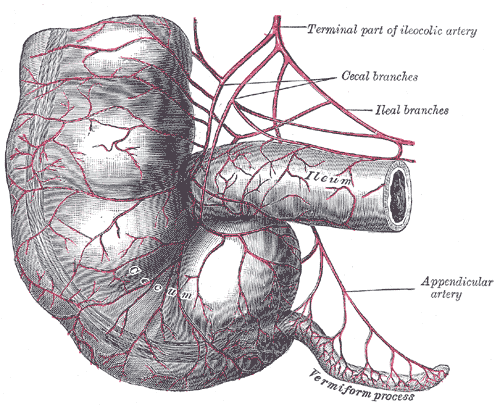
Terminal ileum, cecum,
and vermiform appendix
The word [vermis] is Latin and means "worm". The term [vermiform appendix] means "the worm-shaped appendage", and refers to a worm-like appendage that is related to the cecum, a segment of the right colon.
This structure was first described by Jacobo Berengario da Carpi in 1524, and it was Andreas Vesalius who first described it as an appendix, and suggested it looked like a worm. It has been called the [vermix] and the [cecal appendix]
The vermiform appendix* has the same four layers found in most of the abdominal digestive tract and is attached to the cecum at the point where the three tenia coli (libera, mesenterica, and omentalis) meet. The length of the vermiform appendix is variable. On average about 2.5 to 3 inches, it can be as long as 10 inches in length, with one recorded case of a 13 inch appendix!**
The location of the vermiform appendix is also subject to anatomical variation, being found in a retrocecal position in 65% of the cases. For more information on this organ's anatomical variations, click here.
The vermiform appendix is an intraperitoneal structure, as it has a peritoneal extension called the mesoappendix. Within the mesoappendix are the appendiceal arteries and veins. The appendiceal artery is usually a branch of the ileocolic artery.
Sources:
1. "The Origin of Medical Terms" Skinner, HA 1970 Hafner Publishing Co.
2. "Medical Meanings - A Glossary of Word Origins" Haubrich, WD. ACP Philadelphia
3 "Tratado de Anatomia Humana" Testut et Latarjet 8 Ed. 1931 Salvat Editores, Spain
4. "Anatomy of the Human Body" Henry Gray 1918. Philadelphia: Lea & Febiger Image modified by CAA, Inc. Original image by Henry Vandyke Carter, MD., courtesy of bartleby.com
*. It is not proper to call this structure the "appendix", as there are many appendices in the human body.
**. Personal note: The longest vermiform appendix I have personally seen was 8 inches (20.3 cm) in length, retrocolic, and the tip of the organ was actually retrohepatic!. Dr. Miranda.
- Details
This article is part of the series "A Moment in History" where we honor those who have contributed to the growth of medical knowledge in the areas of anatomy, medicine, surgery, and medical research.
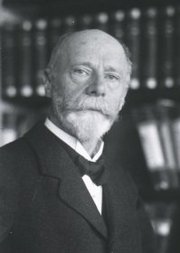
Dr. Willem Einthoven
Dr. Willem Einthoven (1860 - 1927). Einthoven was Dutch, born on 1860 in the city of Semarang in the island of Java. His father was a physician working for the Dutch military. He started his medical studies at the University of Utrecht, Holland. Having developed an interest in ophthalmology and physiology, he developed his medicine doctorate thesis on stereoscopic color vision.
In 1885 Einthoven became a Professor of Physiology at the University of Leiden. Having seen a demonstration of Augustus Waller’s “electrogram” (a device that recorded minute deviations on a mercury column when electrically stimulated) in 1887, he improved it by creating the “string galvanometer”. In 1901 Einthoven published his first recordings of what he called “elektrokardiogramm” (EKG).
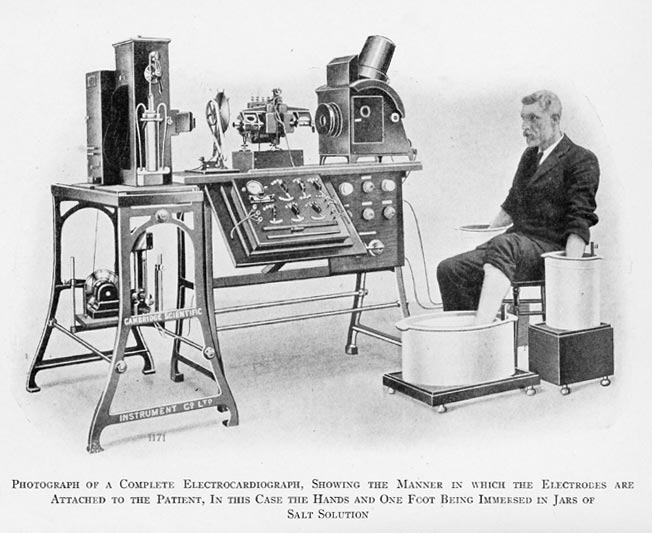
The initial device was bulky, heavy, and required the patient to sit with both arms and the left leg in separate buckets of salt water, but it did record the electrical activity of the heart (Click here for an image of one of the first electrocardiographs). Eventually the device was commercialized and history was made. It was Einthoven who used the letter P,Q,R,S, and T in electrocardiography.
In 1924, Willem Einthoven was awarded the Nobel Prize in Physiology.
Sources:
1. "Willem Einthoven (1860-1927): father of electrocardiography". Merritt, C. Tan. SY. Singapore Med J 53:(1) 17
2. "Willem Einthoven (1860-1927)" Davies, M; Hollman, A. Heart. 1997 October; 78(4): 324
3. "Willem Einthoven: The development of the human electrocardiogram" Cajavilcaa, C.,Varonb, J.Resuscitation 76:3 2008; 325–328
Original image courtesy of "Images from the History of Medicine" at www.nih.gov.
- Details
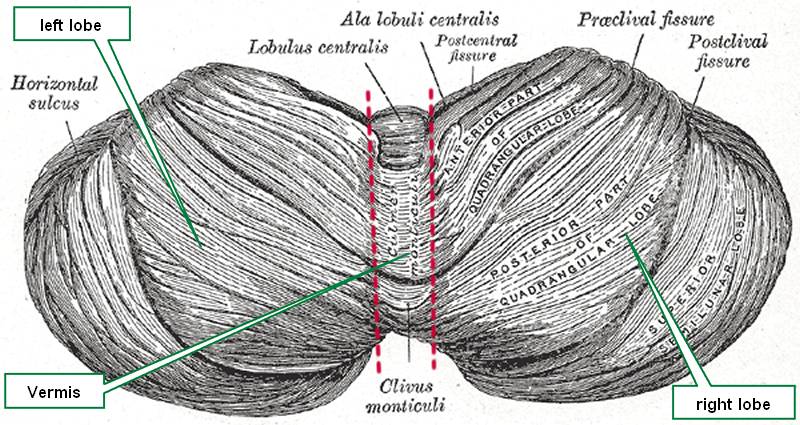
Cerebelum
The word [vermis] is Latin and means "worm".
The vermis is the name given by Galen of Pergamon (129AD - 200AD) to the median lobe of the cerebellum, since when seen from the superior aspect, this cerebellar lobe looks like a multisegmented worm. See accompanying image, or click for a larger depiction.
When seen in a median section, the cerebellar vermis looks like a multilobulated leaf with the fourth ventricle of the brain at its base. It is composed of several smaller lobules: Lingula, central, culmen, clivus, tuber vermis, pyramid, uvula, and nodular lobes.
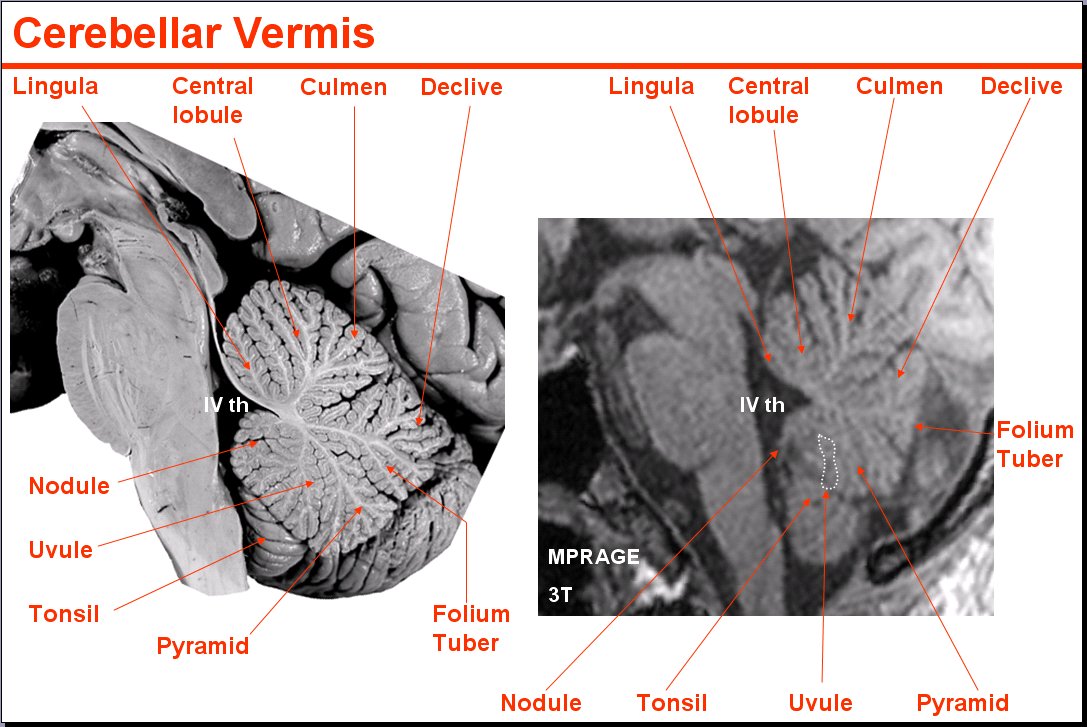
Median section image link courtesy of UCLA Radiology
Sources:
1. "The Origin of Medical Terms" Skinner, HA 1970 Hafner Publishing Co.
2. "Medical Meanings - A Glossary of Word Origins" Haubrich, WD. ACP Philadelphia
3 "Tratado de Anatomia Humana" Testut et Latarjet 8 Ed. 1931 Salvat Editores, Spain
4. "Anatomy of the Human Body" Henry Gray 1918. Philadelphia: Lea & Febiger
Image modified by CAA, Inc. Original image courtesy of bartleby.com
- Details
"Nothing in the human body is colored, or labeled"
Click for a larger image
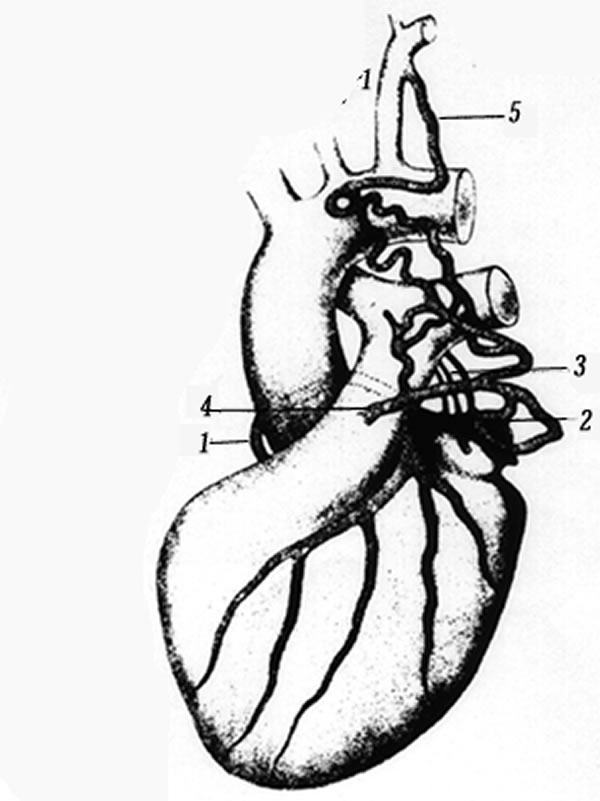
"The Chirurgeon must knowe the Anatomie". Thus states Thomas Vicary (1460 -1561) on the knowledge of Anatomy. He continues: "...for all authors write against those surgeons who work in a man's body not knowing the Anatomie"1. There is no doubt that knowledge must include the awareness of the possibility of anatomical variations. Some anatomical variations, like the "Corona Mortis" can be critical, and in some surgical cases, be the cause for exsanguination!
It is interesting that several medical schools are reducing the total number of hours working on, or moving away from cadaver disection in first year medical school and using computer simulations instead. No computer simulation will give the medical student the detail, variations, and feel of the tissues as actual hands-on experience. I am sure no one wants a surgeon whose first view of the internal aspect of a human body is a living patient...on the surgical table.
It is a fact that "Nothing in the human body is really colored... or labeled" or as someone else said "nothing looks exactly like the anatomy book", unless it is photography, and then each photo is taken after hours of laboring to "Netterize" the organ or area that one is trying to detail. Nothing gives the future professional the exact idea of what to expect in the future patient than the hours and hours of laborious work in the anatomy laboratory.
The same is true with anatomical variations, one "standard" digital cadaver,even with built-in anatomical variations does not give the student the sense of awe and discovery when an anatomical variation is found, interpreted, and analyzed with a group of peers, contributing to the learning process and the formation of future health care professionals.When questioning what is normal or abnormal, Dr. Elizabeth Murray says it most elegantly: "The cadaver is always right"
The image depicts a case of a coronary artery arising from the pulmonary trunk!
Sources:
1. "The Chirurgeon must knowe the Anatomie" R. Shane Tubbs Clin Anat 26:417 (2013)
2. "Two cases of an abnormal coronary artery of the heart arising from the pulmonary artery"Brooks, H; J. Anat. Physiol. 20:26-29, 1886 (anatomyatlases.org)
THIS ARTICLE IS THE THIRD IN A SERIES. TO READ THE FIRST ARTICLE CLICK HERE
- Details
"No anatomical structure has the moral obligation to be where they are supposed to be"
Click for a larger image
Not only may an anatomical structure be absent, such as in the case of renal aplasia or agenesis, or in the case of a non-existent circumflex coronary artery, but sometimes extra structures can be found. Such is the case where a kidney can present two or even three ureters, all functional. Double inferior vena cavae, cervical ribs, lumbar ribs, the list goes on and on!
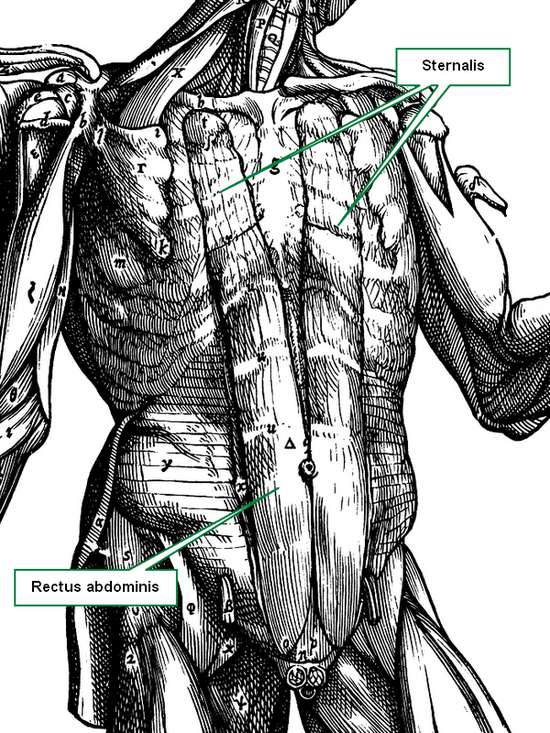
Muscles can be added to this list, again, with absence of a muscle, or with new and completely unexpected attachments. An example of this is the presence of a continuation of the rectus abdominis muscle into the chest region, a variation called a sternalis muscle.
The accompanying image shows the sternalis muscle in one of the "muscle plates" of De Humani Corporis Fabrica Libri Septem, published in 1543 by Andreas Vesalius. This image was criticized by showing a muscle that does not exist, although Vesalius clearly stated in the text of his book that this was an anatomical variation that he had seen.
For many decades surgeons had to operate and "see what they could find". There were the days of the exploratory laparotomy. After the discovery of the application of X-rays by Wilhem Konrad Roentgen (1845 - 1923) and the incredible advances in imaging techniques including CT-scan, MRI, PET, etc, the surgeon is now not usually surprised by anatomical variations.
There are areas in the body that have an high rate of anatomical variation, such as the hepatobiliary region, which includes the "Triangle of Calot". In this area, the standard anatomy is found only in 64% of the cases! In the rest, expect the unexpected. Lahey (1948) states "...the fact that cholecystectomy is a dangerous operation. It is dangerous unless one realizes.... that anomalous anatomy is very common". Today the dangers are less, because of better visualization and technology, but anatomical variations are still there.
Another area where anatomical variations are extremely important is the heart's coronary circulation. Anatomical variations can cause different cardiac dominance. Normal anatomy states that there are two coronary arteries, yet, up to five separate coronary arteries arising directly from the ascending aorta have been described! There is one variation where the left coronary arises from the right coronary artery, effectively having only one artery arise from the aorta and being in charge of all the arterial supply to the heart. What happens if this single artery stenoses? Bear in mind that this is not an "anomalous" vessel, it is just an anatomical variation.
Sources:
1. Lahey DH, discussing the paper "Partial Hepatectomy with Intrahepatic Cholangiojejunostomy" by Wilson H, and Gillespie CE, Ann Surg. 1949 June; 129(6): 756–765
2. "Renal aplasia is the predominant cause of congenital solitary kidneys" Hiraoka, M et al Kidney Int. 2002 May;61(5):1840-4.
This article is the second in a series of three; Click here for the first article.
TO CONTINUE READING: CLICK HERE
- Details
"The only constant in anatomy is variation"

Click for a larger image
This dictum is incredibly powerful and true. Even the so-called "anatomical constants" are subject to it.
One common misconception is that "we are all the same". This could not be further from the truth. Every body is different from every else's body. Anatomical variations range from the minimal to the incredible. One of the most interesting anatomical variations is the one called "situs inversus". In this case the individual is a mirror image of a human. The apex of the heart points to the right side of the body; the duodenum circles to the right, the liver "hangs" from the left side of the respiratory diaphragm, etc. This particular anatomical variation presents in different degrees and can sometimes coexist with some cardiovascular congenital abnormalities.
Of course there are minor anatomical variations that have no effect on daily life at all and are only discovered by accident, or upon autopsy or dissection. One of the most complete resources on this topic is the Illustrated Encyclopedia of Human Anatomic Variations. An excerpt from this site states: "It is clear that textbook writers and teachers over the centuries, even until today, fail to understand or to transmit to their students the crucial concept that anatomical and physiological diversity and variation is a canon of living organisms. This failure leads to the belief that textbooks are conveying immutable facts with only few anomalous exceptions".
Shown here is an extremely rare case of a third kidney. Dixon (1911) describes in his research paper that as of that date, only 10 cases were known, of these only eight were recorded, with 87% of them found on the left side of the body. Click on the image for a larger depiction.
Source and primary image: "Supernumerary kidney: The occurrence of three kidneys in an adult male subject" Dixon, A.F. J. Anat. Physiol. 45:117-121, 1911.
THIS POST IS CONTINUED, CLICK HERE