
Medical Terminology Daily (MTD) is a blog sponsored by Clinical Anatomy Associates, Inc. as a service to the medical community. We post anatomical, medical or surgical terms, their meaning and usage, as well as biographical notes on anatomists, surgeons, and researchers through the ages. Be warned that some of the images used depict human anatomical specimens.
You are welcome to submit questions and suggestions using our "Contact Us" form. The information on this blog follows the terms on our "Privacy and Security Statement" and cannot be construed as medical guidance or instructions for treatment.
We have 896 guests online
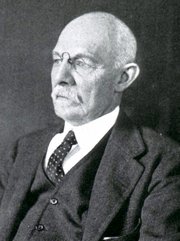
William S. Halsted, MD
(1852 – 1922)
American anatomist, teacher, and surgeon, William Stewart Halsted was born in New York City, USA to a wealthy family of English origin. His father was involved in charitable work and Governor and trustee to a city hospital. Not a brilliant student initially, Halsted took an undergraduate in Liberal Arts in Yale, CT., after which he entered the Medical College of Physicians at the Columbia College, where he excelled.
As a second-year medical student Halsted applied and obtained a position in surgery at a local hospital. In here he learned about Lister’s antiseptic technique and became an adamant proponent of it to reduce infection. In 1877 Halsted obtained his MD. After a short time as House Physician at the New York Hospital, Halsted traveled to Europe to further his education studying for two years at the Universities of Vienna, Leipzig, and W?rzburg.
Besides being at the forefront of surgical and antiseptic techniques (introducing the use of rubber gloves in surgery), Halsted was extremely concerned with the way medical students were taught in the US. He pioneered bedside clinical round discussions with the medical students after two years of basic sciences studies. Halsted developed the idea of a patient chart; he also developed the residency program for medical students in use today.
Halsted is probably the most influential researcher and surgeon at the turn of the century. He dedicated time to the study of intestinal anastomoses and the use of silk as a suture material. His experimental work in 1887 proved that the inclusion of the submucosa layer in an anastomosis was mandatory, as well that a single layered anastomosis was enough to attain closure. Perhaps Halsted’s most important contribution was the application and use of the scientific method to surgical questions. Halsted’s principles, also known as "Halsted's Rules of Surgery", set the standards used today in surgical suturing and surgical stapling.
He also pioneered the development and surgical techniques for radical mastectomy as a treatment for breast cancer.
As a side effect of this studied in anesthesia and the use of cocaine for anesthesia, Halsted became addicted to this substance, a problem that followed him through the years. Without impairing his capacity as a researcher and a surgeon, Halsted eventually recovered. He died in Baltimore in 1922 as a complication to surgery.
Sources:
1. Dubay, A. D., & Franz, G. M. (2003). Acute Wound Healing: The Biology of Acute Wound Failure. Surg Clin NA, 83, 463-481.
2. Halsted, W. S. (1887). Circular Suture of the Intestine - An Experimental Study. Am J Med Sci, 436-461.
3. “William Stewart Halsted: his life and contributions to surgery” Osborne, P. Lancet Oncol 2007; 8: 256–65
4. “William Stewart Halsted: Surgical pioneer” Burress, P Endoc Today (2010), 8: (2) 22
5. “William Stewart Halsted (1852–1922) Neurological stamp” Haas, LF J Neurol Neurosurg Psych 2000;69:641
Original image courtesy of "Images from the History of Medicine" at www.nih.gov

"Clinical Anatomy Associates, Inc., and the contributors of "Medical Terminology Daily" wish to thank all individuals who donate their bodies and tissues for the advancement of education and research”.
Click here for more information


- Details

Click for a larger image
The iliopubic tract is a thickening of the transversalis fascia found in direct relation, immediately posterior to the inguinal (Poupart's) ligament. As the inguinal ligament, the iliopubic tract extends between the anterior superior iliac spine (ASIS) superolaterally, and the pubic tubercle inferomedially.
This obscure structure has been brought up to light because it is one of the anatomical landmarks used in laparoscopic herniorrhaphy. When securing a mesh to reinforce the posterior abdominal wall, and also prevent mesh migration, the surgeon will place sutures, tacks, or staples in this structure. Since the iliopubic tract (posteriorly) and the inguinal ligament (anteriorly) are so close together, they are both secured when doing this procedure.
The image shows the location of the inguinal ligament. The iliopubic tract is immediately posterior to it.
Image property of: CAA, Inc. Artist: David M. Klein
- Details

Left clavicle, superior surface
The clavicle is part of the anterior portion of the shoulder girdle. It is an elongated bone with an "italic S" curvature. The Latin term for clavicle is [clavicula], and it has two root terms: [-clavic-] and [-clav-]. This is why we have the terms [subclavicular], and [subclavian] both meaning the same: "inferior to the clavicle".
The clavicle articulates medially with the manubrium of the sternum (see image on this article) by way of the sternoclavicular joint. This joint contains a meniscus. Laterally, the clavicle articulates with the acromial process or acromium of the scapula.
The clavicle has the muscular insertions of several muscles: sternocleidomastoid, trapezius, pectoralis major, deltoid, subclavius, and sternohyoid.
Sources:
1. "The Origin of Medical Terms" Skinner, HA 1970 Hafner Publishing Co.
2 "Tratado de Anatomia Humana" Testut et Latarjet 8 Ed. 1931 Salvat Editores, Spain
3. "Anatomy of the Human Body" Henry Gray 1918. Philadelphia: Lea & Febiger
Image modified by CAA, Inc. Original image by Henry Vandyke Carter, MD., courtesy of bartleby.com
- Details
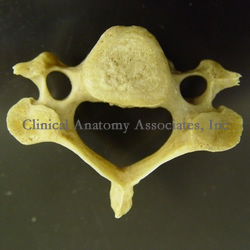
Cervical vertebra, superior view
The term [foramen transversarium] is Latin for "transverse foramen". It refers to bilateral foramina (openings) found lateral to the vertebral body in the cervical vertebrae. These foramina are found only in cervical vertebrae and serve as a good way to identify them.
Through the foramina transversaria (plural form) pass the vertebral artery and vertebral vein. The vertebral artery is one of the first branches to arise off the subclavian arteries. While the vertebral vein passes through all seven foramina transversaria, the vertebral artery does not pass through the foramen transversarium of the seventh cervical vertebra (vertebra prominens).
Image property of:CAA.Inc.Photographer:David M. Klein
- Details
This article is part of the series "A Moment in History" where we honor those who have contributed to the growth of medical knowledge in the areas of anatomy, medicine, surgery, and medical research.

Carl Wernicke
Carl Wernicke (1848-1905). German psychiatrist, neurologist, and neurosurgeon, Carl Wernicke was born in 1848 in the town of Tarnowitz, in what was then Prussia. He studied medicine in Breslau, Poland. In 1817 he became an assistant psychiatrist at a Breslau hospital. Fascinated with the discoveries and publications of Paul Broca on localized brain damage and aphasia, Wernicke left his post for a time to work with Theodor Meynert in Vienna. At that time Meynert was considered an authority in neuropsychiatry. In 1874, soon after his return to Breslau, Wernicke published his ideas and findings in aphasia in a revolutionary publication "The Aphasia Symptom Complex". Wernicke was only 26.
At the time, the general outlook on brain activity was that the brain worked in localized areas. Carl Wernicke's ideas were that although this was true, the functionality of the brain resided in the connections between the different areas of the brain. His ideas were right. Wernicke described what later would be known as "sensory aphasia" or the eponymic "Wernicke's aphasia".
Wernicke was a pioneer in the surgical treatment of hydrocephalus, as well as the surgical treatment of brain abscesses. He published several books, including a brain atlas. Carl Wernicke died as the consequence of a bicycle accident in 1905.
Sources:
1. "Pioneers in Neurology: Carl Wernicke (1848–1905)" Pillmann, F. J Neurol (2003) 250 : 1390–1391
2. "The scientific history of hydrocephalus and its treatment" Aschoff, A.; Ashemi, P.; Kunze, S.Neurosurg Rev (1999) 22:67–93
3. "Aphasia" Marshall,RS; Lazar, RM;PhD, Mohr,JP. Medical Update for Psychiatrists. Elsevier (1998)3;5:132–138
- Details
Click for a larger image
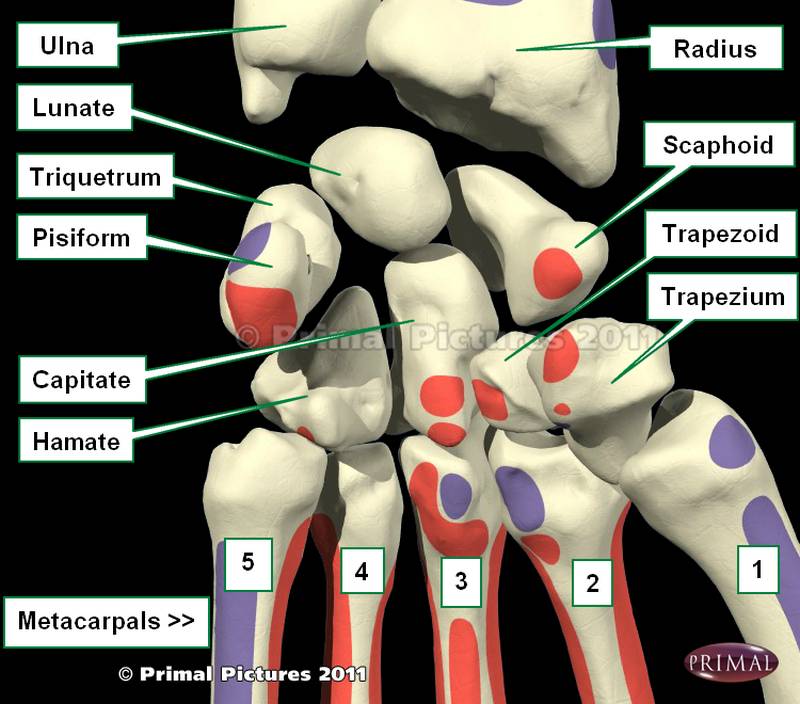
The lunate bone is one of the proximal carpal bones that form the wrist. The name arises from the Latin [luna], meaning "moon". The lunate bone has a deep concavity and crescent-like shape, resembling a crescent moon. This bone is also known as the "semilunar bone" or the os lunatum.
The lunate bone has six surfaces (as a die). It articulates with the scaphoid bone by way of a strong ligament, the scapholunate interosseous ligament. This ligament has several components. Besides the scaphoid bone, the lunate bone articulates with the radius, capitate, hamate, and the triquetrum.
The accompanying image shows the anterior (volar) surface of the wrist. Click on the image for a larger picture.
Image modified from the original: "3D Human Anatomy: Regional Edition DVD-ROM." Courtesy of Primal Pictures
- Details

Click for a larger image
The term [endarterectomy] is composed by the prefix [end-] (sometimes used as [endo]), meaning "inner" or "internal"; the root term [-arter-], meaning "artery", and the suffix [-ectomy] meaning "removal" or "excision".
An endarterectomy is performed to remove atheromatous plaque that is causing arterial stenosis. Although every artery is a candidate for this procedure, carotid endarterectomy is one of the most frequently peripheral vascular procedures performed.
The plaque causing arterial stricture can be the origin of thrombi (in situ blood clots), or emboli (loose blood clots that travel with the flood of blood). These emboli can be the cause of cerebral transient ischemic attacks (TIA's).
In an endarterectomy the objective is to remove the inner layer of the vessel containing the atheroma. This layer is the tunica intima of the vessel. The problem when performing the procedure is to maintain perfusion of the brain which receives much of its blood supply trough the internal carotid artery. The brain also receives blood through the vertebral arteries and the contralateral internal carotid artery. All these vessels are interconnected at the base of the brain by the arterial circle of Willis, named after Thomas Willis (1621 - 1675)
For a YouTube video of the procedure: CLICK HERE (9 minutes)
For an image of the carotid plaque in situ: CLICK HERE

The image shows an anterior view of the right-side carotid system.
Images property of: CAA.Inc. Artist:Dr. E. Miranda