
Medical Terminology Daily (MTD) is a blog sponsored by Clinical Anatomy Associates, Inc. as a service to the medical community. We post anatomical, medical or surgical terms, their meaning and usage, as well as biographical notes on anatomists, surgeons, and researchers through the ages. Be warned that some of the images used depict human anatomical specimens.
You are welcome to submit questions and suggestions using our "Contact Us" form. The information on this blog follows the terms on our "Privacy and Security Statement" and cannot be construed as medical guidance or instructions for treatment.
We have 422 guests online
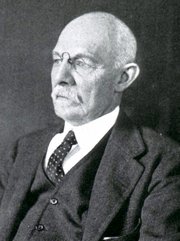
William S. Halsted, MD
(1852 – 1922)
American anatomist, teacher, and surgeon, William Stewart Halsted was born in New York City, USA to a wealthy family of English origin. His father was involved in charitable work and Governor and trustee to a city hospital. Not a brilliant student initially, Halsted took an undergraduate in Liberal Arts in Yale, CT., after which he entered the Medical College of Physicians at the Columbia College, where he excelled.
As a second-year medical student Halsted applied and obtained a position in surgery at a local hospital. In here he learned about Lister’s antiseptic technique and became an adamant proponent of it to reduce infection. In 1877 Halsted obtained his MD. After a short time as House Physician at the New York Hospital, Halsted traveled to Europe to further his education studying for two years at the Universities of Vienna, Leipzig, and W?rzburg.
Besides being at the forefront of surgical and antiseptic techniques (introducing the use of rubber gloves in surgery), Halsted was extremely concerned with the way medical students were taught in the US. He pioneered bedside clinical round discussions with the medical students after two years of basic sciences studies. Halsted developed the idea of a patient chart; he also developed the residency program for medical students in use today.
Halsted is probably the most influential researcher and surgeon at the turn of the century. He dedicated time to the study of intestinal anastomoses and the use of silk as a suture material. His experimental work in 1887 proved that the inclusion of the submucosa layer in an anastomosis was mandatory, as well that a single layered anastomosis was enough to attain closure. Perhaps Halsted’s most important contribution was the application and use of the scientific method to surgical questions. Halsted’s principles, also known as "Halsted's Rules of Surgery", set the standards used today in surgical suturing and surgical stapling.
He also pioneered the development and surgical techniques for radical mastectomy as a treatment for breast cancer.
As a side effect of this studied in anesthesia and the use of cocaine for anesthesia, Halsted became addicted to this substance, a problem that followed him through the years. Without impairing his capacity as a researcher and a surgeon, Halsted eventually recovered. He died in Baltimore in 1922 as a complication to surgery.
Sources:
1. Dubay, A. D., & Franz, G. M. (2003). Acute Wound Healing: The Biology of Acute Wound Failure. Surg Clin NA, 83, 463-481.
2. Halsted, W. S. (1887). Circular Suture of the Intestine - An Experimental Study. Am J Med Sci, 436-461.
3. “William Stewart Halsted: his life and contributions to surgery” Osborne, P. Lancet Oncol 2007; 8: 256–65
4. “William Stewart Halsted: Surgical pioneer” Burress, P Endoc Today (2010), 8: (2) 22
5. “William Stewart Halsted (1852–1922) Neurological stamp” Haas, LF J Neurol Neurosurg Psych 2000;69:641
Original image courtesy of "Images from the History of Medicine" at www.nih.gov

"Clinical Anatomy Associates, Inc., and the contributors of "Medical Terminology Daily" wish to thank all individuals who donate their bodies and tissues for the advancement of education and research”.
Click here for more information


- Details
Click for a larger image
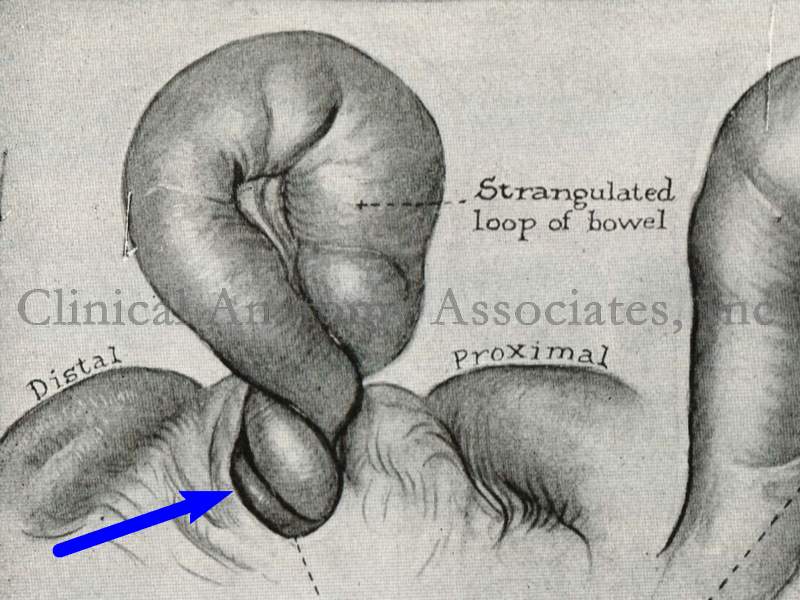
UPDATED: The word [volvulus] arises from the Latin word [volvere], meaning "to twist" or "to roll". It refers to the rolling or twisting of a segment of the gastrointestinal (GI) tract enough to cause stenosis or stricture of the vessels supplying the GI segment. This can lead to ischemia and eventual necrosis or infarction of the organ. A volvulus will also cause blockage of the passage of food through the GI tract. The plural for [volvulus] is [volvuli].
A volvulus can occur anywhere the GI tract is intraperitoneal; that is, it has a mesentery or mesentery-like attachment that renders it mobile and therefore can allow it to twist. Most volvuli occur in the transverse and sigmoid colon, as well as the jejunum and ileum. The etiology of a volvulus is multiple, ranging from peristaltic hypermobility, congenital malrotation pathology of the GI tract, to internal hernias, either congenital or acquired.
In the accompanying image by Thorek (1938), the arrow indicates the location of a mesenteric defect, being the cause for an internal hernia and intestinal torsion or volvulus. For more information and images, you can read this 2011 article by Timpone, V.M. et al. on "Abdominal Twists and Turns: Part I, Gastrointestinal Tract Torsions With Pathologic Correlation"
Article image in the public domain. modified from Thorek, 1938 "Modern Surgical Technique"
- Details
This article is part of the series "A Moment in History" where we honor those who have contributed to the growth of medical knowledge in the areas of anatomy, medicine, surgery, and medical research.
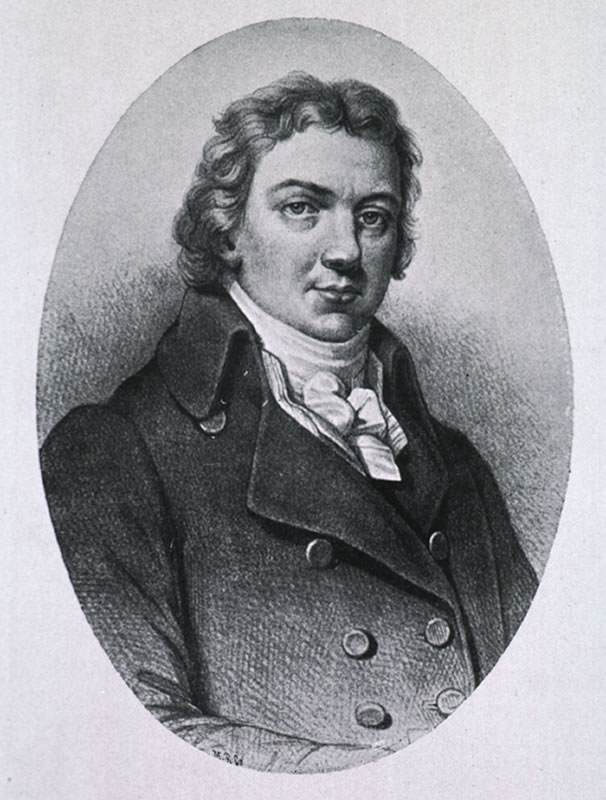
Edward Jenner
Edward Jenner (1749 - 1823). English physician and surgeon, Edward Jenner was born in Berkeley, Gloucestershire. His training included a seven year apprenticeship to a surgeon. He then moved to London where he completed his training at the St. George’s Hospital with John Hunter. Jenner became Hunter’s assistant for anatomical dissection and research. After finishing his studies, he returned to Berkeley.
During Jenner’s time smallpox was a disease with high mortality and terrible complications that could leave a patient blind or scarred for life. Of most interest to him was local lore that related that farmers and milkmaids that contracted cowpox could not contract smallpox, even when in direct exposure to smallpox. Cowpox is a viral infection of cows causing only minor discomfort and complications when acquired by a human.
In 1796 Jenner was visited by Sarah Nelmes, a patient with smallpox-like signs on her hands. Jenner diagnosed cowpox instead of smallpox and discovered that she was a milkmaid. Sensing the need for additional research, he inoculated a young boy by scratching the boy’s skin and then rubbing some of the material exuding from Sarah’s pustules. The boy developed cowpox.
A month and a half later Jenner exposed the boy to smallpox. The boy did not develop any signs or symptoms of smallpox. The new era of vaccination had started.
In spite of his success, the spread of this new technique was slow and not easy, with many detractor and critics. In the end, Jenner was honored for his discovery. In 1980 the World Health Organization formally declared the erradication of smallpox from the world. Individuals are not vaccinated against smallpox anymore and only a few samples of the virus exist in restricted laboratories in the world.
In the pages of “Medical Terminology Daily” we explain why the process is called “vaccination” and also the role that Jenner’s discovery had in the “Royal Philanthropic Vaccination Expedition” to the New World.
Sources:
1. “Edward Jenner and the history of smallpox and vaccination” Riedel, S Proc (Bayl Univ Med Cent). Jan 2005; 18(1): 21–25
2. “Edward Jenner and the eradication of smallpox” Willis NJ Scott Med J. 1997 Aug; 42(4):118-21.
3. "Smallpox; A Great and Terrible Scourge" U.S National Library of Medicine"
Image in the Public Domain. Courtesy of the National Library of Medicine, Digital Collections.
- Details
The medical suffix [-(o)logy] originates from the Greek, although there is discussion as to the real meaning of the term in Ancient Greek. In modern Greek the word [λόγος] (logos) means "reason", while the word [λόγια] (logia) means "words". The fact is that over time the meaning of this suffix has evolved to mean "study of" and has been applied to most of the medical sciences. Some examples are:
- Biology: The study of life
- Histology: The study of tissues
- Anthropology: The study of man
- Physiology: The study of function
- Nephrology: The study of the kidney
- Gynecology: Study of women
Note: The links to Google Translate include an icon that will allow you to hear the Greek or Latin pronunciation of the word.
- Details
The root term [antrhop-] is a derivate from the Greek word [άνθρωπος] (anthropos) meaning "man". [Andr(o)] is a similar root term with the same meaning. Applications of this root term include:
- Anthropoid: The suffix [-oid] originates from the Greek [oeides], meaning "similar to", "like", or "shaped like". Similar to a man
- Anthropogenic: The suffix [-(o)genic] means "pertaining to genesis, creation, or origin”. Something that creates a man
- Anthropologist: The suffix [-(o)logy] means "study of”. The study of man. If you are interested in forensic anthropology, click here for the Facebook page of my good friend Dr. Elizabeth Murray, PhD, DAFBA.
- Anthropometric: The suffix [-(o)metric] means "measurement”. The measurements of man. An example of this are the anthropometric studies of Peter Paul Broca (1824 - 1880) who named many of the craniometric points in the human skull
Note: The links to Google Translate include an icon that will allow you to hear the Greek or Latin pronunciation of the word.
- Details
Open letter to friends and colleagues:
I started "Medical Terminology Daily" in October 2012, hosted at my own website, which has been online since 1998. The objective of "Medical Terminology Daily" is to be a service to the medical community, medical students, medical industry, and public in general. We post a workweek daily medical, anatomical, or surgical term, its meaning and usage, as well as biographical notes on anatomists, surgeons, and researchers through the ages. This last content stays for a week on the sidebar called "A Moment in History" and after a week, it is published as a main body article.
Each week we send a newsletter with a week's worth of articles to those who have subscribed. An example of the newsletter can be seen here.
Initially, I thought this site to be mostly about Clinical Anatomy and Medical Terminology, but the trends of the requests and conversations have created articles on Histology, Pathology, Surgical Procedures and Techniques, History of Surgery, etc. This has taxed me and the few contributors we have.
After almost two years the traffic is very good and now I am looking to expand the group of contributors to the site. I could not do it before because we lacked a good submission system for the articles. We are now in the final beta testing stage for the submission system.
We are looking to add ten new contributors to the website from different venues in Medical Sciences, including physicians, surgeons, anatomists, and university professors in Basic Medical Sciences. Preferably, all contributors should have graduate and postgraduate studies. Although we do appreciate the interest of students and the public in general, we want to maintain a very high level of professionalism and credibility. If you yourself cannot be a contributor, you may know someone who would qualify. Feel free to forward this letter as needed by clicking on the envelope icon at the top of this article.
I am sure that everybody is busy, but even small contributions are most welcome. Contributors can use the material in this website for their own teaching purposes: all we ask is proper credit where it is due.
If you want to consider participating, first please look at the footer of the "Medical Terminology Daily" website. at In this footer are the links to the pages that we offer our contributors as well as the guidelines for publication, and the link to access the backend of the website and write an article directly.
Each contributor can do as much or as little as they want, and we offer a page so that you can post a biography, or links to your website. We have one contributor (not listed yet) that is planning to present this website to his students and have them work on article ideas, so they learn to research as well as to write properly. His plan is to select the three best articles in his class and submit them for publication. The publication of the article with recognition to the author will be another item on the student's CV!
If you want to apply as a contributor, please send a message using the "Contact Us" page in this website with information on your studies, place of work, and how to contact you back. I promise to answer all of the requests. Those who are accepted as contributors will receive their login information as well as a manual to manage the back end of the website.
Your consideration is most appreciated
Sincerely,
- Details
The suffix [-emia] is a derivate from the Greek word [αίμα] (ema) meaning "blood". The same word and meaning applies to the root terms [-hem-] and [-hemat-]. In the case of the suffix [-emia] there is the connotation of a "condition related to the blood". Applications of this suffix include:
- Hyperemia: The prefix [hyper-] means "over", "above" or "excessive". Refers to a condition where there is too much blood flow to an area of the body
- Anemia: The prefix [a-] means "absence"or "without". Refers to a condition where there are dangerous levels of blood in a patient
- Polycythemia: The prefix [poly-] means "many".The root term [-cyt-] means "cell", and the suffix [-emia] means "blood". Many cells in the blood, the opposite of "anemia"
- Hypoglycemia: The prefix [hypo-] means "under", "deficient" or "below".The root term [-glyc-] means "sugar". Low levels of blood sugars
- Hypercholesterolemia: The prefix [hyper-] means "over", "above" or "excessive". The root term [-cholesterol-] is self-explanatory. High levels of cholesterol in the blood
Note: The links to Google Translate include an icon that will allow you to hear the Greek or Latin pronunciation of the word.