
Medical Terminology Daily (MTD) is a blog sponsored by Clinical Anatomy Associates, Inc. as a service to the medical community. We post anatomical, medical or surgical terms, their meaning and usage, as well as biographical notes on anatomists, surgeons, and researchers through the ages. Be warned that some of the images used depict human anatomical specimens.
You are welcome to submit questions and suggestions using our "Contact Us" form. The information on this blog follows the terms on our "Privacy and Security Statement" and cannot be construed as medical guidance or instructions for treatment.
We have 1052 guests online
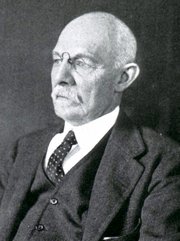
William S. Halsted, MD
(1852 – 1922)
American anatomist, teacher, and surgeon, William Stewart Halsted was born in New York City, USA to a wealthy family of English origin. His father was involved in charitable work and Governor and trustee to a city hospital. Not a brilliant student initially, Halsted took an undergraduate in Liberal Arts in Yale, CT., after which he entered the Medical College of Physicians at the Columbia College, where he excelled.
As a second-year medical student Halsted applied and obtained a position in surgery at a local hospital. In here he learned about Lister’s antiseptic technique and became an adamant proponent of it to reduce infection. In 1877 Halsted obtained his MD. After a short time as House Physician at the New York Hospital, Halsted traveled to Europe to further his education studying for two years at the Universities of Vienna, Leipzig, and W?rzburg.
Besides being at the forefront of surgical and antiseptic techniques (introducing the use of rubber gloves in surgery), Halsted was extremely concerned with the way medical students were taught in the US. He pioneered bedside clinical round discussions with the medical students after two years of basic sciences studies. Halsted developed the idea of a patient chart; he also developed the residency program for medical students in use today.
Halsted is probably the most influential researcher and surgeon at the turn of the century. He dedicated time to the study of intestinal anastomoses and the use of silk as a suture material. His experimental work in 1887 proved that the inclusion of the submucosa layer in an anastomosis was mandatory, as well that a single layered anastomosis was enough to attain closure. Perhaps Halsted’s most important contribution was the application and use of the scientific method to surgical questions. Halsted’s principles, also known as "Halsted's Rules of Surgery", set the standards used today in surgical suturing and surgical stapling.
He also pioneered the development and surgical techniques for radical mastectomy as a treatment for breast cancer.
As a side effect of this studied in anesthesia and the use of cocaine for anesthesia, Halsted became addicted to this substance, a problem that followed him through the years. Without impairing his capacity as a researcher and a surgeon, Halsted eventually recovered. He died in Baltimore in 1922 as a complication to surgery.
Sources:
1. Dubay, A. D., & Franz, G. M. (2003). Acute Wound Healing: The Biology of Acute Wound Failure. Surg Clin NA, 83, 463-481.
2. Halsted, W. S. (1887). Circular Suture of the Intestine - An Experimental Study. Am J Med Sci, 436-461.
3. “William Stewart Halsted: his life and contributions to surgery” Osborne, P. Lancet Oncol 2007; 8: 256–65
4. “William Stewart Halsted: Surgical pioneer” Burress, P Endoc Today (2010), 8: (2) 22
5. “William Stewart Halsted (1852–1922) Neurological stamp” Haas, LF J Neurol Neurosurg Psych 2000;69:641
Original image courtesy of "Images from the History of Medicine" at www.nih.gov

"Clinical Anatomy Associates, Inc., and the contributors of "Medical Terminology Daily" wish to thank all individuals who donate their bodies and tissues for the advancement of education and research”.
Click here for more information


- Details

Click for a larger image
The pulmonary trunk is one of the great vessels of the heart. It is an artery that takes deoxygenated blood to the lungs as part of pulmonary circulation.
It starts proximally at the pulmonary semilunar valve. This valve is situated at superior end of the outflow tract of the right ventricle, an area called the conus arteriosus.
The pulmonary trunk has relation with the aorta on its right side, the left auricle and the left main coronary artery posteriorly. The pulmonary trunk is a short vessel, usually less than one centimeter in length. Most of the pulmonary trunk is found inside the pericardium. Almost immediately after it exits the pericardium it divides into a left and a right pulmonary artery, each one delivering deoxygenated blood to a lung.
It is a common misconception to call this vessel the "pulmonary artery". This is not correct, as the pulmonary arteries are the left and the right pulmonary arteries.
Sources:
1. "Tratado de Anatomia Humana" Testut et Latarjet 8 Ed. 1931 Salvat Editores, Spain
2. "Gray's Anatomy" 38th British Ed. Churchill Livingstone 199
Image modified from the original by Henry VanDyke Carter, MD. Gray's Anatomy.
- Details
Click for a larger image
The superior vena cava (SVC) is one of the great vessels, a large vein that receives the venous return from the upper portion of the body, including the head and neck, upper extremities, and chest, with some venous return from the posterior aspect of the abdomen. The exception is the venous return of the heart which comes back by way of the coronary veins and coronary sinus.
The SVC originates at the junction of the left brachiocephalic vein with the right brachiocephalic vein. Its origin is described at the lower border of the first rib. The SVC ends at the cavoatrial junction, where it empties into the right atrium of the heart. It is here at the cavoatrial junction that anatomists describe a small horseshoe-shaped structure, the sinoatrial node or SA node, part of the conduction system of the heart.
The length of the SVC is between 6 to 8 cm. There are many anatomical variations of the superior vena cava, as described here.
The arch of the azygos vein empties into the posterior aspect of the SVC. The arch of the azygos vein receives the venous return of the azygos and hemiazygos venous systems, including the venous return of the posterior intercostal veins, and the ascending lumbar veins.
Sources:
1. "Tratado de Anatomia Humana" Testut et Latarjet 8 Ed. 1931 Salvat Editores, Spain
2. "Gray's Anatomy" 38th British Ed. Churchill Livingstone 1995
Image modified from the original by Henry VanDyke Carter, MD. Gray's Anatomy.
- Details
This article is part of the series "A Moment in History" where we honor those who have contributed to the growth of medical knowledge in the areas of anatomy, medicine, surgery, and medical research.
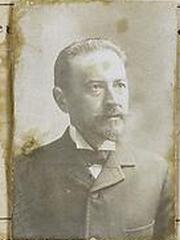
Juan Vucetich (1858–1925)
Personal note: When working on the root term [-dactyl-] I came upon the biography of Juan Vucetich, the individual who created the modern method of dactyloscopy. Even though not a physician or anatomist, his life and accomplishments deserve to be presented here. Dr. Miranda.
Juan Vucetich (1858–1925) Juan Vucetich was born Ivan Vučetić in Croatia. In 1882, at 24 years of age he immigrated to Argentina, where he adopted the Spanish translation of his Croatian name. Because of his literacy (I have found no information on his actual studies), he started to work at the Argentinian Sanitary Works until he transferred to the Police Department Office of Identification and Statistics.
Vucetich was placed in charge of the anthropometric method used at the time to identify criminals based on bodily measurements. After reading an article in a French journal on Francis Galton's experiments with fingerprints as a means of identification, Vucetich began collecting fingerprints, taken from arrested men, while also making Bertillon-style anthropometric measurements. Galton's initial study proposed 40 parameters to classify fingerprints, but no system to collect or identify and individual using only this method.
He soon devised a useable system to group and classify fingerprints, which he called "Ichnophalangometrics" (description of phalangeal measurements). Thankfully, that name was later changed to dactyloscopy
Vucetich demonstrated the utility of fingerprint evidence in an 1892 case, which resulted in the identification and conviction of a suspect for first-degree murder. Shortly after that, he dismissed entirely the Bertillon anthropometric system, arguing that a full ten-finger set of fingerprints was sufficient for identification, and that complicated anthropometric measurements were unnecessary.
In 1900, the Argentine Republic began issuing a kind of internal passport which included fingerprints—a practice that was eventually adopted by many other countries. The 1904 publication of "Dactiloscopía Comparada", Vucetich's definitive work on fingerprint identification, and his travels to other countries, helped to spread his system throughout the world. Today, the Argentinian Police Academy is named after Juan Vucetich
Sources:
1. "Juan Vucetich and the origins of forensic fingerprinting". Visible Proofs. National Library of Medicine
2. Vucetich, Juan. Dactiloscopia comparada: El nuevo sistema argentino. Tip. Jacobo Peuser, 1904
- Details
The prefix [semi-] originates from the Latin [semis] meaning "half". Applications of this prefix include:
- Semicomatose: Not completely in a coma, half in, half out
- Semimembranous: The name of a muscle that is half membranous (tendinous), half muscle
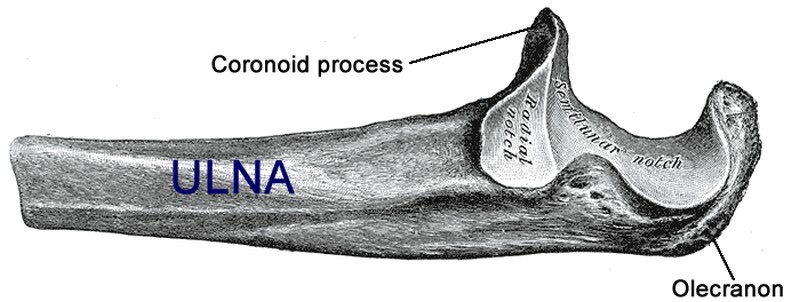
- Semilunar: With the shape of a half-moon, as the semilunar area of the olecranon
- Semicartilaginous: Half formed by cartilage
- Details
The [olecranon] is the bony prominence of the elbow, that what some call "the funny bone". It is hook-shaped and has a semilunar (half-moon shaped) area which forms part of the elbow joint, articulating with the trochlea of the humerus.
Covered by a bursa, the olecranon receives the distal attachments of the triceps brachii muscle and the anconeous muscle.
Click for a larger image
The word [olecranon] originates from the mixing of two Greek words [ωλένη] (oleni) meaning "ulna" and the word [κρανίοmeaning "head", or "cranium". Literally, "the head of the ulna"
Note: The links to Google Translate in these articles include an icon that will allow you to hear the Greek or Latin pronunciation of the word.
- Details
The root term [-galact-] originates from the Greek [γάλα] (gala) meaning "milk". The use of this Greek word can be seen in the word [galaxy] initially used to refer to the Milky Way, our own galaxy. Applications of this include:
- Galactorrhea: The suffix [-(o)rrhea] means "flow" or "discharge". A discharge of milk
- Galactocyte: The suffix [-(o)cyte] means "cell". A milk-producing cell
- Galactophorous: A conduit or tube that carries milk
- Galactophoritis: An inflammation or infection of a conduit or tube that carries milk
- Galactopoiesis: The suffix [-(o)poieisis] means "to make", "action", "process". or "performance.. Refers to the process that creates milk
Note: The links to Google Translate include an icon that will allow you to hear the Greek or Latin pronunciation of the word.