
Medical Terminology Daily (MTD) is a blog sponsored by Clinical Anatomy Associates, Inc. as a service to the medical community. We post anatomical, medical or surgical terms, their meaning and usage, as well as biographical notes on anatomists, surgeons, and researchers through the ages. Be warned that some of the images used depict human anatomical specimens.
You are welcome to submit questions and suggestions using our "Contact Us" form. The information on this blog follows the terms on our "Privacy and Security Statement" and cannot be construed as medical guidance or instructions for treatment.
We have 792 guests online
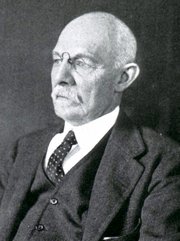
William S. Halsted, MD
(1852 – 1922)
American anatomist, teacher, and surgeon, William Stewart Halsted was born in New York City, USA to a wealthy family of English origin. His father was involved in charitable work and Governor and trustee to a city hospital. Not a brilliant student initially, Halsted took an undergraduate in Liberal Arts in Yale, CT., after which he entered the Medical College of Physicians at the Columbia College, where he excelled.
As a second-year medical student Halsted applied and obtained a position in surgery at a local hospital. In here he learned about Lister’s antiseptic technique and became an adamant proponent of it to reduce infection. In 1877 Halsted obtained his MD. After a short time as House Physician at the New York Hospital, Halsted traveled to Europe to further his education studying for two years at the Universities of Vienna, Leipzig, and W?rzburg.
Besides being at the forefront of surgical and antiseptic techniques (introducing the use of rubber gloves in surgery), Halsted was extremely concerned with the way medical students were taught in the US. He pioneered bedside clinical round discussions with the medical students after two years of basic sciences studies. Halsted developed the idea of a patient chart; he also developed the residency program for medical students in use today.
Halsted is probably the most influential researcher and surgeon at the turn of the century. He dedicated time to the study of intestinal anastomoses and the use of silk as a suture material. His experimental work in 1887 proved that the inclusion of the submucosa layer in an anastomosis was mandatory, as well that a single layered anastomosis was enough to attain closure. Perhaps Halsted’s most important contribution was the application and use of the scientific method to surgical questions. Halsted’s principles, also known as "Halsted's Rules of Surgery", set the standards used today in surgical suturing and surgical stapling.
He also pioneered the development and surgical techniques for radical mastectomy as a treatment for breast cancer.
As a side effect of this studied in anesthesia and the use of cocaine for anesthesia, Halsted became addicted to this substance, a problem that followed him through the years. Without impairing his capacity as a researcher and a surgeon, Halsted eventually recovered. He died in Baltimore in 1922 as a complication to surgery.
Sources:
1. Dubay, A. D., & Franz, G. M. (2003). Acute Wound Healing: The Biology of Acute Wound Failure. Surg Clin NA, 83, 463-481.
2. Halsted, W. S. (1887). Circular Suture of the Intestine - An Experimental Study. Am J Med Sci, 436-461.
3. “William Stewart Halsted: his life and contributions to surgery” Osborne, P. Lancet Oncol 2007; 8: 256–65
4. “William Stewart Halsted: Surgical pioneer” Burress, P Endoc Today (2010), 8: (2) 22
5. “William Stewart Halsted (1852–1922) Neurological stamp” Haas, LF J Neurol Neurosurg Psych 2000;69:641
Original image courtesy of "Images from the History of Medicine" at www.nih.gov

"Clinical Anatomy Associates, Inc., and the contributors of "Medical Terminology Daily" wish to thank all individuals who donate their bodies and tissues for the advancement of education and research”.
Click here for more information


- Details
The term [volar] is used in human anatomy and orthopedics to denote either the palm of the hand or the sole of the feet. The volar surface of the hand is the anterior aspect or palm, whereas the volar surface of the feet is the inferior aspect or sole of the foot. How we came to use this word as such is a strange trip through the evolution and use of words.
The word [volar] originates from the Latin[vola] meaning "to fly". If you look online the definition of many for [volar] is "The hollow of the palms of the hands and soles of the feet". Very far from "to fly". The word was first used for the palms of the hands when mimicking a a flying bird. The hollow of the hands forces the air, hence [vola]. In fact, in Spanish the word for "to fly" is "volar" and in Italian, "volare". The term [volar] was then used by extension for the soles of the feet.
The term to refer to the palms of the hands and soles of the feet is in disuse except in orthopedics and can be found in some anatomy books. Overtime the word has been changed to [palmar] in the hand, and to [plantar] in the feet. This is why we have a muscle called the "palmaris longus" and we talk about the "plantar fascia".
Note: The links to Google Translate in these articles include an icon that will allow you to hear the Greek or Latin pronunciation of the word.
- Details
The word [phalanx] originates from the Greek [φάλαγγα] referring to a group of soldiers aligned in groups and in rows, as in a formation for battle. The plural form for this word is phalanges.
The Greek phalanx was a closed rank formation with interlocking shields and long spears between the shields. The phalanx was considered in its time one of the most effective formations for battle.
Aristotle thought that the bones that form the fingers resembled rows of aligned soldiers and gave this name to the bones that form the fingers.
Note: The links to Google Translate in these articles include an icon that will allow you to hear the Greek or Latin pronunciation of the word.
- Details
The root term [-andr(o)-] originates from the Greek [άνδρας] meaning "man". Applications of this root term include:
- Androgenic: The suffix [-(o)genic] means "pertaining to genesis, creation, or origin”. Something that creates a man
- Android: The suffix [-oid] originates from the Greek [oeides], meaning "similar to", "like", or "shaped like". Similar to a man
- Androgynous: root term [-gyn(o)-] originates from the Greek [γυναίκα] (gyneka) meaning "woman". The term refers to an individual that shows traits of both man and woman.
Note: The links to Google Translate in these articles include an icon that will allow you to hear the Greek or Latin pronunciation of the word.
- Details
The suffix [-emesis] originates from the Greek [εμετό] meaning "to vomit", to "throw up", or "spew". This suffix can be used as a stand-alone word. Applications of this suffix include:
- Hematemesis: Vomiting blood
- Hyperemesis: The prefix [hyper-] means "excessive". Excessive vomiting
- Hyperemesis gravidarum: A case of hyperemesis in the early stages of pregnancy
Note: The links to Google Translate in these articles include an icon that will allow you to hear the Greek or Latin pronunciation of the word.
- Details
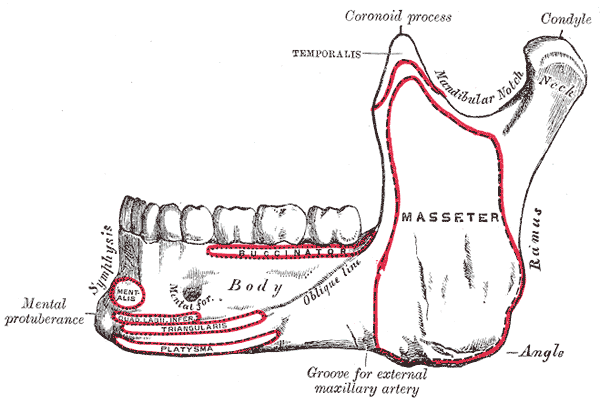
Lateral view of the mandible
The word [mandible] has a Latin origin in the word [mandibula] which itself arises from the Latin word [mandere] meaning "to chew", and refers to the bony lower jaw (see accompanying image).
This term has been in use for a short time. Originally the term "maxilla" was used both the upper and lower jaw, naming one the "upper maxilla" and the other the "lower maxilla". Today the bony portion of the upper jaw is simply named "maxilla" while the bony portion of the lower jaw is called the "mandible".
Note: This article only deals with the etymology of the word "mandible". The anatomical description of the mandibular bone will be presented in a later article.
Source:
1. "Anatomy of the Human Body" Henry Gray 1918. Philadelphia: Lea & Febiger
Original image public domain by Henry VanDyke Carter, MD.
- Details
This article is part of the series "A Moment in History" where we honor those who have contributed to the growth of medical knowledge in the areas of anatomy, medicine, surgery, and medical research.
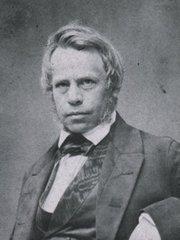
Friedrich Gustav Jakob Henle
Friedrich Gustav Jakob Henle (1809 -1885) German physician, anatomist, histologist, and physiologist. Born in the city F?rth, Henle entered the University of Bonn and studied anatomy with Johannes Muller (1801 – 1859), a professor of anatomy and histology. Henle dedicated his efforts to scientific research, and became the managing editor of the journal “Archives of Anatomy, Physiology, and Scientific Medicine” founded by Muller.
Henle’s career in Berlin suffered after he was arrested for 40 days in jail, because of his past membership in a radical liberal and nationalistic student fraternity, the Burschenschaften. He transferred from Berlin to Zürich where he founded the School of Rational Medicine.
Among his publications, the “Allgemeine Anatomie “(1841) is considered the first treatise on microscopic histology. Also, his book “Handbuch der systematischen Anatomie des Menschen” (Handbook of Human Systematic Anatomy) is a great anatomy book with good illustrations.
Henle moved from Zürich to Heidelberg, and from there to Gôttingen, where he accepted the position of Professor of Anatomy. He stayed at Gôttingen until his death in 1885.
Henle’s many remembered contributions are mostly in the area of histology. His name is found in many eponyms. The eponym most associated with his name is “Henle’s loop”, part of the tubular component of a nephron.
- Crypts of Henle: Microscopic pockets located in the conjunctiva of the eye
- Henle's fissure: Fibrous tissue between the cardiac muscle fibers.
- Henle's ampulla: Ampulla of the uterine (Fallopian) tube
- Henle's layer: Outer layer of cells of root sheath of a hair follicle.
- Henle's ligament (tendon): Tendon of the transversus abdominis muscle.
- Henle's membrane: The layer forming the inner boundary of the choroid of the eye
Sources:
1. "The Origin of Medical Terms" Skinner, HA 1970 Hafner Publishing Co.
2. “The Man Behind the Eponym Jacob Henle: Henle’s Layer of the Internal Root Sheath” Steffen C. Am J Dermatopath (2001) 23(6): 549–551
3. “The life of Jacob Henle” Robinson A Medical Life Co. 1921.
Original image in the public domain. Courtesy of Wikipedia.