
Medical Terminology Daily (MTD) is a blog sponsored by Clinical Anatomy Associates, Inc. as a service to the medical community. We post anatomical, medical or surgical terms, their meaning and usage, as well as biographical notes on anatomists, surgeons, and researchers through the ages. Be warned that some of the images used depict human anatomical specimens.
You are welcome to submit questions and suggestions using our "Contact Us" form. The information on this blog follows the terms on our "Privacy and Security Statement" and cannot be construed as medical guidance or instructions for treatment.
We have 786 guests online
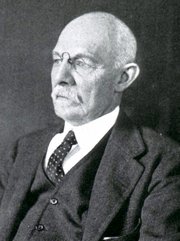
William S. Halsted, MD
(1852 – 1922)
American anatomist, teacher, and surgeon, William Stewart Halsted was born in New York City, USA to a wealthy family of English origin. His father was involved in charitable work and Governor and trustee to a city hospital. Not a brilliant student initially, Halsted took an undergraduate in Liberal Arts in Yale, CT., after which he entered the Medical College of Physicians at the Columbia College, where he excelled.
As a second-year medical student Halsted applied and obtained a position in surgery at a local hospital. In here he learned about Lister’s antiseptic technique and became an adamant proponent of it to reduce infection. In 1877 Halsted obtained his MD. After a short time as House Physician at the New York Hospital, Halsted traveled to Europe to further his education studying for two years at the Universities of Vienna, Leipzig, and W?rzburg.
Besides being at the forefront of surgical and antiseptic techniques (introducing the use of rubber gloves in surgery), Halsted was extremely concerned with the way medical students were taught in the US. He pioneered bedside clinical round discussions with the medical students after two years of basic sciences studies. Halsted developed the idea of a patient chart; he also developed the residency program for medical students in use today.
Halsted is probably the most influential researcher and surgeon at the turn of the century. He dedicated time to the study of intestinal anastomoses and the use of silk as a suture material. His experimental work in 1887 proved that the inclusion of the submucosa layer in an anastomosis was mandatory, as well that a single layered anastomosis was enough to attain closure. Perhaps Halsted’s most important contribution was the application and use of the scientific method to surgical questions. Halsted’s principles, also known as "Halsted's Rules of Surgery", set the standards used today in surgical suturing and surgical stapling.
He also pioneered the development and surgical techniques for radical mastectomy as a treatment for breast cancer.
As a side effect of this studied in anesthesia and the use of cocaine for anesthesia, Halsted became addicted to this substance, a problem that followed him through the years. Without impairing his capacity as a researcher and a surgeon, Halsted eventually recovered. He died in Baltimore in 1922 as a complication to surgery.
Sources:
1. Dubay, A. D., & Franz, G. M. (2003). Acute Wound Healing: The Biology of Acute Wound Failure. Surg Clin NA, 83, 463-481.
2. Halsted, W. S. (1887). Circular Suture of the Intestine - An Experimental Study. Am J Med Sci, 436-461.
3. “William Stewart Halsted: his life and contributions to surgery” Osborne, P. Lancet Oncol 2007; 8: 256–65
4. “William Stewart Halsted: Surgical pioneer” Burress, P Endoc Today (2010), 8: (2) 22
5. “William Stewart Halsted (1852–1922) Neurological stamp” Haas, LF J Neurol Neurosurg Psych 2000;69:641
Original image courtesy of "Images from the History of Medicine" at www.nih.gov

"Clinical Anatomy Associates, Inc., and the contributors of "Medical Terminology Daily" wish to thank all individuals who donate their bodies and tissues for the advancement of education and research”.
Click here for more information


- Details
Click for a larger image
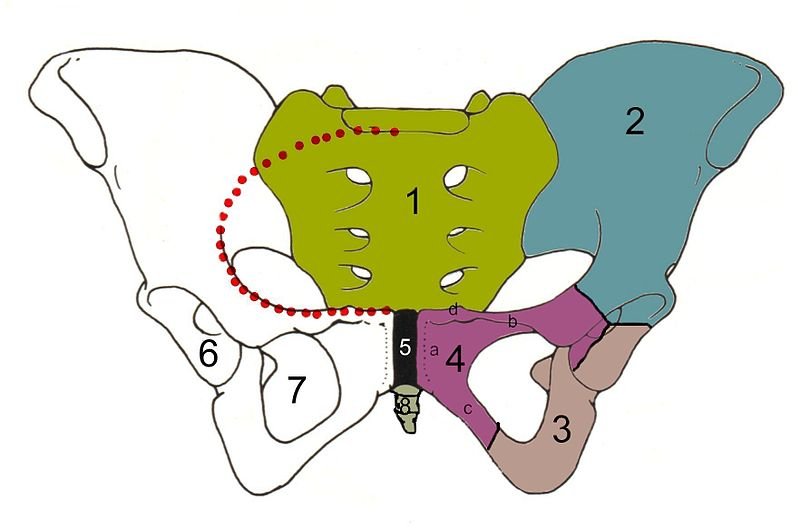
The os pubis, also known as the "pubic bone" is a bilateral bone found in the anterior aspect of the pelvis. It is one of the three components of the os coxae (hip bones). See number 4 in the accompanying image, click on the image for a larger depiction.
Each bone is composed by:
• Body: (a) The anteromedial component. Each medial aspect of these bones is related to the pubic symphysis (5). The superior border of the corpus os pubis is called the pubic crest, site of attachment for the rectus abdominis and pyramidalis muscles
• Superior pubic ramus: (b) The superior bony extension of the pubic bone. On its superior aspect there is a sharp bony edge called the pectineal line of the pubis, site of attachment for the pectineal ligament (Cooper's ligament), and part of the pelvic brim. The superior pubic ramus is the superior boundary of the obturator foramen
• Inferior pubic ramus: (c) The inferior bony extension of the pubic bone. In conjunction with the ischium (3), the inferior pubic ramus forms the inferior boundary of the obturator foramen
• Pubic tubercle: (d) A small bony protrusion in the superior aspect of the pubic bone
Original image, Public domain, courtesy of Wikipedia

- Details
|
The prefix [-trans-] originates from the Latin and means "trough", "across", or "beyond". This prefix is quite used in vernacular language too. Applications of this prefix include:
|
|
| Back to MTD Main Page | Subscribe to MTD |
- Details
The medical term [schizophrenia] is formed by the combination of two root terms of Greek origin. The term [-schiz] comes from the Greek word [σχίσις] and means "to tear" or "to separate". In Medicine today its meaning is that of "a cleft", a "split", or "a separation". The second root term [-phren-] has two meanings, "diaphragm", and "mind". The suffix [-ia] means "condition". Thus analyzed, the word [schizophrenia] means "a condition of a split mind".
Schizophrenia is a chronic, severe, and disabling brain disorder where the patient may hear voices other people do not hear. They may believe other people are reading their minds, controlling their thoughts, or plotting to harm them. Schizophrenic patients may not make sense when they talk. They may sit for hours without moving or talking. Sometimes people with schizophrenia seem perfectly fine until they talk about what they are really thinking
Some of the patients may lose total touch with reality, presenting with hallucination, delusions, or catatonia. Others may present with depression-like symptoms such as monotony, and reclusion. Schizophrenic patients also present with memory problems and inability to carry instructions.
For more information on this condition, please click here to go to the National Institute of Mental Health website on the topic.
- Details
This article is part of the series "A Moment in History" where we honor those who have contributed to the growth of medical knowledge in the areas of anatomy, medicine, surgery, and medical research.
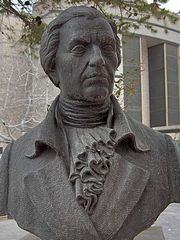
Francisco Javier Balmis
The Balmis Expedition (1803 -1806) The “Royal Philanthropic Vaccine Expedition”, otherwise known as the "Balmis expedition" is a little known chapter in the history of the eradication of smallpox from this world.
One of the unintended consequences of the Spanish invasion of the New World and the work of the “Conquistadores” was the introduction of smallpox to a virgin population. Other viruses were also introduced, so that between smallpox, measles, rubella, etc. it is said that in 1520 almost 50% of the population of Mexico died because of a biological infection.
Edward Jenner (1749 – 1823) discovered in 1796 that someone infected with cowpox would be protected against smallpox. The vaccine and the expansion of its use brought some relief to Europe, but the damage caused by smallpox in the Spanish colonies was catastrophic. Smallpox in its more virulent variety carried at the time a mortality rate close to 30%, leaving those who survived the virus with skin pockmarks or blinded for life. It is estimated that towards the end of the 18th century, 400,000 people died in Europe because of smallpox, and one third of the survivors were left blind.
A solution was needed, so in 1803 the Spanish king Carlos IV commissioned Don Francisco Javier de Balmis i Berenguer (1753 – 1819), a Spanish phyisician, to find a solution to the smallpox problem. While planning what was later to be known as the “Royal Philanthropic Vaccine Expedition” Balmis received critical contributions from Don Antonio de Gimbernat y Arbós (of Gimbernat’s ligament).
The main problem to this expedition was that there was no refrigeration, and the vaccine production and storage as we know it today had not been invented. The procedure was simple: Inoculate the live virus of cowpox from someone who was infected with cowpox. The solution was brilliant. A group of 10 physicians and 25 orphaned children were recruited along with nurses, and having at least one infected child on board each ship, the expedition sailed on November 30, 1803. During the long voyage, child after child were sequentially infected with the smallpox virus so that four months later, on March 19, 1804, the expedition landed in Venezuela with a child with the virus.
From here, the same method was used to distribute the vaccine North and South, to cover all of the Spanish territories until 1810. The original expedition is known as the “Balmis expedition”, and Balmis returned to Spain in 1806. Other expeditions were named after other leaders (Salvany, Justiniano, Grajales y Bolaños, etc.) but all carried the original strain brought to the Americas by Balmis. Although the original 25 children were granted the title of “special children of the Spanish nation”, no one knows how many children were used in the end, or what was their eventual fate transplanted away from their homes.
The image in this article, courtesy of Wikipedia, is a bust found at the Medical College of the Miguel Hernandez University in San Juan de Alicante, Spain
Sources:
1. “La viruela, aliado oculto en la conquista española” Sanchez-Silva, DJ. INFORMED 2007; 9 (12) 581-587
2. “La expedición de Balmis” Laval ER Rev Chil Infect 2003; 107-108
3. “Antonio de Gimbernat, 1734-1816” Matheson NM. Proc R Soc Med 1949; 42: 407-10.
4. “La vuelta al mundo de la expedición de la vacuna (1803-1810)” Diaz de Yraola, G. (2003)
5. “La segunda expedicion de Balmis” Tuells, J.; Duro-Torrijos, JL G Med Mex 2013 (149) 377-84
Original image in the Public Domain courtesy of Wikipedia

- Details
The prefix [eu-] is of Greek origin and means "good", or "well". It is found in medical and everyday terms as follow:
- Euphoria: The root term [-phor-] means "to bear", "to carry" or "oneself" Euphoria is "feeling good about oneself". The antonym would be "dysphoria"
- Euphonic:The root term [-phon-] means "sound", or "voice". To "sound good"
- Eugenic: Good genes
- Euthanasia: From the Greek word [θάνατος] (thanatos) meaning "death". A good death
- Eulogy: The root term [-log-] means "word". A "good word", a "good speech"
- Eunym: A good name
Note: The links to Google Translate include an icon that will allow you to hear the pronunciation of the word
- Details
The term [dysphoria] is composed of the prefix [dys-] meaning "abnormal, the root term [-phor-] meaning "to bear" or "to carry", and the suffix [-ia] meaning "condition" or "situation". The root term requires a little more explanation. Initially the term was used to denote "enduring", later "productive" or "fertile" and in modern medical terminology, the meaning of mental health, as in to "carry oneself" or "well-being".
Thus explained, dysphoria means "a condition of abnormal feeling about oneself". The term is used in depressive mood disorders and is characterized by anxiety, depression, sleeping disorder, etc.
The opposite of dysphoria is [euphoria] from the Greek suffix [eu-] meaning "good" or "well". Euphoria is "feeling good"