
Medical Terminology Daily (MTD) is a blog sponsored by Clinical Anatomy Associates, Inc. as a service to the medical community. We post anatomical, medical or surgical terms, their meaning and usage, as well as biographical notes on anatomists, surgeons, and researchers through the ages. Be warned that some of the images used depict human anatomical specimens.
You are welcome to submit questions and suggestions using our "Contact Us" form. The information on this blog follows the terms on our "Privacy and Security Statement" and cannot be construed as medical guidance or instructions for treatment.
We have 426 guests online
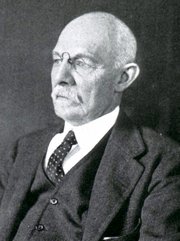
William S. Halsted, MD
(1852 – 1922)
American anatomist, teacher, and surgeon, William Stewart Halsted was born in New York City, USA to a wealthy family of English origin. His father was involved in charitable work and Governor and trustee to a city hospital. Not a brilliant student initially, Halsted took an undergraduate in Liberal Arts in Yale, CT., after which he entered the Medical College of Physicians at the Columbia College, where he excelled.
As a second-year medical student Halsted applied and obtained a position in surgery at a local hospital. In here he learned about Lister’s antiseptic technique and became an adamant proponent of it to reduce infection. In 1877 Halsted obtained his MD. After a short time as House Physician at the New York Hospital, Halsted traveled to Europe to further his education studying for two years at the Universities of Vienna, Leipzig, and W?rzburg.
Besides being at the forefront of surgical and antiseptic techniques (introducing the use of rubber gloves in surgery), Halsted was extremely concerned with the way medical students were taught in the US. He pioneered bedside clinical round discussions with the medical students after two years of basic sciences studies. Halsted developed the idea of a patient chart; he also developed the residency program for medical students in use today.
Halsted is probably the most influential researcher and surgeon at the turn of the century. He dedicated time to the study of intestinal anastomoses and the use of silk as a suture material. His experimental work in 1887 proved that the inclusion of the submucosa layer in an anastomosis was mandatory, as well that a single layered anastomosis was enough to attain closure. Perhaps Halsted’s most important contribution was the application and use of the scientific method to surgical questions. Halsted’s principles, also known as "Halsted's Rules of Surgery", set the standards used today in surgical suturing and surgical stapling.
He also pioneered the development and surgical techniques for radical mastectomy as a treatment for breast cancer.
As a side effect of this studied in anesthesia and the use of cocaine for anesthesia, Halsted became addicted to this substance, a problem that followed him through the years. Without impairing his capacity as a researcher and a surgeon, Halsted eventually recovered. He died in Baltimore in 1922 as a complication to surgery.
Sources:
1. Dubay, A. D., & Franz, G. M. (2003). Acute Wound Healing: The Biology of Acute Wound Failure. Surg Clin NA, 83, 463-481.
2. Halsted, W. S. (1887). Circular Suture of the Intestine - An Experimental Study. Am J Med Sci, 436-461.
3. “William Stewart Halsted: his life and contributions to surgery” Osborne, P. Lancet Oncol 2007; 8: 256–65
4. “William Stewart Halsted: Surgical pioneer” Burress, P Endoc Today (2010), 8: (2) 22
5. “William Stewart Halsted (1852–1922) Neurological stamp” Haas, LF J Neurol Neurosurg Psych 2000;69:641
Original image courtesy of "Images from the History of Medicine" at www.nih.gov

"Clinical Anatomy Associates, Inc., and the contributors of "Medical Terminology Daily" wish to thank all individuals who donate their bodies and tissues for the advancement of education and research”.
Click here for more information


- Details

Click for a larger image
The [vertebral endplate] is the term used to denote a structure formed by the superior (and inferior) aspect of the vertebral body and a layer of hyaline cartilage related to it. The vertebral endplate is formed by the cortical bone of the anular epiphysis, the central depression and the hyaline cartilage that fills the depresssion.
The vertebral endplate is important for the health of the intervertebral disk (IVD). Since the IVD loses its blood supply early in life all the nutrition to the IVD has to pass through the cortical bone and the hyaline cartilage. Note that hyaline cartilage is avascular. Separation of the components of the vertebral endplate due to trauma or other pathology can cause the IVD to become pathological.
The vertebral endplate also plays an important role in the biomechanics of spine movement. Being slightly incurved, the endplate acts as a shock absorber, bending up to 1/2 mm. Damage to the endplate can reduce this function and set the stage for failure of the endplate and a potential vertebral fracture.
Sometimes the IVD can herniate through the endplate causing what is known as "Schmorl's bodies".
Image property of: CAA.Inc.Photographer: David M. Klein
- Details
The medical word [avascular] means "without vessels" and refers to structures that do not have vessels providing it with blood supply. Avascular structures, like hyaline cartliage, receive their oxygen and nutrients by diffusion from nearby structures.
The preffix [-a-] means "without", and the root term [-vascul-] means "vessels".
- Details
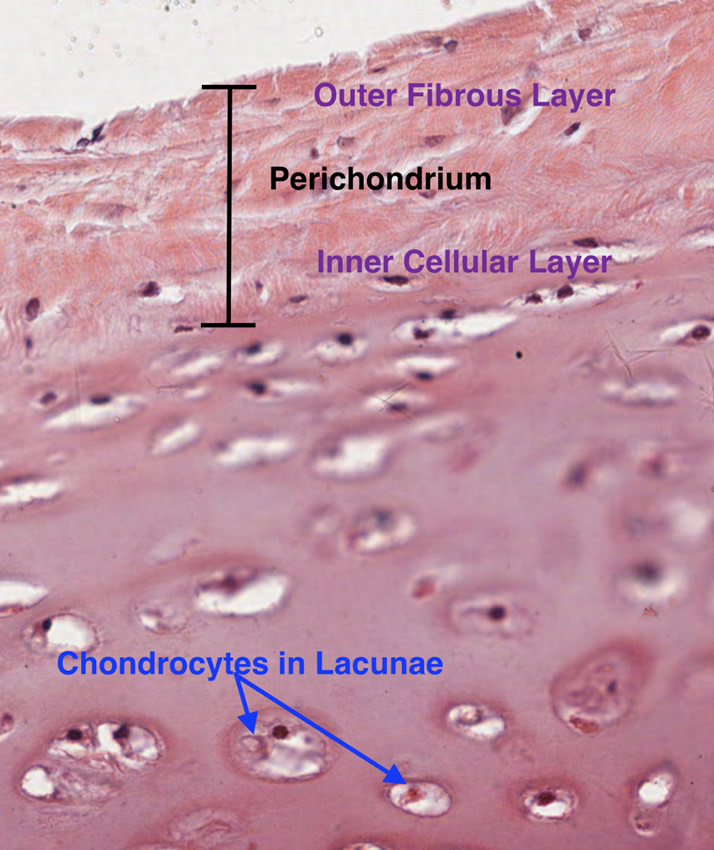
Hyaline cartilage
Hyaline cartilage is a type of cartilage characterized by a very homogenous avascular matrix. It is the most common type of cartilage. Hyaline cartilage has a bluish glassy look to it, hence the name.
Within the matrix of hyaline cartilage there are spaces called "lacunae" wich contain chondrocytes. These produce and maintain the extracellular matrix. Hyaline cartilage is found covering articular surfaces allowing for effortless sliding of the articular surfaces one against the other. Hyaline cartilage is avascular.
The accompanying image is a histology slide of hyaline cartilage. For more information on hyaline cartilage, read the article "The Importance of Hyaline Cartilage"by Dr. Stephen Gallik.
The word "hyaline" is a derivate of the Greek [υαλώδης] (yalódis) meaning "glassy".
Thanks to Dr. Stephen Gallik for the mage and links. For more information on mammalian hystology, you can visit Dr. Gallik's website here.
Note: Google Translate includes the symbol (?). Clicking on it will allow you to hear the pronunciation of the word.
- Details
This term has two roots terms and a suffix. [-sacr-] means "sacred" , but in this case refers to the sacral bone or sacrum. [-colp-] means "vagina", and the suffix [-opexy] means "fixation", "surgical fixation", or "suspension". As always, the [-o-] between the initial two root terms means "and". Following the rules to combine root terms, the word [sacrocolpopexy] means "fixation of the sacrum and vagina". The term "sacrocolposuspension" is synonymous with "sacrocolpopexy"
The fixation or suspension can be attained by the use of sutures, surgical staples, bone tacks, mesh, etc. or a combination of these devices. A sacrocolpopexy can be needed in the case of a weakened or damaged pelvic diaphragm that can lead to urinary incontinency and recurrent urinary infections, among other problems.
• For a procedural video of sacrocolpopexy click here. WARNING: The video is age-restricted
- Details
This article is part of the series "A Moment in History" where we honor those who have contributed to the growth of medical knowledge in the areas of anatomy, medicine, surgery, and medical research.
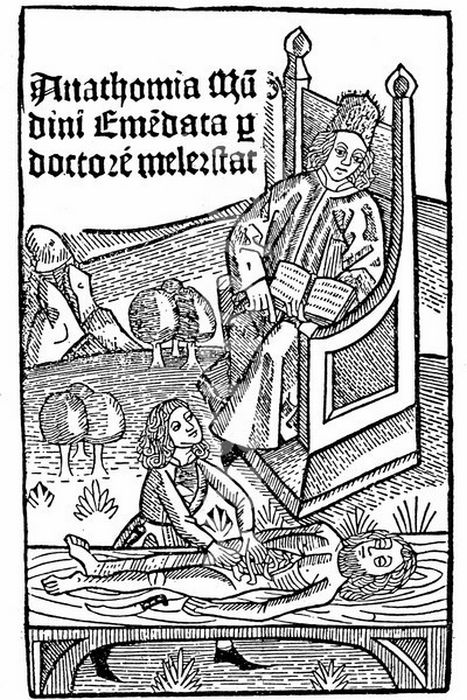
Click for a larger image
Mondino de Luzzi (ca.1270 – 1326). Italian anatomist, born Raimondo de Luzzi in the city of Bologna circa 1270. He was also known as Mondino, Remondino, or Mundinus de Leutiis, de Lentiis, de Lucci, and other variations of his name. His father Nerino Franzoli was an apothecary, and Mondino also started working as such.
In 1290 he enrolled in the Medical School at the University of Bologna obtaining his medical degree circa 1290. Mondino stayed at the university, where he continued to teach until his death in 1326.
His major publication is “Anothomia Corporis Humani”, written circa 1316 and found only in manuscript form. It was finally printed in movable type in 1478, making it easily available to the public. While some authors like Singer, 1925 contend that this is his only publication, others discuss the possibility that Mondino de’ Luzzi wrote other books that have been adjudicated to other authors as at the time the name “Mondino” was very common.
“Anothomia Corporis Humani” is the first anatomical book based on actual dissections, and the book was organized almost as a dissection manual, explaining dissection techniques to visualize specific structures. Initially this book had no illustrations, but some were added in later publications.
With over 40 editions, the last one in 1668, this book was used for almost 250 years. Mondino restarted human dissections in medical schools almost 1,500 years the medical school of Alexandria, leading many to call Mondino the “restorer of anatomy”.
It is said that Leonardo da Vinci (1452 – 1519) used one of Mondino’s books as a dissection manual to guide his own. Because Mondino followed Galen’s dictums and teachings, he was harshly criticized for his errors by Andreas Vesalius (1514 – 1564).
Although it is not clear if Mondino himself performed the actual dissections (he says he did), it is clear that he directed them. We know of two of his assistants: Otto Agenio Lustrolanus and Alessandra Giliani, the first woman prosector and anatomist. When Mondino died the same year as Alessandra Giliani, the expectation was that his assistant would continue the work of the master. Sadly Otto Agenio Lustrolanus died before he was 30 years old.
In the introduction to “Anothomia” Mondino says: "A work upon any science or art-as saith Galen-is issued for three reasons: First, that one may satisfy his friends. Second, that he may exercise his best mental powers. Third, that he may be saved from the oblivion incident to old age. Therefore, moved by these three causes, I have proposed to my pupils to compose a certain work on Medicine.”
"And because a knowledge of the parts to be subjected to medicine (which is the human body, and the names of its various divisions) is a part of medical science, as saith Averrhoes in his first chapter, in the section on the definition of medicine, for this reason among others I have set out to lay before you the knowledge of the parts of the human body which is derived from anatomy, not attempting to use a lofty style, but the rather that which is suitable to a manual procedure."
Sources:
1. “Mondino de' Luzzi's commentary on the Canones Generales of Mesue the Younger” Welborn, MC. Isis , 22: 1 (1934) , 8-11
2. “Medieval neuroanatomy: the text of Mondino dei Luzzi and the plates of Guido da Vigevano” Orly R. J Hist Neurosci. 1997 6 (2):113-123
3. “Mondino de Luzzi (1270-1326) Restaurador de la Disecci?n Anat?mica” Rever?n, RR. Informe Medico 2007; 9 (12):589-592
4. “The history and illustration of anatomy in the Middle Ages” Gurunluoglu, R, et al. J Med Biogr 2013 21: 219 – 229
5. “The Mondino Myth” Pilcher, LS. 1906
Original image courtesy of NLM

- Details
Hyaline cartilage
Cartilage is a type of avascular tissue with a highly specialized extracellular matrix that contains chondrocytes. The condrocytes produce and maintain the extracellular matrix. The root term meaning [cartilage] is [-chondr-], which originatesfrom the Greek [χόνδρος] or [chondros] meaning "cartilage" or "gristle". The Latin equivalent is [cartilago] giving us the synonymous root term [-cartilag-], from which [cartilage] arises.
The matrix contains large amounts of glicosaminoglycans, which allows for easy diffusion of substances from surrounding structures and blood vessels. Being avascular, cartilage does not have its own blood supply. The extracellular matrix also has large quantities of hyaluronic acid, which allows cartilage a weight-bearing capacity. This is why cartilage is particularly useful in bony joints and covering articular surfaces.
There are three types of cartilage present in the human body:
• Elastic cartilage: This type of cartilage is characterized by elastic fibers, usually in layers or lamellae
• Fibrocartilage: This type of cartilage is characterized by large bundles of collagen, making it look and feel fibrous
• Hyaline cartilage: This type of cartilage is characterized by an homogenous amorphous matrix
Thanks to Dr. Stephen Gallik for the mage and links. For more information on mammalian hystology, you can visit Dr. Gallik's website here.