
Medical Terminology Daily (MTD) is a blog sponsored by Clinical Anatomy Associates, Inc. as a service to the medical community. We post anatomical, medical or surgical terms, their meaning and usage, as well as biographical notes on anatomists, surgeons, and researchers through the ages. Be warned that some of the images used depict human anatomical specimens.
You are welcome to submit questions and suggestions using our "Contact Us" form. The information on this blog follows the terms on our "Privacy and Security Statement" and cannot be construed as medical guidance or instructions for treatment.
We have 459 guests online
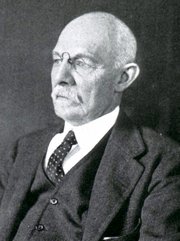
William S. Halsted, MD
(1852 – 1922)
American anatomist, teacher, and surgeon, William Stewart Halsted was born in New York City, USA to a wealthy family of English origin. His father was involved in charitable work and Governor and trustee to a city hospital. Not a brilliant student initially, Halsted took an undergraduate in Liberal Arts in Yale, CT., after which he entered the Medical College of Physicians at the Columbia College, where he excelled.
As a second-year medical student Halsted applied and obtained a position in surgery at a local hospital. In here he learned about Lister’s antiseptic technique and became an adamant proponent of it to reduce infection. In 1877 Halsted obtained his MD. After a short time as House Physician at the New York Hospital, Halsted traveled to Europe to further his education studying for two years at the Universities of Vienna, Leipzig, and W?rzburg.
Besides being at the forefront of surgical and antiseptic techniques (introducing the use of rubber gloves in surgery), Halsted was extremely concerned with the way medical students were taught in the US. He pioneered bedside clinical round discussions with the medical students after two years of basic sciences studies. Halsted developed the idea of a patient chart; he also developed the residency program for medical students in use today.
Halsted is probably the most influential researcher and surgeon at the turn of the century. He dedicated time to the study of intestinal anastomoses and the use of silk as a suture material. His experimental work in 1887 proved that the inclusion of the submucosa layer in an anastomosis was mandatory, as well that a single layered anastomosis was enough to attain closure. Perhaps Halsted’s most important contribution was the application and use of the scientific method to surgical questions. Halsted’s principles, also known as "Halsted's Rules of Surgery", set the standards used today in surgical suturing and surgical stapling.
He also pioneered the development and surgical techniques for radical mastectomy as a treatment for breast cancer.
As a side effect of this studied in anesthesia and the use of cocaine for anesthesia, Halsted became addicted to this substance, a problem that followed him through the years. Without impairing his capacity as a researcher and a surgeon, Halsted eventually recovered. He died in Baltimore in 1922 as a complication to surgery.
Sources:
1. Dubay, A. D., & Franz, G. M. (2003). Acute Wound Healing: The Biology of Acute Wound Failure. Surg Clin NA, 83, 463-481.
2. Halsted, W. S. (1887). Circular Suture of the Intestine - An Experimental Study. Am J Med Sci, 436-461.
3. “William Stewart Halsted: his life and contributions to surgery” Osborne, P. Lancet Oncol 2007; 8: 256–65
4. “William Stewart Halsted: Surgical pioneer” Burress, P Endoc Today (2010), 8: (2) 22
5. “William Stewart Halsted (1852–1922) Neurological stamp” Haas, LF J Neurol Neurosurg Psych 2000;69:641
Original image courtesy of "Images from the History of Medicine" at www.nih.gov

"Clinical Anatomy Associates, Inc., and the contributors of "Medical Terminology Daily" wish to thank all individuals who donate their bodies and tissues for the advancement of education and research”.
Click here for more information


- Details
This article is part of the series "A Moment in History" where we honor those who have contributed to the growth of medical knowledge in the areas of anatomy, medicine, surgery, and medical research.

Click for a larger image
When I started the sidebar segment entitled "A Moment in History", I thought that it would be only biographical articles. On January 28, 2014, traveling from Austin TX to Cincinnati I was reading a wonderful book: "Masters of the Scalpel" (1962) by Sarah R. Riedman Ph.D. In one of the chapters Dr. Riedman writes about the first use of anesthesia in Surgery. Because of the author's style, as I read the following excerpt, I found myself wondering how it would have felt to be there while history was being made:
"On the morning of October 16, 1846, all but one of the principals were ready in the amphitheatre: Dr. Warren, the senior surgeon, his assistants and strong-armed men who were to hold the patient down, the students, and other spectators were waiting; the patient was brought in, pale with fright.
There was no turning back: everything was set for the removal of the tumor on his jaw. Only Morton (Dr. William T. G. Morton) had not arrived. Dr. Warren was ready to proceed without him, announcing to the onlookers: "As Dr. Morton has not arrived, I presume he is otherwise engaged." And he was - putting the finishing touches on his inhaler in the instrument maker's shop.
Just as the skeptical audience burst into laughter at Dr. Warren's remark, Morton appeared. The operation was held up for a few minutes while Morton prepared a sponge soaked in ether which he placed in the inhaling globe, temporarily corked.
As he came forward to the operating table on which the patient was strapped as always before an operation, Dr. Warren turned to Morton, saying: "Well sir! Your patient is ready."
But Morton wished to gain the patient's confidence. Pointing to Eben Frost ( A patient from whom Dr. Morton had removed a tooth under ether) who in gratitude had come along to the hospital, he said to the pale man: "There is a man who has been operated on under this chemical, and can tell you that it worked." Frost gladly complied.
"Are you afraid?" Morton asked the patient. Whether from courage or confidence, the patient replied, "No, I will do as you tell me."
Click for a larger image
Morton then put the neck of the flask to the patient's mouth, instructing him to breathe. Slowly the patient went under, his arms and legs jerking in a way probably familiar to frequenters at "ether frolics." As yet no one suspected what the chemical was. After several minutes, the patient was asleep and relaxed. It was now Morton's cue in the drama, as he turned to Dr. Warren. "Sir, your patient is ready."
Warren made the incision. He, like the witnesses, was ready for the bloodcurdling screams so familiar in the operating room. But the patient uttered not a sound.
The operation over, the patient slowly regained consciousness. When questioned by Morton, he readily admitted having felt no pain.
Dr. Warren then broke the silence with the famous words: "Gentlemen, this is no humbug!" And Dr. Henry J. Bigelow: "I have seen something today that will be heard round the world."
The first page of a new chapter in the story of surgery was turned that day."
While looking out the airplane window to the passing cities below, I thought about the millions of people that had been affected by this "Moment in History" and that it needed to be shared and retold to the generations to follow.
The operation took place in the first operating room built at the Massachusetts General Hospital. This room has been preserved and is today known as the "Ether Dome". You can read an article on a visit I made to this historic place. Dr. Miranda
Biographical note: Sarah Regal Riedman was born on April 20, 1902 in Kishiniev, Rumania and became a U.S. citizen in 1918. In 1926, she received a bachelor's degree from Hunter College, followed by a Masters of Science degree from New York University in 1928. In 1935, Ms. Riedman received her Ph.D. from Columbia University. She taught at Hunter College from 1926 to 1930, and at Brooklyn College from 1930 to 1952. At Brooklyn College, she was an instructor, and later an assistant professor of biology.
Ms. Riedman began writing science books for children in 1947, with the publication of "How Man Discovered His Body". Between 1947 and 1983, she wrote or co- wrote approximately forty books. We have not been able to find further information on her. Any contribution to her biography will be most welcome.
Original image (public domain) courtesy of NLM

- Details
Click for a larger image
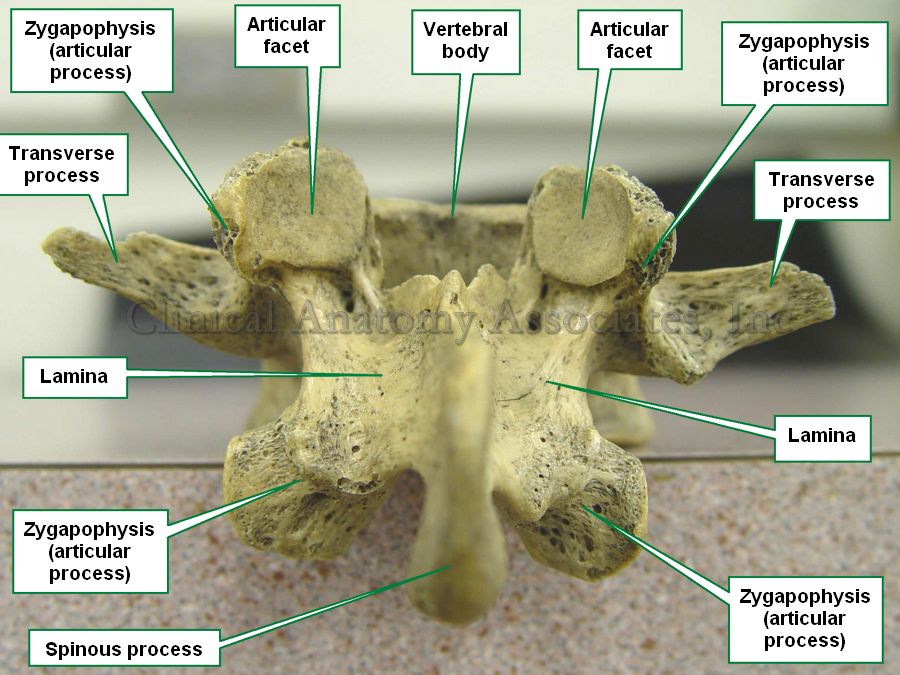
The term [zygapophysis] is Greek. [-zyg-] means "yoked" or "paired", [-ap-] means "away" or "out", while the suffix [-(o)physis] means "growth". The term means "a paired outgrowth". Its plural form is "zygapophyses".
The term zygapophysis is used to denote four bony outgrowths or processes found in the posterior aspect of most vertebrae, arising in the zone of junction of pedicle and lamina. The zygapophyses are paired (left and right) and then they are inferior and superior. They are also called "articular processes".
Each zygapophysis presents with a smooth articular surface called an [articular facet]. Each articular facet is covered with hyaline cartilage. Two adjacent articular facets will form a synovial type joint known as a zygapophyseal joint or a facet joint.
In the cervical region the zygapophyseal joints are so close that they form a lateral pillar, known as the "lateral mass" or "articular pillar".
Arthritic degeneration of the zygapophyseal joints can lead to reduced spinal mobility and pain. The image shows the posterior view of a lumbar vertebra. Click on the image for a larger depiction.
Image property of: CAA.Inc. Photographer: David M. Klein
- Details
The suffix [-(o)cyte] arises from the Greek [κελί] meaning "a hollow vessel" or a"cell". The term [-cyt-] can also be used as a root term, also meaning "cell". Examples of its use are:
- Leukocytopenia: A combination of root terms; [leuk], means "white", and [-cyt-] means "cell". The suffix [-(o)penia] means deficiency. A white cell deficiency
- Erythrocyte: The root [-erythr-] means "red". A red cell, referring to a red blood cell
- Leukocyte: The root [-leuk-] means "white". A white cell, referring to a white blood cell
- Blastocyte: The root term [-blast-] is used to mean "to build". A cell that builds. Usually refers to a fibroblast
- Osteoclastocyte: A combination of root terms; [-oste-], means "bone", and [-clast-] means "to destroy". A cell that destroys bone.
- Details
Click for a larger image
The word [axis] arises from the Greek [άξων] meaning "axle".
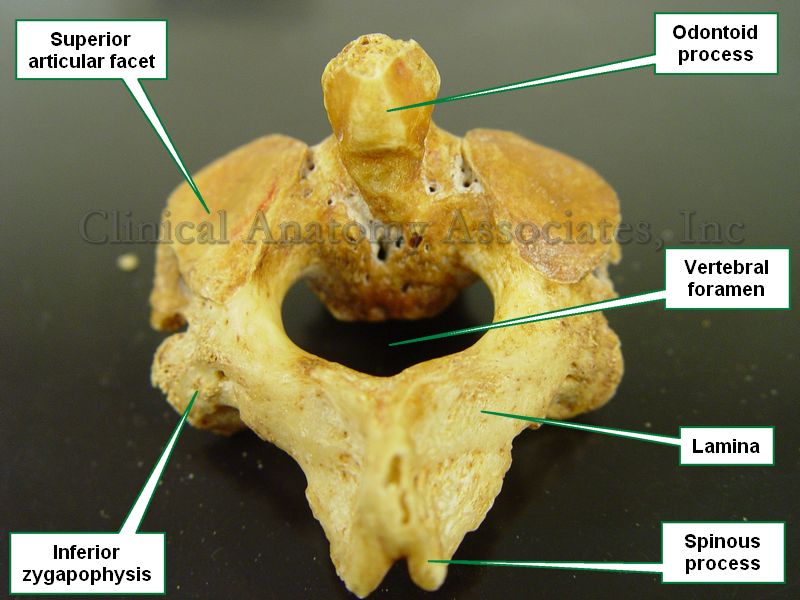
[Axis] is the proper name given to the second cervical vertebra (C2). The name is from the action of C2. Because of its odontoid process and associated ligaments and joints, the axis allows the head to pivot around the axis of the odontoid process or dens.
As with all cervical vertebrae, the axis presents with foramina transversaria (no readily visible in the accompanying image), lateral masses with superior and inferior articular facets, pedicles and laminae. Usually the spinous process of C2 is bifid.
There are three atlantoaxial joints (between atlas and axis). Two of them are posterolateral, the zygapophyseal or facet joints. The median atlantoaxial joint between the atlas and the odontoid process of the axis is important in axial rotation of the head.
The superior articular processes of the axis forms part of the posterolateral atlantoaxial joints . In an uncharacteristic situation, the superior articular facet extends slightly from the lateral mass into what is considered the body of C2.
The median atlantoaxial joint components and its related ligaments, the alar ligament, the cruciform ligament, and the apical ligamen of the dens will be featured in separate articles.
Image property of: CAA.Inc. Photographer: David M. Klein
- Details
Click for a larger image
The term [odontoid] arises from the Greek [δόντι] meaning "tooth". The suffix [-oid] means "similar to". Similar to a tooth.
The odontoid process, also known as the "dens", is a tooth-like bony process found in the anterior aspect of the second cervical vertebra (C2), also known as the "axis" because of its function, serving as a pivot point to the head.
Embryologically, the odontoid process is the body of the first cervicalvertebra (C1, atlas) that has been incorporated into C2. This is proven by the presence, deep in the structure of the dens, of a small remnant of an intervertebral disc-like structure. This concept has been challenged by different authors.
The dens presents a small anterior facet to articulate with the posterior aspect of the anterior arch of the atlas (C1), a posterior area for the attachment of the alar ligaments, and a small ligament at its apex, the apical ligament, that attaches to the inferior aspect of the occipital bone.
Image property of: Photographer: David M. Klein
- Details
This article is part of the series "A Moment in History" where we honor those who have contributed to the growth of medical knowledge in the areas of anatomy, medicine, surgery, and medical research.
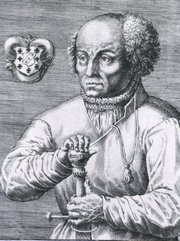
Paracelsus
Paracelsus (1493 – 1541). Swiss physician and alchemist , Phillipus Aureolus Theophrastus Bombastus Von Hohenheim was born in Einsiedeln in 1493 (one year after Columbus discovered America) in what is today is Switzerland. At an early age he became a migrant student, visiting several universities including Tubingen, Vienna, Wirttemberg, Heidelberg, and Cologne. There is discussion as to whether he received or not a medical degree, although most authors today agree he might had. In 1510 he moved to Ferrara where he attained (apparently) his medical degree in 1516. During his constant travels he started to understand that folk medical treatment based on actual observation was better than what was published and followed blindly by the physicians of the time.
He started to call himself “Paracelsus” which means “alongside Celsus”, seen as one of the greatest physicians in history. Paracelsus continued his travels, visiting Egypt and Jerusalem. It is at this time that he started delving into the world of alchemy, returning to his home circa 1524.
Paracelsus was appointed “Town Physician” of the city of Basle but created controversy when he started lecturing in German (not Latin) and invited the general public as well as his students to his lectures. In his presentations he introduced the concepts of direct observation of the patient and empirical treatment, based his statements on experiments and reasoning opposing the “classics” Galen, and Avicenna.
In 1527, during a demonstration he publicly burned the works of Avicenna to prove his point. This caused a backlash from the university and town authorities who expelled him in 1528. From this point on, Paracelsus’ life is constant wandering. He settles for a time and then travels again. In spite of his disdain for the works of the “medical greats”, he himself writes a large number of works, including medicine, surgery, theology, astronomy, magic, etc. Many of these works are not published until after his death as he is considered to be contradicting Galen. In 1530 he writes the best description of syphilis and recommended its treatment with mercury.
In 1541 he was appointed to a post on the staff of Duke Ernest of Bavaria, but he died in mysterious circumstances on September 24 of that year at the White Horse Inn in Salzburg.
Paracelsus is a controversial image, bound in legend. For many, Paracelsus was bombastic, quarrelsome, opinionated and a drunkard. For others he is a figure of his time, clashing with the classics and giving us a new way to look at the world and at diseases. He taught that wounds must be allowed to drain and not, as was common, packed with unhealthy materials. According to him, the human body primarily consists of salt, sulphur, and mercury, and it is the separation of these elements that causes illness. He introduced mineral baths and made opium, mercury, lead and other minerals part of his treatment, foreshadowing modern pharmacology with the use of chemical remedies, mercury for syphilis, laudanum and antimony. Paracelsus stated in 1538 that “Everything is a poison, the dose alone which makes a thing not a poison”.
I just discovered an interesting chain of events. For a time Paracelsus had a medical student that later decided not to continue his medical studies and instead dedicated himself to the new art of printing. His name was Johannes Oporinus and he was the printer that Andreas Vesalius selected to print his masterpiece, the "Fabrica".
Sources
1. “Paracelsus” Abbott.A. Nature 366: (1993) 98
2. “Paradigm lost: a celebration of Paracelsus on his quincentenary” Feder. G. Lancet. 341: (1993) 1396-1397
3. “Does Paracelsus deserve a place in the medical pantheon?” Bynum, B. 367: (2006) 29; 1389–1390
4. “Paracelsus: founder of medical chemistry” Endeavour 15:4 (1991) 147
5. “Paracelsus: the medical Luther” Leary B. 73: 3(1984) 131-133
6. “Paracelsus and the Philosopher’s Stone” TenHoor, W. Am J Surg (1935) 30:3 563-572