
Medical Terminology Daily (MTD) is a blog sponsored by Clinical Anatomy Associates, Inc. as a service to the medical community. We post anatomical, medical or surgical terms, their meaning and usage, as well as biographical notes on anatomists, surgeons, and researchers through the ages. Be warned that some of the images used depict human anatomical specimens.
You are welcome to submit questions and suggestions using our "Contact Us" form. The information on this blog follows the terms on our "Privacy and Security Statement" and cannot be construed as medical guidance or instructions for treatment.
We have 560 guests online
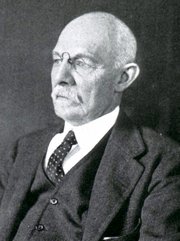
William S. Halsted, MD
(1852 – 1922)
American anatomist, teacher, and surgeon, William Stewart Halsted was born in New York City, USA to a wealthy family of English origin. His father was involved in charitable work and Governor and trustee to a city hospital. Not a brilliant student initially, Halsted took an undergraduate in Liberal Arts in Yale, CT., after which he entered the Medical College of Physicians at the Columbia College, where he excelled.
As a second-year medical student Halsted applied and obtained a position in surgery at a local hospital. In here he learned about Lister’s antiseptic technique and became an adamant proponent of it to reduce infection. In 1877 Halsted obtained his MD. After a short time as House Physician at the New York Hospital, Halsted traveled to Europe to further his education studying for two years at the Universities of Vienna, Leipzig, and W?rzburg.
Besides being at the forefront of surgical and antiseptic techniques (introducing the use of rubber gloves in surgery), Halsted was extremely concerned with the way medical students were taught in the US. He pioneered bedside clinical round discussions with the medical students after two years of basic sciences studies. Halsted developed the idea of a patient chart; he also developed the residency program for medical students in use today.
Halsted is probably the most influential researcher and surgeon at the turn of the century. He dedicated time to the study of intestinal anastomoses and the use of silk as a suture material. His experimental work in 1887 proved that the inclusion of the submucosa layer in an anastomosis was mandatory, as well that a single layered anastomosis was enough to attain closure. Perhaps Halsted’s most important contribution was the application and use of the scientific method to surgical questions. Halsted’s principles, also known as "Halsted's Rules of Surgery", set the standards used today in surgical suturing and surgical stapling.
He also pioneered the development and surgical techniques for radical mastectomy as a treatment for breast cancer.
As a side effect of this studied in anesthesia and the use of cocaine for anesthesia, Halsted became addicted to this substance, a problem that followed him through the years. Without impairing his capacity as a researcher and a surgeon, Halsted eventually recovered. He died in Baltimore in 1922 as a complication to surgery.
Sources:
1. Dubay, A. D., & Franz, G. M. (2003). Acute Wound Healing: The Biology of Acute Wound Failure. Surg Clin NA, 83, 463-481.
2. Halsted, W. S. (1887). Circular Suture of the Intestine - An Experimental Study. Am J Med Sci, 436-461.
3. “William Stewart Halsted: his life and contributions to surgery” Osborne, P. Lancet Oncol 2007; 8: 256–65
4. “William Stewart Halsted: Surgical pioneer” Burress, P Endoc Today (2010), 8: (2) 22
5. “William Stewart Halsted (1852–1922) Neurological stamp” Haas, LF J Neurol Neurosurg Psych 2000;69:641
Original image courtesy of "Images from the History of Medicine" at www.nih.gov

"Clinical Anatomy Associates, Inc., and the contributors of "Medical Terminology Daily" wish to thank all individuals who donate their bodies and tissues for the advancement of education and research”.
Click here for more information


- Details
Click for a larger image
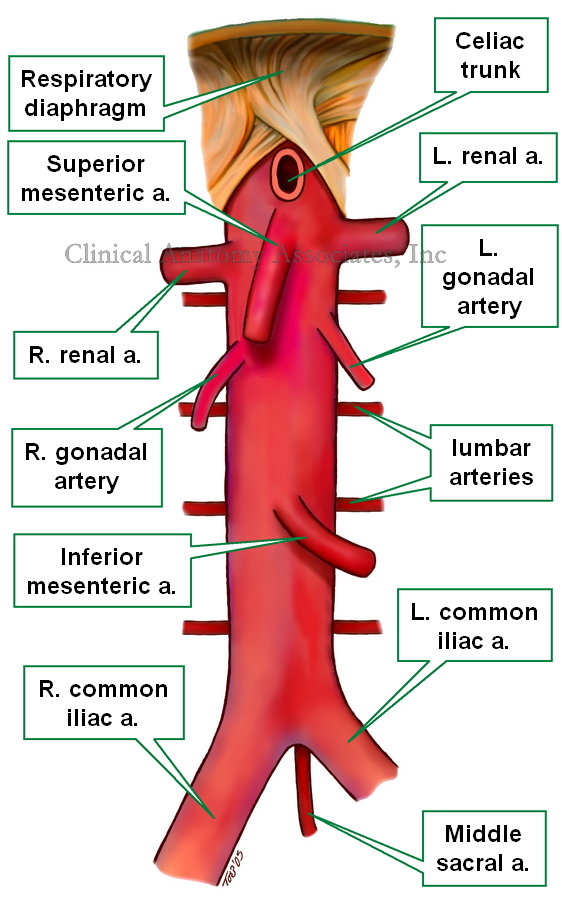
The bifurcation of the aorta is the point at which the abdominal aorta ends distally. At this point the aorta bifurcates giving origin to the right and left common iliac arteries. These arteries trend anterolaterally towards the pelvic brim.
The aortic bifurcation is usually found anterior to the inferior border of the 4th lumbar vertebra vertebra, slightly to the left of the midline. In surface anatomy, the bifurcation corresponds to a point slightly left to the midline and just about two fingerbreadths (two centimeters) inferior to the umbilicus.
This is an important landmark in surface anatomy in laparoscopic surgery. When placing the first periumbilical trocar the surgeon must angle the trocar posteroinferiorly towards the pelvic basin as to avoid perforating or lacerating the abdominal aorta. This situation has been studied in many journal articles.
Inferior to the aortic bifurcation is the confluence of both common iliac veins which give origin to the inferior vena cava.
The middle sacral artery arises from the lower portion of the abdominal aorta and appears inferior to the aortic bifurcation in the midline an continuing on its way to the anterior aspect of the sacrum.
The fact that the aorta bifurcates in front of the 4th lumbar vertebra leaves the L5-S1 intervertebral disc free of major arteries (with the exception of the middle sacral artery) allowing surgeons access to the intervertebral disc to perform laparoscopic removal of the disc with implantation of a device to allow intervertebral fusion in the case of intervertebral disc disease.
Sources:
1. “Major vascular injuries during laparoscopic procedures” Nordestgaard, AG et al Am J Surg (1995) 169,5: 543–545
2. “Evaluation of the direct trocar insertion technique at laparoscopy” Byron. JW et al Obst Gyn (1989) 74:3, 423-425
3. “Open versus closed establishment of pneumoperitoneum in laparoscopic surgery” Bonjer, HJ et al Br J Surg, 84: 599–602
4. “Serious Trocar Accidents in Laparoscopic Surgery: A French Survey of 103,852 Operations” Champault G et al Surg Lap Endosc (1996) 6(5):367-70
5. “Major vascular injuries during gynecologic laparoscopy” Chapron CM et al J Am Coll Surg (1997) 185:5 461-465
Image property of:CAA.Inc.Artist: Victoria G. Ratcliffe
- Details
Adjectival medical term that means “pertaining to a hospital”. The word is a derivate of the Greek word [νοσοκομείο] (nosokomio) meaning “hospital”. This term is itself composed by two Greek terms: [νόσος] (nosos), meaning “disease” or “injury” and [κομέω], meaning “to take care of”, so the Greek term [νοσοκομείο] means “to take care of a sick person” and the place where you do that is logically, a “hospital”.
This term was later adopted by Roman doctors, giving rise to the Latin term “nosocomium”, from which we derive our English “nosocomial”.
Although we use the term “hospital-acquired infection”, a proper way of saying this is “nosocomial infection”. A synonym for [nosocomial] is [iatrogenic].
Interestingly, the Latin root for “injury”, or [noxa] gave us the Golden Rule of Surgery” “Primum Non Nocere”
Thanks to Sharon L. Mueller, RN for suggesting this article.
Note: The links to Google Translate include an icon that will allow you to hear the Greek or Latin pronunciation of the word.
- Details
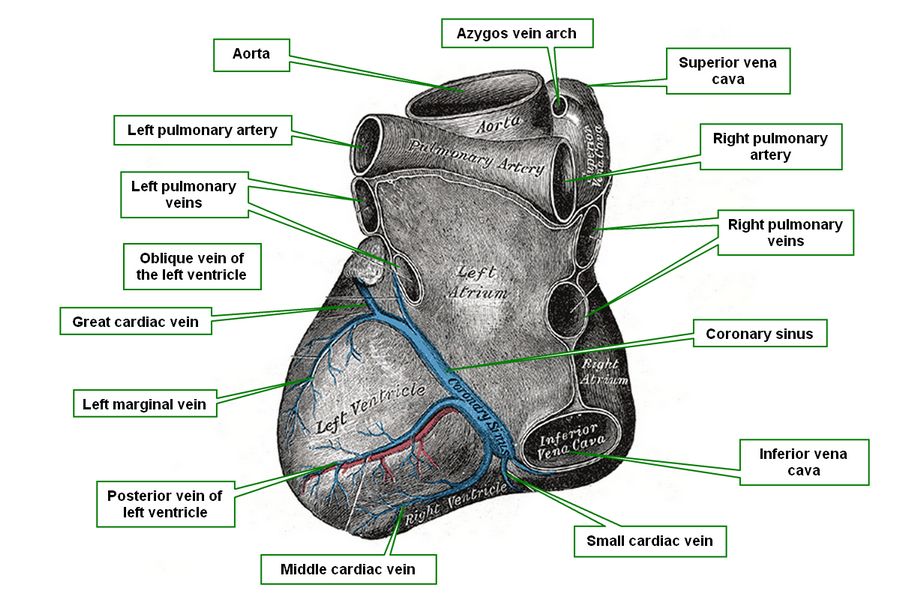
Middle cardiac vein
The middle cardiac vein is a vein that runs alongside or parallel to the posterior interventricular artery, also known as the posterior descending artery (PDA).
The middle cardiac vein appears close to the cardiac apex and ascends in the posterior interventricular sulcus (groove) to empty into the coronary sinus. It is responsible for venous drainage of the posterior aspect of the right and left ventricular wall as well as the posterior aspect of the interventricular septum.
Sources:
1 "Tratado de Anatomia Humana" Testut et Latarjet 8 Ed. 1931 Salvat Editores, Spain
2. "Anatomy of the Human Body" Henry Gray 1918. Philadelphia: Lea & Febiger
Original image modified. Image courtesy of bartleby.com
- Details
This is a Facebook post. If you cannot see it, click on the following link: https://www.facebook.com/CAAInc/posts/1000784059938724
- Details
- Hits: 17229
Click for a larger image
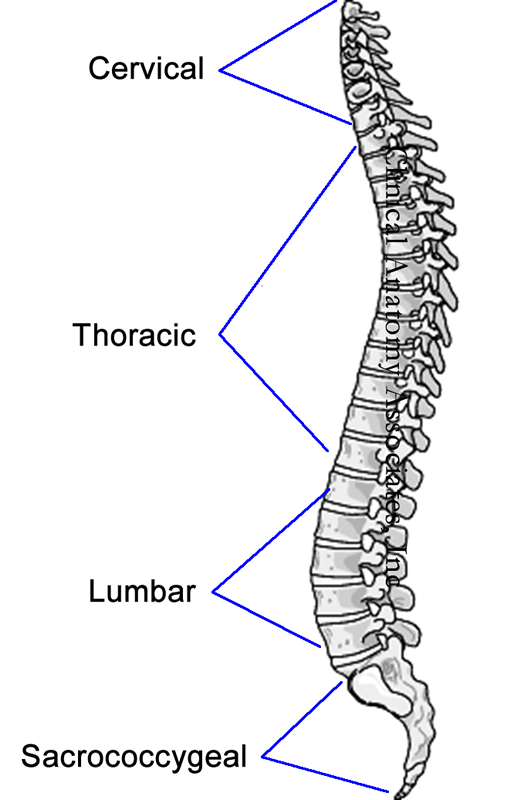
UPDATED: In both these words the suffix [-osis] means "condition". The root term [-kyph-] is Greek and means "bent or bowed" without an indication of the direction of bending, thus the term was originally used for any abnormal spinal curvature. It was Hippocrates who first used this term to denote "hunchback". Since then the term [kyphosis] denotes a curvature of the spine towards posterior, or better described, a spinal curvature in the median plane with a posterior convexity.
Hippocrated also used the Greek term [lordosis] to denote a curvature opposite to kyphosis. Lordosis is then a spinal curvature in the median plane with an posterior concavity.
In the human spine, as viewed from the lateral aspect (see image), there are four normal curvatures. The cervical and lumbar curvatures are lordotic, while the thoracic and sacrococcygeal curvatures are kyphotic. Based on this description kyphosis and lordosis are normal conditions of the human spine.
A pathological, excessive, or exacerbated curvature should be denoted with the terms [hyperkyphosis] and [hyperlordosis] respectively; the prefix [hyper-] meaning "excessive". Through use, the terms [kyphosis] and [lordosis] are also used to denote pathological conditions. Hyperkyphosis has mostly a thoracic presentation, while hyperlordosis has mostly a lumbar presentation.
In vernacular terms, an individual with hyperkyphosis is known as a "hunchback", while an individual with hyperlordosis is known as a "swayback".
Image property of: CAA.Inc. Artist:D.M. Klein
- Details
Click for a larger image
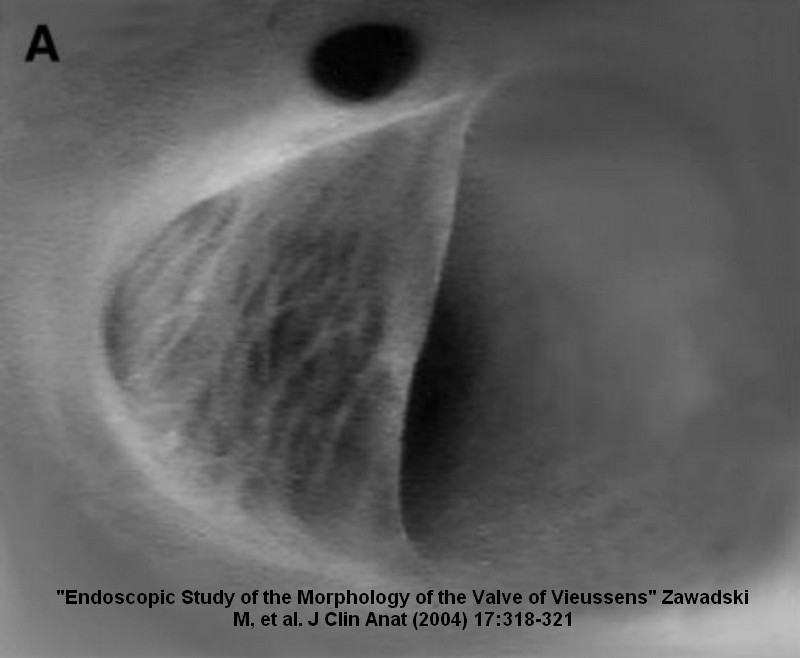
The eponymic “valve of Vieussens” is a venous valve found at the most proximal portion (or beginning) of the coronary sinus. The valve was first described by Raymond de Vieussens and thus carries its name.
Venous valves are common on peripheral veins but they tend not to be present on intraabdominal and intrathoracic veins, with some exceptions. These valves are form by thin veil-like reduplications of the venous endothelium.
Zawadzki, et al (2004) demonstrated in an endoscopic study of the valve of Vieussens that it is present in 78% of the cases and that the valve can be single, double, and even triple. The morphology of this particular valve is of interest as there are some cardiac catheterization procedures that may attempt to pass a retrograde catheter or fluid from the coronary sinus into the great cardiac vein.
Sources:
1. “Endoscopic Study of the Morphology of Vieussens Valve” Zawadzki, M. et al Clinical Anatomy (2004) 17:318 –321
2. “The valve of Vieussens: an important cause of difficulty in advancing catheters into the cardiac veins” Corcoran, SJ J Cardiovasc Electrophysiol. 1999 Jun;10(6):804-8
3. “Valve of Vieussens: An obstacle for left ventricular lead placement” Sthromer, B Can J Cardiol. Sep 2008; 24(9): e63