
Medical Terminology Daily (MTD) is a blog sponsored by Clinical Anatomy Associates, Inc. as a service to the medical community. We post anatomical, medical or surgical terms, their meaning and usage, as well as biographical notes on anatomists, surgeons, and researchers through the ages. Be warned that some of the images used depict human anatomical specimens.
You are welcome to submit questions and suggestions using our "Contact Us" form. The information on this blog follows the terms on our "Privacy and Security Statement" and cannot be construed as medical guidance or instructions for treatment.
We have 523 guests online
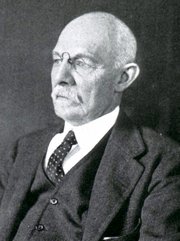
William S. Halsted, MD
(1852 – 1922)
American anatomist, teacher, and surgeon, William Stewart Halsted was born in New York City, USA to a wealthy family of English origin. His father was involved in charitable work and Governor and trustee to a city hospital. Not a brilliant student initially, Halsted took an undergraduate in Liberal Arts in Yale, CT., after which he entered the Medical College of Physicians at the Columbia College, where he excelled.
As a second-year medical student Halsted applied and obtained a position in surgery at a local hospital. In here he learned about Lister’s antiseptic technique and became an adamant proponent of it to reduce infection. In 1877 Halsted obtained his MD. After a short time as House Physician at the New York Hospital, Halsted traveled to Europe to further his education studying for two years at the Universities of Vienna, Leipzig, and W?rzburg.
Besides being at the forefront of surgical and antiseptic techniques (introducing the use of rubber gloves in surgery), Halsted was extremely concerned with the way medical students were taught in the US. He pioneered bedside clinical round discussions with the medical students after two years of basic sciences studies. Halsted developed the idea of a patient chart; he also developed the residency program for medical students in use today.
Halsted is probably the most influential researcher and surgeon at the turn of the century. He dedicated time to the study of intestinal anastomoses and the use of silk as a suture material. His experimental work in 1887 proved that the inclusion of the submucosa layer in an anastomosis was mandatory, as well that a single layered anastomosis was enough to attain closure. Perhaps Halsted’s most important contribution was the application and use of the scientific method to surgical questions. Halsted’s principles, also known as "Halsted's Rules of Surgery", set the standards used today in surgical suturing and surgical stapling.
He also pioneered the development and surgical techniques for radical mastectomy as a treatment for breast cancer.
As a side effect of this studied in anesthesia and the use of cocaine for anesthesia, Halsted became addicted to this substance, a problem that followed him through the years. Without impairing his capacity as a researcher and a surgeon, Halsted eventually recovered. He died in Baltimore in 1922 as a complication to surgery.
Sources:
1. Dubay, A. D., & Franz, G. M. (2003). Acute Wound Healing: The Biology of Acute Wound Failure. Surg Clin NA, 83, 463-481.
2. Halsted, W. S. (1887). Circular Suture of the Intestine - An Experimental Study. Am J Med Sci, 436-461.
3. “William Stewart Halsted: his life and contributions to surgery” Osborne, P. Lancet Oncol 2007; 8: 256–65
4. “William Stewart Halsted: Surgical pioneer” Burress, P Endoc Today (2010), 8: (2) 22
5. “William Stewart Halsted (1852–1922) Neurological stamp” Haas, LF J Neurol Neurosurg Psych 2000;69:641
Original image courtesy of "Images from the History of Medicine" at www.nih.gov

"Clinical Anatomy Associates, Inc., and the contributors of "Medical Terminology Daily" wish to thank all individuals who donate their bodies and tissues for the advancement of education and research”.
Click here for more information


- Details

Click for a larger image
UPDATED: This is a medical word that originates from Greek roots. The word [pathos] meaning "disease", and the word [γνωμο] (gnomos) or [gnomonikos] meaning "opinion", "judge" or "someone fit to judge". The word [pathognomonic] refers to a symptom, a sign, or a combination that, by its presence, defines or diagnoses a specific pathology or condition.
Most pathognomonic diagnoses are attained by a combination of symptoms and signs. Single pathognomonic events are not common. An example would be the presence of Koplik's spots in the buccal mucosa close to the exit of the parotid duct which are pathognomonic for measles. Koplik's spots (named after Dr. Henry Koplik) are small white spots with a reddish background. In addition to this location, Koplik's spots can be found occasionally on the conjunctiva, vaginal mucosa, or gastrointestinal mucosa1.
Sources:
1. Steichen, O., & Dautheville, S. (2009). Koplik spots in early measles. Can Med Assoc J 180 (5), 583
2. Koplik H. The diagnosis of the invasion of measles from a study of the exanthema as it appears on the buccal mucous membrane. Arch Pediatr 1896;13:918-22.
3. "Despedir al Sarampion" Article in Spanish by Dr. Luis Vasta.
- Details

Click for a larger image
The [proper hepatic artery], also known as the [hepatic artery proper] is the continuation of the common hepatic artery after the branching of the gastroduodenal artery. The proper hepatic artery is between 1.5 to 2.3 cm in length and close to 5mm in diameter.
It ascends superiorly, anterior to the portal vein and to the left of the common bile duct and hepatic duct. These three structures, arterial, venous, and bliliary, form the portal triad. The portal triad is found between the two layers of the lesser omentum.
The proper hepatic artery ends when it bifurcates giving origin to the left and right hepatic arteries.For more information on anatomical variations of the celiac trunk and the proper hepatic artery click here.
The image shows an anteroinferior view of the liver and stomach, the duodenum and stomach are reflected anteriorly. CT= Celiac trunk, CHA= Common hepatic artery, PHA= Proper hepatic artery, GDA= Gastroduodenal artery
Sources:
1. "Gray's Anatomy"38th British Ed. Churchill Livingstone 1995
2. "Tratado de Anatomia Humana" Testut et Latarjet 8 Ed. 1931 Salvat Editores, Spain
3. "Variations of hepatic artery: anatomical study on cadavers" Sebben, GA et al Rev. Col. Bras. Cir. 40:3 May/June 2013
- Details
This article is part of the series "A Moment in History" where we honor those who have contributed to the growth of medical knowledge in the areas of anatomy, medicine, surgery, and medical research.
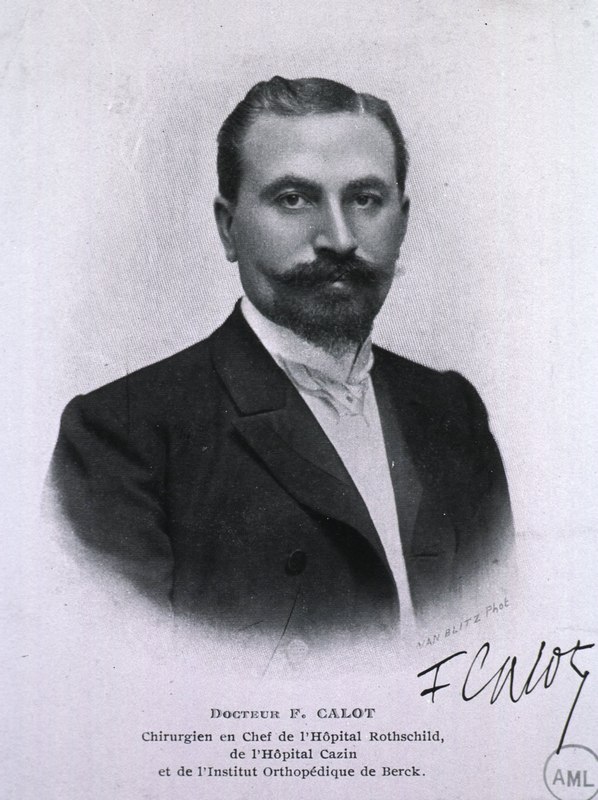
Jean-Francois Calot (1861 – 1944)
Jean-Francois Calot (1861 – 1944). French physician and anatomist, Jean-Francois Calot was born in Arrens-Marsous, a small farming community of the Hautes-Pyrénées. He received his bachelor degree in 1880 at Saint-Pe de Bigorre, and then continued to study Medicine at the University of Paris, where he worked as an anatomy prosector. His doctoral thesis “De La Cholecystectomie” (On Cholecystectomy) was published in 1890 and republished in 1891.
Although his main interest laid in orthopedics and tuberculosis, Calot’s name is eponymically tied to an anatomical landmark described in his thesis, the “Triangle of Calot”, a triangular area that includes the biliary ducts associated with the gallbladder and the vascular supply to the gallbladder. This is an important region because of the high number of anatomical variations found in the area.
There is a discrepancy between the original description of this triangular region by Calot and what is used today. For more information, click on this link to read more on the “Triangle of Calot”, also known as the “cystohepatic triangle”.
During his medical career Calot worked at several French hospitals including the Rothschild hospital where he became Chief of Surgery. He was also the Chief of Surgery for the Cazin-Perrochaud Hospital, and the Orthopedic Institute of Berck-sur-Mer
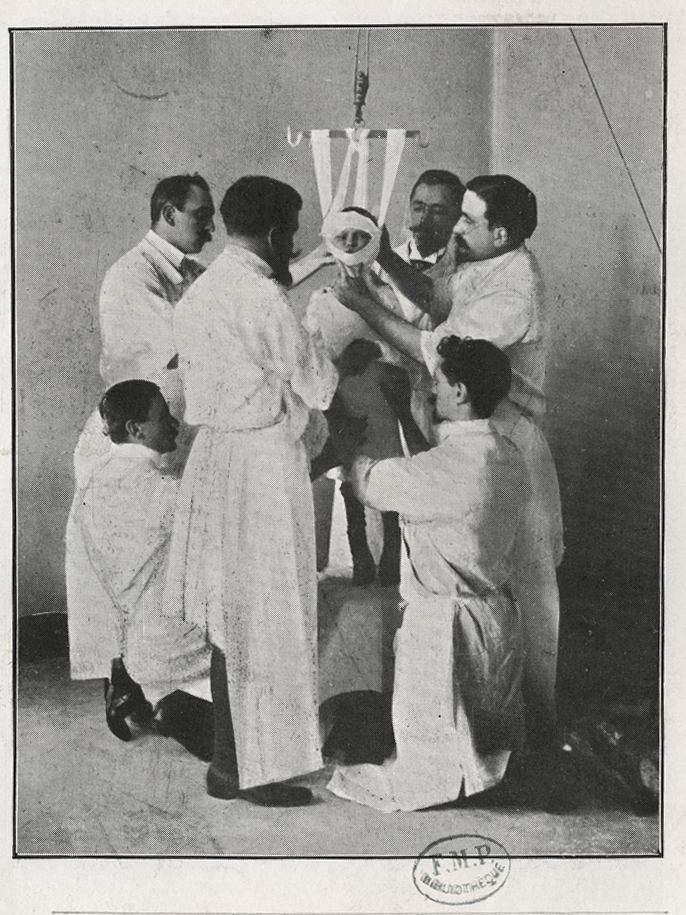
Dr. Jean-Francois Calot and
the treatment of Pott's disease
During his orthopedic career Calot published many books “Chirurgie et orthopédie de guerre”, “Les maladies qu'on soigne á Berck”, “Berck et ses traitements : les raisons de sa supériorit?”, but his opus magnus is the book “« L'orthopédie indispensable aux praticiens” (Indispensable orthopedics for practitioners).
Calot is also known for his treatment of tuberculotic abscesses, and a conservative approach to musculoskeletal tuberculosis. The surgical approach of the times was to surgically open and clean the tuberculotic bone. Calot is known to have said “Ouvrir la tuberculose, c'est ouvrir la porte d' la mort” (To open the tuberculosis is to open the door to death).
Continuing his studies and treatment of tuberculosis, on December 22nd, 1896 Calot presents the the French Academy of Medicine a study of the treatment of 37 patients with hyperkyphosis due to Pott’s disease, a tuberculotic spinal deformity, named after Sir Percival Pott. This method included traction and a brace. The second image shows this treatment. Dr. Calot is standing at the center, looking at the patient.
In 1900 Calot founded the “Orthopedic Institute of Berck” which today is known as “Calot’s Institute of Berck-sur-Mer”.
Sources:
1. “Calot's triangle” Abdalla S, Pierre S, Ellis H. Clin Anat. 2013 May;26 (4):493-501
2. “La Vie et l'OEuvre de Francois Calot, chirurgien orthopédiste de Berck” Loisel, P. (in French). Report presented at Société Francaise d'Histoire de la Médecine on 18 March 1987
Image 1: Original image courtesy of the National Library of Medicine
Image 2: Original image public domain courtesy of the Universite Paris-Descartes Histoire de la Santé

- Details
UPDATED: This is a word based on the Greek term [νευρών] (nevrón), which was used initially to denote or mean "sinew" or "tendon". The early descriptions of anatomy made no difference between a nerve and a tendon. The meaning of the word [aponeurosis], although not exactly literal, is that of a "flat tendon".
This is important in abdominal wall anatomy and to understand the anatomy of the inguinofemoral region as it relates to hernia. There are three aponeuroses (plural form), the external oblique aponeurosis, the internal oblique aponeurosis, and the transversus abdominis aponeurosis, all contributing to the rectus sheath and the linea alba.
There are other aponeuroses in the human body, such as the fascia lata and the superficial and deep gastrocnemius aponeuroses that end in the calcaneal (Achilles) tendon.
- Details
Click for a larger image
The [common hepatic artery] is one of the three branches that arise from the celiac trunk providing blood supply to the liver, duodenum, and pancreas. The common hepatic artery ends where the gastroduodenal artery arises, and then changes its name to proper hepatic artery
It is a relatively short artery, close to 3 cm. in length, with an average diameter of 7 mm.
It can present with simple to complex anatomical variations. In one of them the common hepatic artery arises from the superior mesenteric artery and not from the celiac trunk. For more information on anatomical variations of the celiac trunk and the common hepatic artery click here.
The image shows an anteroinferior view of the liver and stomach, the duodenum and stomach are reflected anteriorly. CT= Celiac trunk, CHA= Common hepatic artery, PHA= Proper hepatic artery, GDA= Gastroduodenal artery
Sources:
1. "Gray's Anatomy"38th British Ed. Churchill Livingstone 1995
2. "Tratado de Anatomia Humana" Testut et Latarjet 8 Ed. 1931 Salvat Editores, Spain
3. "Variations of hepatic artery: anatomical study on cadavers" Sebben, GA et al Rev. Col. Bras. Cir. 40:3 May/June 2013
Image property of: CAA.Inc.Photographer: David M. Klein