
Medical Terminology Daily (MTD) is a blog sponsored by Clinical Anatomy Associates, Inc. as a service to the medical community. We post anatomical, medical or surgical terms, their meaning and usage, as well as biographical notes on anatomists, surgeons, and researchers through the ages. Be warned that some of the images used depict human anatomical specimens.
You are welcome to submit questions and suggestions using our "Contact Us" form. The information on this blog follows the terms on our "Privacy and Security Statement" and cannot be construed as medical guidance or instructions for treatment.
We have 259 guests online
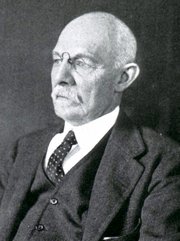
William S. Halsted, MD
(1852 – 1922)
American anatomist, teacher, and surgeon, William Stewart Halsted was born in New York City, USA to a wealthy family of English origin. His father was involved in charitable work and Governor and trustee to a city hospital. Not a brilliant student initially, Halsted took an undergraduate in Liberal Arts in Yale, CT., after which he entered the Medical College of Physicians at the Columbia College, where he excelled.
As a second-year medical student Halsted applied and obtained a position in surgery at a local hospital. In here he learned about Lister’s antiseptic technique and became an adamant proponent of it to reduce infection. In 1877 Halsted obtained his MD. After a short time as House Physician at the New York Hospital, Halsted traveled to Europe to further his education studying for two years at the Universities of Vienna, Leipzig, and W?rzburg.
Besides being at the forefront of surgical and antiseptic techniques (introducing the use of rubber gloves in surgery), Halsted was extremely concerned with the way medical students were taught in the US. He pioneered bedside clinical round discussions with the medical students after two years of basic sciences studies. Halsted developed the idea of a patient chart; he also developed the residency program for medical students in use today.
Halsted is probably the most influential researcher and surgeon at the turn of the century. He dedicated time to the study of intestinal anastomoses and the use of silk as a suture material. His experimental work in 1887 proved that the inclusion of the submucosa layer in an anastomosis was mandatory, as well that a single layered anastomosis was enough to attain closure. Perhaps Halsted’s most important contribution was the application and use of the scientific method to surgical questions. Halsted’s principles, also known as "Halsted's Rules of Surgery", set the standards used today in surgical suturing and surgical stapling.
He also pioneered the development and surgical techniques for radical mastectomy as a treatment for breast cancer.
As a side effect of this studied in anesthesia and the use of cocaine for anesthesia, Halsted became addicted to this substance, a problem that followed him through the years. Without impairing his capacity as a researcher and a surgeon, Halsted eventually recovered. He died in Baltimore in 1922 as a complication to surgery.
Sources:
1. Dubay, A. D., & Franz, G. M. (2003). Acute Wound Healing: The Biology of Acute Wound Failure. Surg Clin NA, 83, 463-481.
2. Halsted, W. S. (1887). Circular Suture of the Intestine - An Experimental Study. Am J Med Sci, 436-461.
3. “William Stewart Halsted: his life and contributions to surgery” Osborne, P. Lancet Oncol 2007; 8: 256–65
4. “William Stewart Halsted: Surgical pioneer” Burress, P Endoc Today (2010), 8: (2) 22
5. “William Stewart Halsted (1852–1922) Neurological stamp” Haas, LF J Neurol Neurosurg Psych 2000;69:641
Original image courtesy of "Images from the History of Medicine" at www.nih.gov

"Clinical Anatomy Associates, Inc., and the contributors of "Medical Terminology Daily" wish to thank all individuals who donate their bodies and tissues for the advancement of education and research”.
Click here for more information


- Details
Click for a larger image
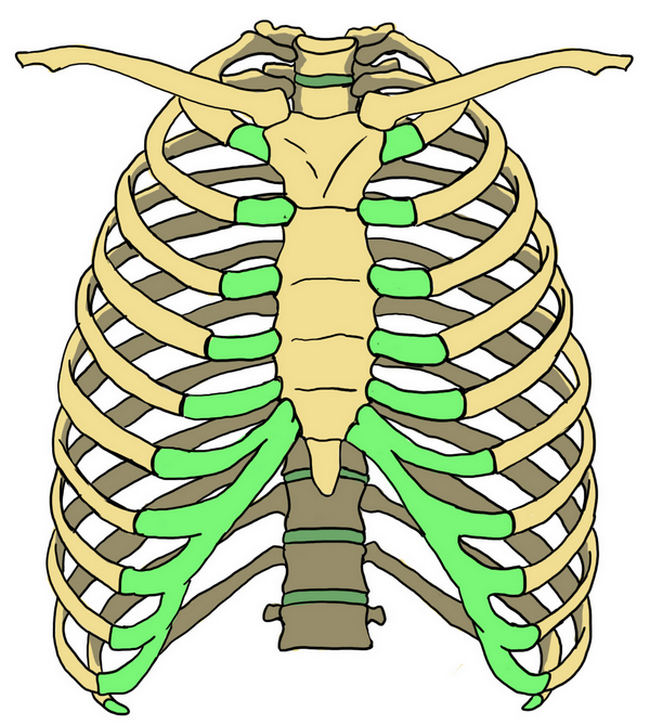
The term is a mix of two Greex root terms, [Pneum-] meaning "air" and [thorax] for "chest". The term [pneumothorax] means "air in the chest".
A pneumothorax occurs when the parietal pleura that lines the internal aspect of the chest and the visceral pleura that lines a lung are separated by a small amount of air that penetrates the thoracic cavity. This air causes the capillary action of the pleural fluid to fail, allowing for more air to enter the thoracic cavity and the lung to collapse.
Since the pleural cavities are separate, the collapse of one lung does not necessarily failure of the contralateral lung, except in a rare anatomical variation where both pleural cavities are communicated.
A pneumothorax can be spontaneous, with no apparent cause, or caused by trauma that allows the air to enter the thorax. If blood and air enter the thoracic cavity, the condition is then called a "pneumohemothorax".
Copyrighted image property of:CAA.Inc. Artist:D.M. Klein
- Details
This medical term is Greek and is composed of [ίδιος] (idios) meaning "self" or "one's own", something peculiar to a particular individual. This is probably why this root term is used for [idiot] or [idiocy]. The second portion of the word is also Greek [πάθος] (pathos) meaning "suffering", or "disease". The word [idiopathic] literally means "one's own disease".
The term is used today to denote a pathology that has no known cause.
- Details
Click for a larger image
[UPDATED] The medical term [hemangioma] is formed by two root terms and a suffix. The root term [hem-] arises from the Greek word [αίμα] (a?ma) meaning "blood", the second root term [-angi-] .from the Greek term [αγγείο] (angeio), meaning "vessel” and the suffix [-oma] (ωμα), also Greek, meaning "mass", "growth”, or "tumor". The term [hemangioma] then means a “mass of blood vessels”, a description not far from the truth.
A variation of the term is [hemangiomata], where the suffix [-omata] is plural, indicating multiple hemangiomas.
In general, a hemangioma can be described as a mass of blood vessels that can be convoluted, radiated, or swollen. Usually benign, hemangiomas appear in newborns and tend to evolve, involve, and disappear in the first ten years of life.
Other types of hemangiomas can be found in adults, with a tendency to be more prevalent in females than males. There are three types of hemangiomas described:
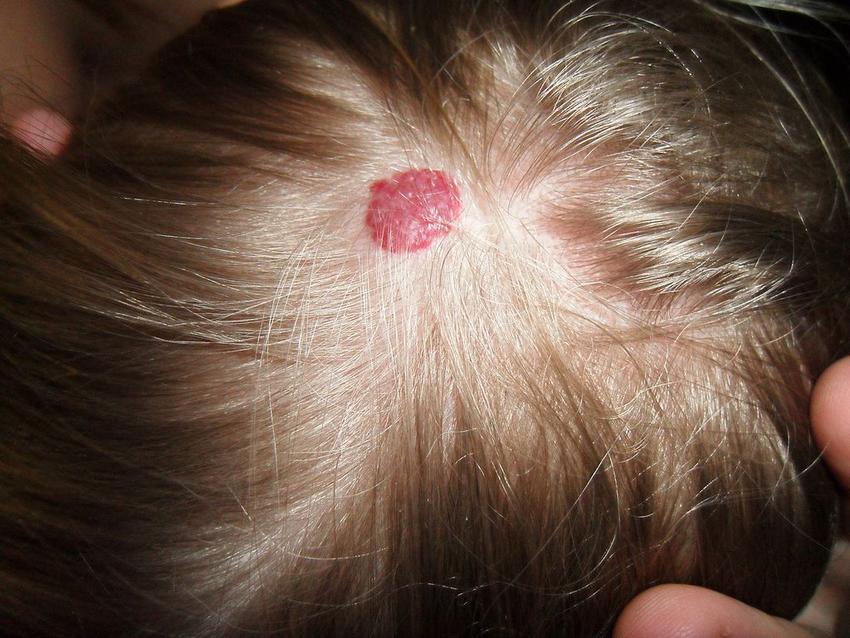
• Capillary hemangioma. Usually form skin patches known as “strawberry hemangiomas”. See image.
• Venous hemangioma. They are characterized by a “knot” or convoluted mass of veins. Since veins are usually more dilated than arteries, they are also known as “cavernous hemangiomas”. They can be found in a subcutaneous location or on internal organs, such as the liver.
• Arterial hemangioma. Formed by arteries, they tend to radiate and form a network of arteries, hence the term “plexiform hemangiomas”
• Vulvar hemangiomata. Multiple hemangiomas in the external female genitalia. For more information, click here
The image shows a small hemangioma in the scalp of a two-year old. Image by Cbheumircanl (Own work) [Public domain], via Wikimedia Commons
- Details
This term describes a structure that is composed of a multinucleated cytoplasm. It is either the result of the fusion of multiple adjoining cells, or the formation (by division) of multiple nuclei in a large cell.
Since cardiac muscle is formed by separate cells that are anatomically, mechanically, chemically, and electrically connected, the cardiac muscle has been called a "functional syncytium". Functionally, cardiac muscle works as a unit.
For those interested in the etymology of the word [syncytium], it arises from the Greek and its components are the prefix [syn-], meaning "together"; the root term [-cyt-], meaning "cell"; and the suffix [-ium], meaning "layer" or "membrane"
- Details
The root terms [-hem-] and [-hemat-] are both derivate from the Greek word [αίμα] (a?ma) meaning "blood". The same word and meaning applies to the suffix [-emia-]. Applications of these root terms include:
- Hematuria: The suffix [-uria] means "related to urine", or "urine". Refers to a condition where there is detectable blood in the urine
- Hematoma: The suffix [-oma] means "mass", "growth: or "tumor". A mass of blood that usually forms after trauma, a welt.
- Hemangioma: The root term [-angi-] means "vessel". The suffix [-oma] means "mass", "growth: or "tumor". A mass or a growth of blood vessels
Note: The links to Google Translate include an icon that will allow you to hear the Greek or Latin pronunciation of the word.
- Details
From the movie "Short Circuit" (1986):
Howard Marner: "Crosby, we're going to have to ask you to surrender the robot"
Newton Crosby: "Stat?"
Howard Marner: "Stat!"
Newton Crosby: "What does that mean, anyway?"
Howard Marner: "I don't know. But that's not the point"
The medical term [stat] arises from the Latin [statim] which means "immediately". By use and later abbreviation it has become [stat] with the same meaning. The term has somehow become overused in movie and television medical dramas with many people not knowing its meaning or etymology.
Note: The links to Google Translate include an icon that will allow you to hear the Greek or Latin pronunciation of the word.