
Medical Terminology Daily (MTD) is a blog sponsored by Clinical Anatomy Associates, Inc. as a service to the medical community. We post anatomical, medical or surgical terms, their meaning and usage, as well as biographical notes on anatomists, surgeons, and researchers through the ages. Be warned that some of the images used depict human anatomical specimens.
You are welcome to submit questions and suggestions using our "Contact Us" form. The information on this blog follows the terms on our "Privacy and Security Statement" and cannot be construed as medical guidance or instructions for treatment.
We have 486 guests online
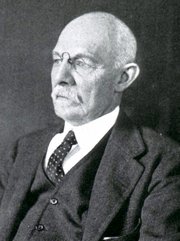
William S. Halsted, MD
(1852 – 1922)
American anatomist, teacher, and surgeon, William Stewart Halsted was born in New York City, USA to a wealthy family of English origin. His father was involved in charitable work and Governor and trustee to a city hospital. Not a brilliant student initially, Halsted took an undergraduate in Liberal Arts in Yale, CT., after which he entered the Medical College of Physicians at the Columbia College, where he excelled.
As a second-year medical student Halsted applied and obtained a position in surgery at a local hospital. In here he learned about Lister’s antiseptic technique and became an adamant proponent of it to reduce infection. In 1877 Halsted obtained his MD. After a short time as House Physician at the New York Hospital, Halsted traveled to Europe to further his education studying for two years at the Universities of Vienna, Leipzig, and W?rzburg.
Besides being at the forefront of surgical and antiseptic techniques (introducing the use of rubber gloves in surgery), Halsted was extremely concerned with the way medical students were taught in the US. He pioneered bedside clinical round discussions with the medical students after two years of basic sciences studies. Halsted developed the idea of a patient chart; he also developed the residency program for medical students in use today.
Halsted is probably the most influential researcher and surgeon at the turn of the century. He dedicated time to the study of intestinal anastomoses and the use of silk as a suture material. His experimental work in 1887 proved that the inclusion of the submucosa layer in an anastomosis was mandatory, as well that a single layered anastomosis was enough to attain closure. Perhaps Halsted’s most important contribution was the application and use of the scientific method to surgical questions. Halsted’s principles, also known as "Halsted's Rules of Surgery", set the standards used today in surgical suturing and surgical stapling.
He also pioneered the development and surgical techniques for radical mastectomy as a treatment for breast cancer.
As a side effect of this studied in anesthesia and the use of cocaine for anesthesia, Halsted became addicted to this substance, a problem that followed him through the years. Without impairing his capacity as a researcher and a surgeon, Halsted eventually recovered. He died in Baltimore in 1922 as a complication to surgery.
Sources:
1. Dubay, A. D., & Franz, G. M. (2003). Acute Wound Healing: The Biology of Acute Wound Failure. Surg Clin NA, 83, 463-481.
2. Halsted, W. S. (1887). Circular Suture of the Intestine - An Experimental Study. Am J Med Sci, 436-461.
3. “William Stewart Halsted: his life and contributions to surgery” Osborne, P. Lancet Oncol 2007; 8: 256–65
4. “William Stewart Halsted: Surgical pioneer” Burress, P Endoc Today (2010), 8: (2) 22
5. “William Stewart Halsted (1852–1922) Neurological stamp” Haas, LF J Neurol Neurosurg Psych 2000;69:641
Original image courtesy of "Images from the History of Medicine" at www.nih.gov

"Clinical Anatomy Associates, Inc., and the contributors of "Medical Terminology Daily" wish to thank all individuals who donate their bodies and tissues for the advancement of education and research”.
Click here for more information


- Details
Click for a larger image
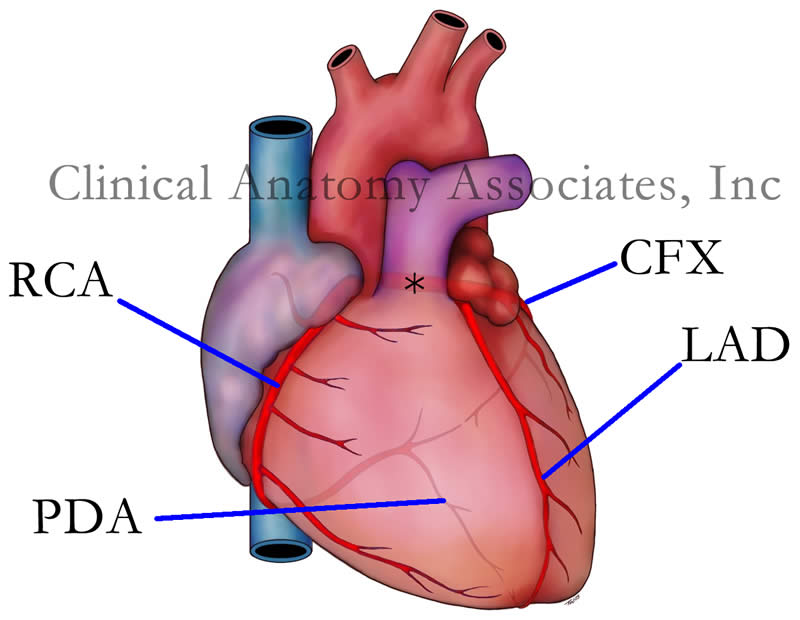
The term [coronary] comes from the Latin root [corona] meaning "crown", therefore [coronary] is used to denote a structure that surrounds another as a crown or a garland. In the heart, the coronary arteries and their branches form a crown that surrounds the heart at the level of the atrioventricular sulcus. There are two coronary arteries, the right coronary artery (RCA), and the left coronary artery (*). Both these coronary arteries are the only branches that arise from the ascending aorta.
The right coronary artery passes from the anterior to the posterior surface of the heart, ending in a terminal branch, the posterior descending artery, or PDA. The left coronary artery, sometimes called the "left main", gives origin to two branches: the circumflex artery (CFX) and the left anterior descending artery (LAD). Each one of these arteries gives origin to several named branches.
There can be interesting anatomical variations in the coronary arteries of the heart. Heart and coronary artery anatomy is one of the topics developed and delivered by CAA, Inc.
Image property of: CAA.Inc.. Artist: Victoria G. Ratcliffe
- Details
Click for a larger image
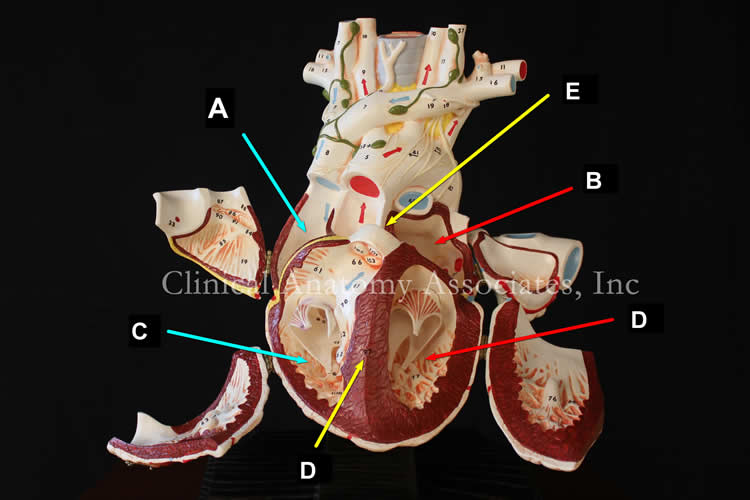
The Latin word [ventriculus] means "little sac" or "little belly" and arises from the Latin term [venter] meaning "belly" or "abdomen". Originally the term [ventricle] was used to denote the stomach. This use of the word has changed and now the term [ventricle] denotes a "sac" or "cavity", as in the "ventricles of the brain". The term [ventricular] means "pertaining or related to a ventricle".
In the case of the heart, the ventricles represent the two inferior chambers of the heart. (see image, items "C=right ventricle" and "D=left ventricle"). The anatomy of the right and left ventricles is quite different. The left ventricle has a thicker lateral muscular wall, almost three times thicker than the lateral wall of the right ventricle.
Image property of:CAA.Inc.Photographer:D.M. Klein
- Details

Click for a larger image
The term [perineum] has two definitions:
1. It is the area of the trunk inferior to the pelvic diaphragm. As such, the perineum contains the ischioanal fossa, the urogenital diaphragm, and the superficial genitalia.
2. It is the area of the body between the upper thighs containing the external openings of urethra, vagina, and anus. This area is delimited (see image) by the symphysis pubis, ischial tuberosities, and coccyx.
The perineum, as described in the second definition, is formed by two large triangular regions. The anterior region (in purple) is called the urogenital triangle, and the posterior region (in yellow) is called the anal triangle.
There is another definition in use that is wrong! Please understand that I post it here as an example only. "The perineum is the area that is found between the scrotum (or vagina) anteriorly and the anus posteriorly". This is NOT the definition of perineum, it is the definition or location of the perineal body, the center of the pelvic floor where 17 named muscles attach of cross. The muscles are:
- Iliococcygeus (2)
- Pubococcygeus (2)
- Superficial transverse perineal (2)
- Deep transverse perineal (2)
- Puborectalis (2)
- Bulbospongiosus (2)
- Pubovaginalis (2)
- Sphincter urethae (1)
Image property of: CAA.Inc.. Artist: D.M. Klein.
Word suggested and edited by:Dr. Sanford S. Osher, MTD Contributor
- Details
Click for a larger image
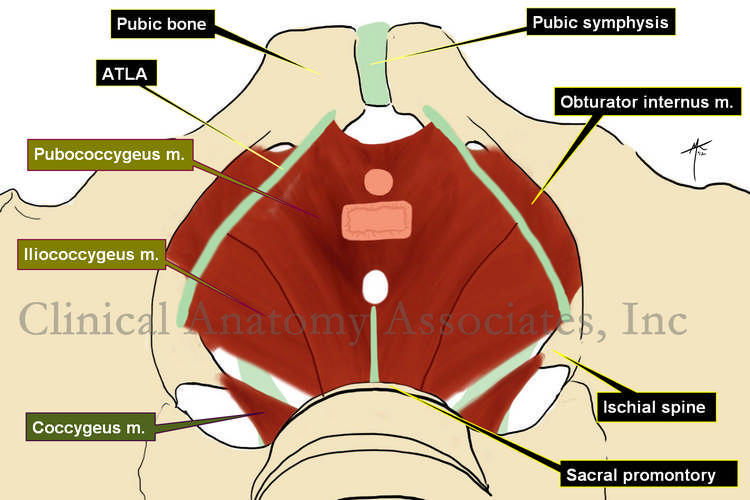
The pelvic diaphragm is one of the four diaphragms in the human body (do you know the other three?) and it represents the lower boundary of the abdominopelvic cavity. This thin and transversely oriented structure is formed from anterior to posterior by the puboccygeus, the iliococcygeus, and the coccygeus muscles.
The first two anterior muscles overlap, the pubococcygeus muscle being superior to the iliococcygeus muscle. Both of them attach laterally to a thickening of the obturator internus fascia that covers the obturator internus muscle. This thickening is known as the arcus tendineus levator ani (ATLA in the image). Because of the relation of the medial fibers of the puboccygeus muscle to the anal canal (puborectalis muscle), and what happens when these muscles contract, these two anterior muscles are known by one common name, the "levator ani" muscle. Click on the picture for a larger image.
The posterior component of the pelvic diaphragm is the coccygeus muscle, which is found lying on the internal aspect of the sacrospinous ligament.
Image property of: CAA.Inc. Artist: D.M. Klein.
Word suggested and edited by:Dr. Sanford S. Osher, MTD Contributor
- Details

Click for a larger image
The root word [-gyne-] is Greek, from [gynaik] meaning "woman" or "female". The suffix [-ology] is also Greek, derived from [logos] meaning "study of". [Gynecology] is then "study of a woman or a female". The term refers to the medical specialty that studies and treats the female reproductive system. A separate specialty, obstetrics, deals with the care of the pregnant patient and delivery of the fetus.
Originally, both specialties were the domain of midwives. It was not until the 1600's that male physicians were allowed to treat gynecological problems and attend births. As the image shows, man-widwifes in Europe were allowed access to the patient only with the use of a "modesty blanket". This is plate XV from the 1681 book "Korte en Bondige Van Der Voortteeling en Kinderbaren" by Samuel Janson.
As an interesting side note in history, the first male physician to work as a man-midwife was Dr. Wertt from Hamburg. Dr Wertt decided to disguise himself as a woman to attend patients. When he was discovered, the punishment was "swift and salutary": He was burned at the stake.
Source:
"The Story of Surgery" by H. Graham, 1939
Word suggested and edited by: Dr. Sanford S. Osher, MTD Contributor
- Details
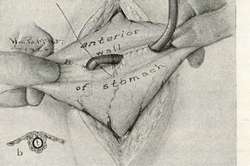
From the Greek word [stoma] meaning "mouth or opening", and the suffix [-y] meaning "process or condition". The suffix [-(o)stomy] refers to the "process of creating an opening". This process can be physiological, without intervention, as in the creation of a spontaneous fistula, or it can be a surgical procedure.
As a working explanation of [-ostomy] in surgery, we like to use the term "drainage". Therefore, an [ileostomy] would be the procedure by means of which a drainage opening is creating an anastomosis between the ileum and the abdominal wall.
The accompanying image shows an early 1900's procedure to create a gastrostomy (Wietzel's gastrostomy). The root term [gastr-] means "stomach".